
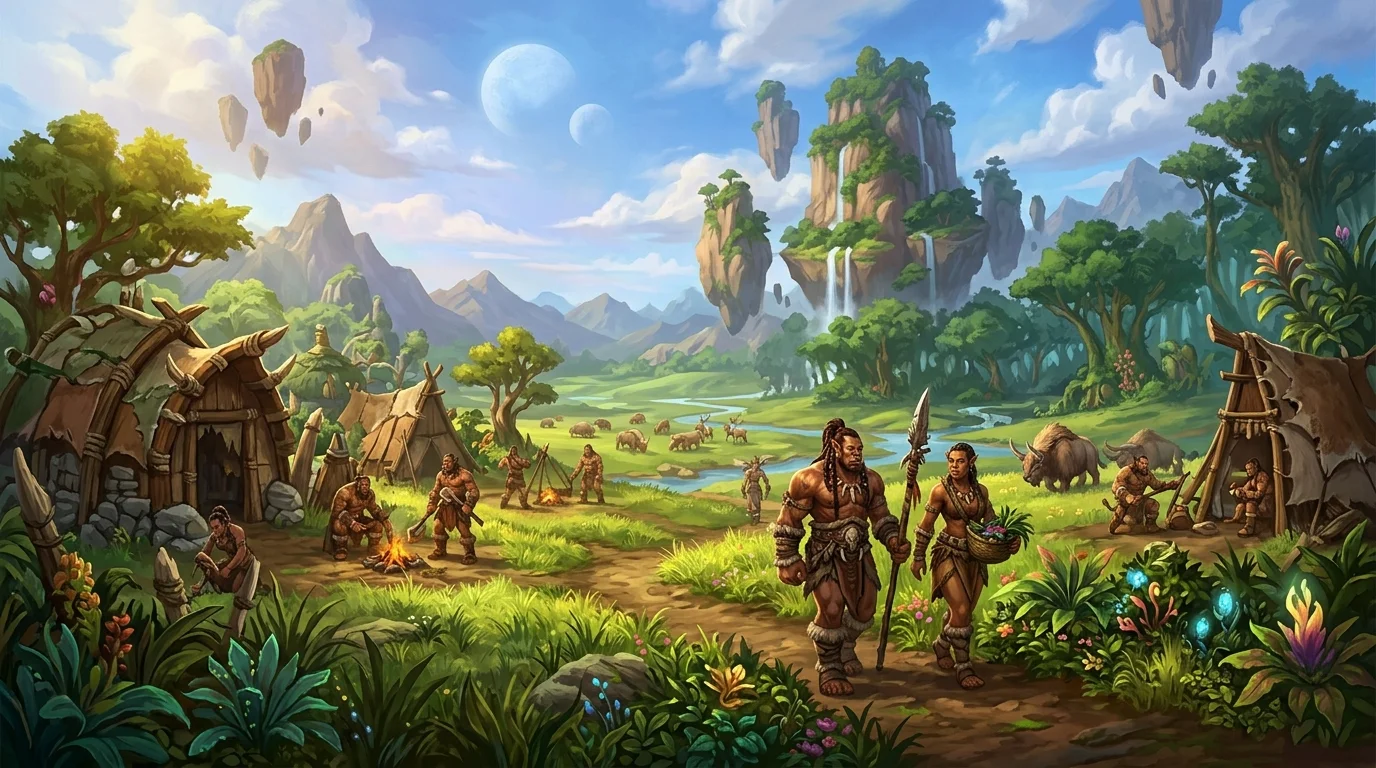
Draenor before corruption: what the Orc planet was like before Gul'dan
Thinking of Draenor only as a destroyed Outland erases half of the tragedy
Many people know Draenor first for what's left of it: Outland, a broken, punctured, and ruined world. But the strength of the story lies precisely in imagining what existed before the explosion of the portals, the demonic corruption and the transformation of the planet into a carcass.
Draenor was alive. And this life was not generic. The planet had its own identity, clans with distinct cultures, memorable biomes, and growing political tension between orcs and draenei long before its total collapse.
Draenor before the portals
A vibrant planet
Before the catastrophe, Draenor was not hellish. It was diverse. There were plains, mountains, forests, sacred valleys, and spiritual centers. The image of the “world of orcs” becomes much richer when you abandon the idea of a uniform barbaric land and start seeing an entire planet with its own rhythms.
The world before the big lie
This is the decisive detail: corruption did not begin when orcs were already monsters. It began when there was still room for coexistence, spirituality and tribal organization without total submission to demonic warfare.
The original orc clans
Frostwolf
Linked to tough survival, honor, and a stronger sense of community, the Frostwolf helps to remember that not every orc identity was tied to expansionist ambition.
Warsong
More aggressive, mobile and marked by warrior energy, the Warsong represent one of the most famous faces of pre-corruption orc culture.
Blackrock
Blackrock condenses power, metal, war and centralization. They are a good image of the orcish military strength before the demonic Horde took full form.
Burning Blade
The Burning Blade helps to show that there were already profound differences in temperament and practice between the clans. Draenor has never been culturally uniform.
The main point
These clans matter because they reveal that the orcs were many peoples, not a single bloc. The tragedy of corruption is also the tragedy of erasing these differences under the same war machine.
The draenei arriving as refugees
Two people on the same planet
When the draenei arrive on Draenor as refugees, the planet is no longer just an orcish world. It becomes a shared space between radically different cultures.
Tension before total war
The relationship between orcs and draenei does not begin with extermination. There is estrangement, distance, asymmetry of power in certain fields and fear fueled by difference. This is important because it shows that Kil'jaeden doesn't create everything from scratch. He manipulates terrain that could already be stressed.
Kil'jaeden's manipulation
The central lie
Kil'jaeden convinces the orcs that the draenei were the threat. This lie works because it touches on fear, pride, collective destiny and the feeling that the clans needed to act before being destroyed.
What Gul'dan does with it
Gul'dan becomes a decisive player because he channels demonic influence into orc politics. He turns suspicion into dogma and spirituality into a tool of power.
The result
From then on, Draenor stops being a tense planet and becomes a doomed planet. Corruption doesn't just destroy an army. It destroys the orcs' ability to remain distinct peoples.
Draenor after the Second War
The opening of the portals
After the events linked to the Second War and Ner'zhul's actions, Draenor suffers from the rampant opening of portals. The planet can't handle it.
The birth of Outland
The physical destruction of Draenor is the last stage of a tragedy that had already been happening before in the spiritual, social and political fields. Outland isn't just born of violent magic. It is born from a world that had already been broken from the inside.
What Draenor represents in lore
| Draenor Layer | What it shows | |-------------------|------------------| | Living biomes | complete planet, not just a war scene | | Distinct clans | orc cultural diversity | | Arrival of the draenei | tense coexistence between refugees and natives | | Demonic manipulation | lie as a civilizational weapon | | Explosion of portals | material destruction after moral and political collapse |
The tragedy of Draenor begins before the visual apocalypse
This is the most important point. The destruction of Draenor is impressive because Outland is visually extreme. But the real tragedy begins before: when fear is organized, when lies become politics and when an entire people is convinced to break with what they were.
Minimum recommendation
To understand Draenor better, it's worth remembering these points:
- think of the planet as a living world before Outland
- see orc clans as different cultures, not a single mass
- understand the draenei as a factor of tension and also of possible coexistence
- Treat Kil'jaeden and Gul'dan as architects of lies, not just war
- see Outland as the end result of a collapse that began long before the explosion
Posts Recomendados
Shadowmoon Valley in two versions: the eternal moon and the valley in alternate Draenor
Shadowmoon Valley is one of WoW's most striking zones: in Outland, a spiritual ruin; in Warlords, a living memory of a past not yet destroyed. See both.
Ner'zhul and the origin of the Scourge: how an orc shaman became the first Lich King
Before Arthas, there was Ner'zhul: a great orc shaman manipulated by the Burning Legion, destroyed by Kil'jaeden and transformed into the first Lich King.
Magtheridon: the pit lord of Hellfire Citadel
Who is Magtheridon: the pit lord who ruled Outland, lost the Black Temple to Illidan and became the blood source for fel orcs in Hellfire Citadel.
Saurfang and Dranosh: father and son of the Horde
Varok and Dranosh Saurfang: the son hidden in Nagrand, his death at the Wrathgate, the Deathbringer in ICC and the father who takes him home. Full arc.