
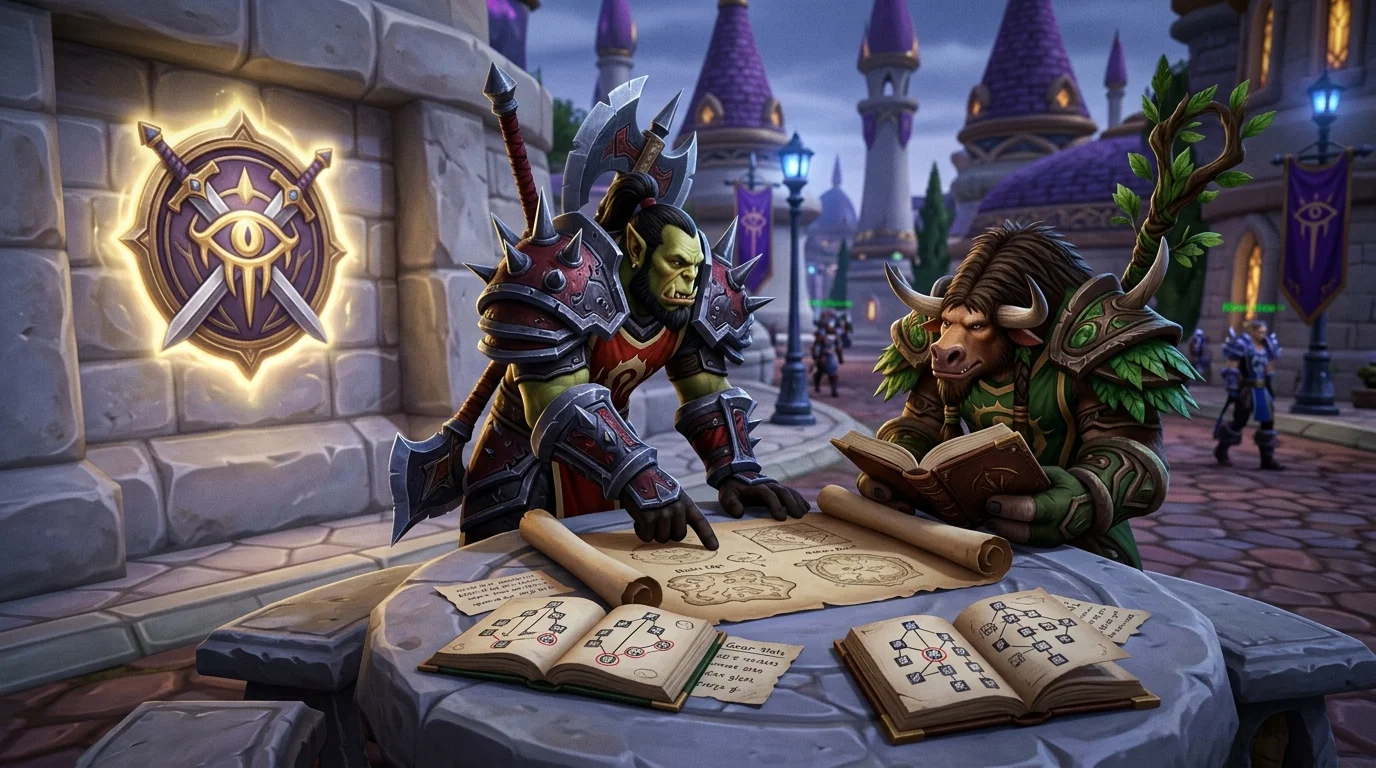
Why does your first arena build matter so much?
Many people enter the arena copying any build from a video, stream or armory without understanding the reason for each talent and each glyph. The problem is simple: arena builds do not exist in a vacuum. It depends on your class, your partner, the bracket you play in and the type of match you want to win.
A bad build isn't just one that does less damage or less healing. It's the one that leaves you unanswered in the games that really matter. In the beginning, you don’t need the “perfect” build. You need a build that is functional, stable, and easy to perform under pressure.
Step 1: define the role of your class in the comp
Before distributing talents, answer a simple question: what does your class need to deliver within the duo or 3v3?
Practical examples:
- If you play Mage, your build needs to prioritize control, survival and creating burst windows
- If you play Warrior, you need constant pressure, uptime and tools to continue offensive
- If you play as a Healer, the build needs to balance sustain, dispel, positioning and defensive cooldowns
- If you play Rogue, the build needs to allow reset, control and clean execution of kill windows
The classic beginner's mistake is to put together a build as if you were playing alone. Arena is not a duel. Your build needs to serve the comp.
Step 2: Choose talents that solve real problems
In the beginning, prioritize talents that do one of three things:
- Increase your consistency
- Improve your survival
- They make it easier to perform under pressure
This is more valuable than putting together an entire tree thinking only about raw damage.
What to prioritize in practice
- cooldown reduction on important skills
- talent that improves mobility or escape
- talents that stabilize resources (mana, energy, rage, runic power)
- utility that helps against common comp
- talent that improves control or defensive response
If two talents seem good, the best one for a beginner is almost always the one that forgives you the most mistakes.
Step 3: choose priority glyphs without inventing fashion
The glyphs in your first build should reinforce the same plan as the talents. There is no point in building defensive talents and choosing glyphs that only work in an ideal scenario.
Secure priority at the beginning
- glyph that improves your most used skill
- glyph that increases security or uptime
- glyph that helps in common matchup
- glyph that reduces punishment for execution errors
At the beginning, avoid creating a “highlight” setup. Arena is won more by consistent repetition than by beautiful play.
Step 4: adapt the build to the partner and bracket
This is the point that most differentiates a functional build from a copied build.
2v2
In 2v2, matches tend to expose individual weaknesses more. Build needs to be stable, defensive enough to survive, and efficient in short windows.
3v3
In 3v3, the build needs to talk more about team coordination, CC chains, cross-CC, combined burst and responses to enemy cooldowns.
How to adapt without complicating things
- If your partner already offers a lot of control, you may need more damage or survival
- If your comp has a strong burst but little resistance, it pays to reinforce defense
- If you face a lot of caster, adapt to dispel, interruption or magic damage reduction
- If you face a lot of melee cleave, value mobility, peel and short cooldown defensives
The best first build is the one that responds to the meta you encounter, not the prettiest video you saw.
Step 5: assemble a simple base and test in short blocks
Don't try to optimize everything before the first row. Set up a secure base, play a few sessions and review.
Simple validation method
Make blocks of 8 to 12 matches and observe:
- do you die with cooldown available?
- lack of mana/resource too early?
- does any talent almost never make a difference?
- do you lose because you lack damage, control or defense?
- does your build help or hinder your execution?
If the answer appears every session, there is already a clear clue to adjustment.
Beginner errors when copying ready setup
1. Copy top player build without copying context
The rank 1 player build presupposes specific execution, partner, communication and goals. At your level, it can become a trap.
2. Choosing too “greedy” talent too early
Ultra offensive build with no defensive base makes you lose the game before you can play.
3. Ignoring your own style
If you still get your positioning wrong, forget the cooldown and run over the keys, the best build is not the most aggressive. It's the one that lets you play better.
4. Changing everything with each defeat
A bad build gets in the way, but changing half the tree every session prevents you from learning any pattern.
5. Not aligning build with keybinds and UI
A good build with a bad UI remains a bad experience. Arena charges reaction speed. If your binds don't keep up, the build looks worse than it is.
Checklist to validate your build before ranking
Before taking the build into a serious session, review this:
- Do your talents have clear game logic?
- Do your glyphs reinforce the same plane?
- Do you know what your comp win condition is?
- do you know which cooldown to use first in defensive exchanges?
- Is your bar organized for quick reaction?
- Did you test the build in real matches and not just on paper?
If you answered “no” to two or more points, it's still worth testing rather than raising your rating in the dark.
How to put together your first build without crashing
The best way to start in the arena is not to look for the perfect build. It's putting together a solid, functional build aligned with your current level. The first good build is the one that lets you learn matchup, exchange cooldowns correctly and understand how your comp wins games.
Minimum recommendation
To get started without getting lost:
- define your role within the company
- prioritize consistency and survival talents
- choose glyphs that reinforce this plan
- adapt to the partner and the bracket
- review the build after short blocks of matches
Posts Recomendados
WotLK PvP Guide — Battlegrounds, Arena and How to Get Started
WotLK PvP without getting crushed early: learn the difference between BG and Arena, build a minimal setup and follow a simple route to improve calmly.
Best spec for each class in PvP
The best PvP spec in WotLK changes everything. Many work on paper, but few hold up in BGs, arena and open world. See which is worth it for each class.
2v2 Arena: which classes combine best
2v2 Arena is still the most common entry point to arena, and the right duo changes everything. What counts is stable synergy, not just tier list hype.
3v3 Arena: strong compositions for beginners
3v3 Arena is the bracket that demands the most coordination, but well-built comps shine brightest there. See strong, accessible comps to start right.