
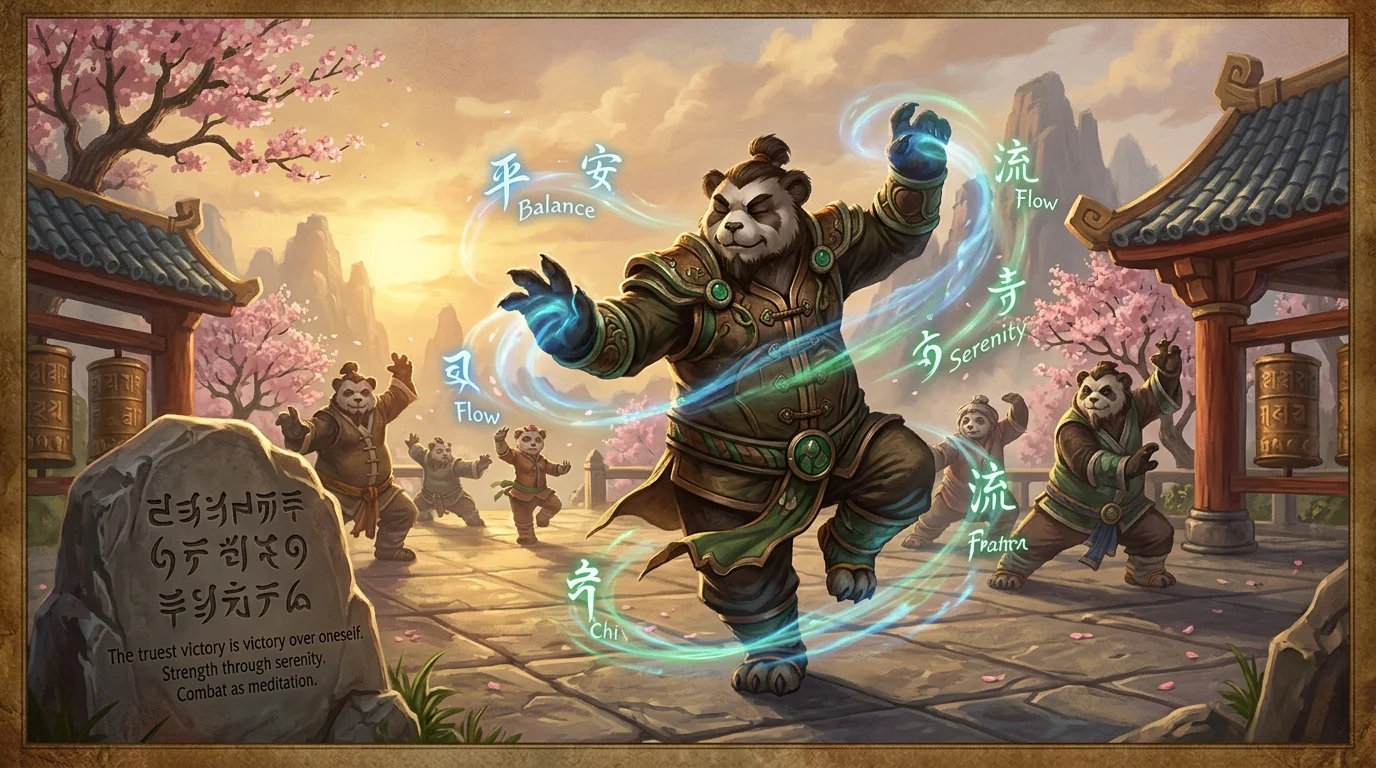
A class that enters Warcraft through another path
Most Warcraft classes have some origin very directly linked to war, plague, fel or cosmic traumas. The monk enters through another door. It comes from practice, culture, body and chi. This does not mean a total absence of conflict, but it does mean another grammar for conflict.
The monk fights as someone who is also cultivating balance.
The pandaren origin
When Mists of Pandaria introduces monks, the class arrives deeply connected to pandaren culture. It's not just a new skill set. It is a way of being in the world that mixes physical discipline, humor, patience, resistance and reading the flow of life.
This origin matters because it prevents the monk from seeming like a generic graft. It is born from the same cultural fabric that produces brewers, pilgrims, chi masters, and survivors who have learned not to fuel chaos.
Chi as strength
Chi, in Warcraft, is not just “fighting energy”. It is guided vitality, internal flow and relationship between body, mind and environment. This differentiates the monk from classes that draw power from outside: Light, Void, Fel, nature, death. The monk first works on his own axis.
That's why the class' fantasy is so clean. Power does not come from a pact. It comes from refinement.
The three specializations and their philosophies
Brewmaster turns absorption and resilience into art. Mistweaver treats healing as flow, circulation, and continuity. Windwalker makes the attack an expression of rhythm, explosion and precision. The three specs seem different in gameplay, but they share the same thesis: acting without breaking inside.
This coherence is one of the class’s greatest qualities. The monk never looks like a collage of three incompatible costumes.
The Peak of Serenity and training
Spaces linked to monastic training reinforce the class's identity because they connect combat and learning. The monk does not “unlock power” in an exceptional moment. He cultivates it. And characters like Chen Stormstout help to translate this: strength without rigidity, wisdom without pose, joy without levity.
Chen is important precisely because he shows that lightness is not superficiality. It is self-control.
Why the monk is unique in lore
The monk is unique because he remembers that Warcraft is not just a universe of armed trauma. It is also a universe of bodily tradition, active serenity and people who have learned to resist without becoming a reflection of the violence they face. That doesn't make the monk any less dangerous. It makes him dangerous for another reason.
He represents a class that prefers balance, but does not confuse balance with passivity.
Minimum recommendation
If you really want to understand monks, don't start with rotation. Start with philosophy. In Warcraft, a monk is not an “unarmed fighter”. It's the idea that combat can also be a spiritual discipline — and that real mastery begins before the first blow.
Posts Recomendados
The Burdens of Shaohao: the animated series about the last Emperor of Pandaria
The Burdens of Shaohao is more than a Mists of Pandaria prologue: it frames the expansion as a spiritual journey before players set foot on the continent.
Pandaria Beyond the Sha: The Stories That Don't Revolve Around Emotional Threat
Pandaria goes beyond the Sha: ancient peoples, local alliances, mogu secrets, Klaxxi, Jinyu and Hozen shape a continent with its own identity. Explore it.
Magtheridon: the pit lord of Hellfire Citadel
Who is Magtheridon: the pit lord who ruled Outland, lost the Black Temple to Illidan and became the blood source for fel orcs in Hellfire Citadel.
Saurfang and Dranosh: father and son of the Horde
Varok and Dranosh Saurfang: the son hidden in Nagrand, his death at the Wrathgate, the Deathbringer in ICC and the father who takes him home. Full arc.