
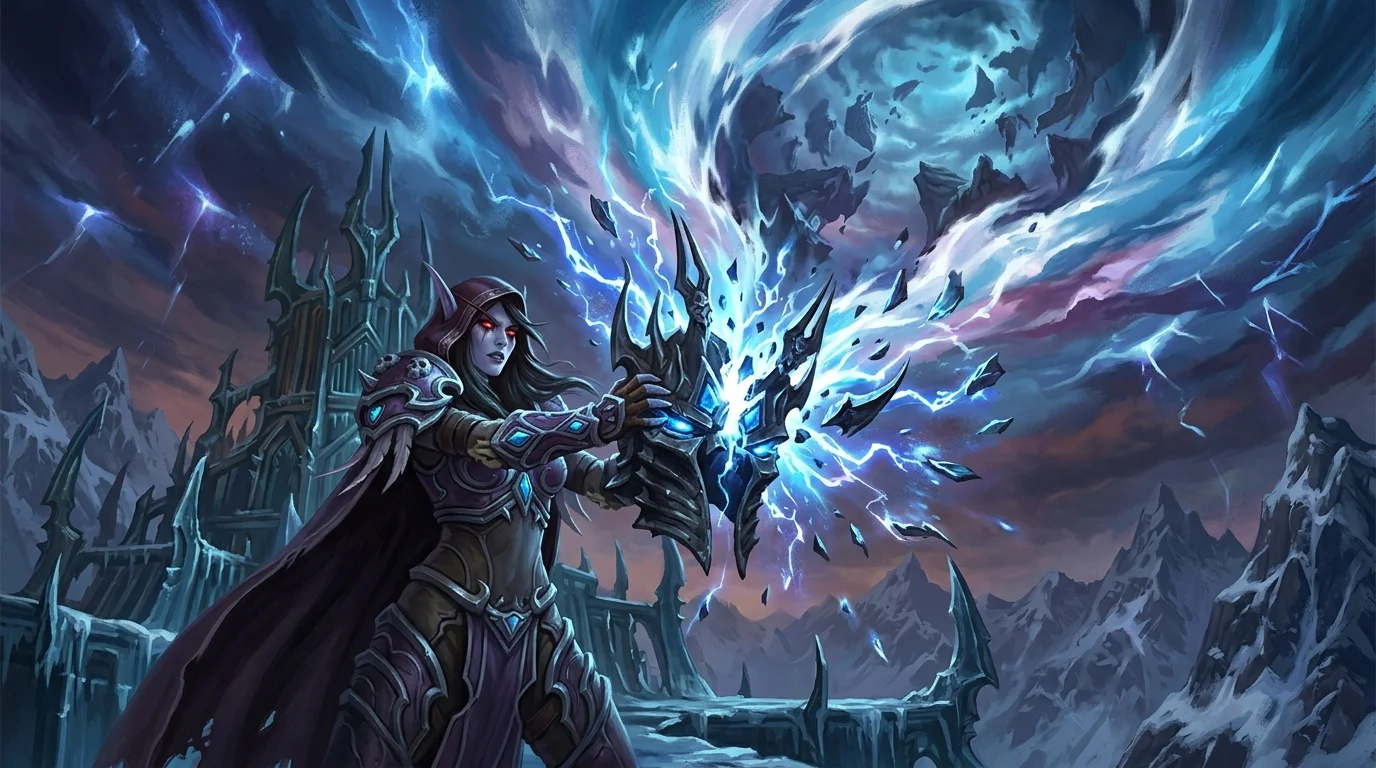
The day the sky of Azeroth tore apart
Few modern World of Warcraft moments have had as immediate an impact as Sylvanas' scene in Icecrown. It wasn't just a villain defeating Bolvar. It was the moment when the entire logic of the afterlife in Warcraft stopped seeming distant and started to interfere directly in the world of the living.
When Sylvanas destroys the Helm of Domination, she does not “kill the Lich King for good.” She does something even more serious: she breaks the veil between life and death and transforms Icecrown into the breaking point of the entire cosmic order linked to souls.
What the Helm of Domination was — and who originally created it
For a long time, it seemed like the Helm of Domination was just an artifact created in the Warcraft III era to control the Scourge. Shadowlands changes that completely.
The helmet and Frostmourne were forged in Torghast, in Runecarver's Oubliette, by the Runecarver — who we later discovered was the imprisoned Primus — acting under the Jailer's coercion. Later, these instruments were put into circulation through the nathrezim and ended up serving as the basis for the creation of the figure of the Lich King.
This is huge in terms of lore because it resets everything:
- the Lich King is no longer an isolated creation of the Burning Legion
- the power of Domination gains an origin directly linked to cosmic death
- the helmet stops being just a crown of necromancy and becomes a tool of a much more ancient plan
In other words: the Helm of Domination has always been greater than Arthas, Ner'zhul, or Bolvar.
Why did Sylvanas go to Icecrown
Sylvanas doesn't climb Icecrown just out of ambition or the desire to humiliate Bolvar. She goes there because she is already committed to the Jailer's plan.
After her entire journey with death, servitude, trauma and rejection of the order imposed on the living and the dead, Sylvanas buys into the idea that the death system in Warcraft was inherently unfair. The Jailer uses exactly this to convince her: he promises to break a system that imprisons destinies and replace that order with something no one else would be forced to serve.
In her mind, going to Icecrown had a clear function:
- defeat Bolvar
- destroy the Frozen Throne symbol
- break the instrument of Domination
- open the path between Azeroth and the beyond
The scene seems impulsive, but it is actually the execution of a plan.
The confrontation with Bolvar Fordragon
This fight is very good precisely because it shows the difference between the two.
Bolvar represents restraint. He doesn't carry the helmet to dominate the world, but to keep the Scourge relatively contained and prevent an even greater disaster. Sylvanas represents rupture. She doesn't want to keep the system working better. You want to break it.
When the two face each other, it is not just power against power. It is order against total subversion. And Sylvanas' victory matters because it proves one decisive thing: the Lich King's power was no longer enough to hold back the bigger game that was being set up in Shadowlands.
The moment of breaking: the veil torn between the living and the dead
When Sylvanas breaks the helmet into two halves, the central image is not the metal destroying itself. It's Icecrown's sky opening.
This is the perfect symbol for what happens in the lore:
- the Helm of Domination no longer contains its historical role
- the bond between Azeroth and the Shadowlands is violently broken
- the veil between the living and the dead tears
- the sky stops seeming like a limit and becomes an open wound
The scene shows that the helmet was not just a functional crown for the Lich King. It was also a stabilization point for a much larger structure. By breaking it, Sylvanas does not "end an era". She removes a lock.
The fall of Bolvar and the collapse of the Frozen Throne
Bolvar does not die at that moment, but his defeat has enormous consequences.
Until then, the Frozen Throne and Helm of Domination still supported the idea that someone needed to occupy that place to contain the Scourge threat. Since the fall of Arthas, Bolvar had been holding this weight extremely hard.
When Sylvanas wins and destroys the helmet:
- Bolvar loses the instrument that linked him to the role of Lich King
- the Frozen Throne no longer fulfills its traditional role
- Scourge's symbolic and practical containment collapses
- Icecrown stops being just the end of the frozen north and becomes a portal to something even worse
That's the whole point: the order of the Frozen Throne doesn't fall because another king replaces it. It falls because the model itself stops working.
What the opening of Shadowlands reveals about the Jailer's plan
This is the moment when Warcraft lore expands the scale of the problem.
The opening of Shadowlands reveals that:
- the Jailer was not a threat “only from beyond”
- he had been acting indirectly in Azeroth for a long time
- the Lich King, the helmet and Frostmourne were part of a strategy to touch the mortal world
- the destruction of Helm was the key to opening the path of no return between the planes
It also becomes clear that Zovaal's plan depended on the collapse of the order of death. When the Arbiter goes dormant and souls start falling straight into the Maw, the Jailer grows stronger. The breaking of the helmet is the physical and visual bridge to this rupture.
In other words: Sylvanas doesn't just open a portal. She participates in a cosmic sabotage of the very structure of the afterlife.
The symbolic weight of the scene
The scene is so good because it works on several levels at once:
For the lore of the Lich King
It ends once and for all the false stability maintained after Bolvar assumed the throne.
For Sylvanas
It shows how far the character went in the name of “breaking the system”.
For cosmology
She reveals that death in Warcraft was not a simple abstraction, but a deeply flawed political and metaphysical system.
For the player
It marks a total transition: from the ice of Northrend to the afterlife.
What many people got wrong about this turn of events
The most common mistake was to treat the scene just as a visual spectacle or as “Blizzard increasing the scale for the sake of increasing it”.
In fact, it closes several lines of accumulated lore:
- the story of Sylvanas's servitude
- the role of the Helm of Domination
- Bolvar's function as containment
- the long-time manipulation of the Jailer
- the idea that Azeroth has always been more connected to cosmic forces than it seemed
Without this, the scene loses half its weight.
Video reference
Final summary
The Helm of Domination was forged in Torghast by the Runecarver/Primus under coercion from the Jailer, and was part of a much larger plan to establish influence over Azeroth. Sylvanas goes to Icecrown because she is already aligned with the Jailer's promise to destroy the unjust order between life and death. By defeating Bolvar and breaking the helmet, she tears the veil between the living and the dead, overturns the function of the Frozen Throne and opens the passage to the Shadowlands.
And that's why this moment is so powerful: because it's not just the end of the Lich King's legacy. This is the moment when Warcraft decides to show that behind necromancy there has always been a much greater war — the war for the architecture of death itself.
Posts Recomendados
Argent Crusade, Ebon Blade and the fall of the Lich King
The Lich King's fall came from two responses to Scourge horror: Tirion's purified crusade in the Argent Crusade and the Ebon Blade's bitter redemption.
The Jailer, Zereth Mortis and the end of Shadowlands
The Jailer, Zovaal, tries to expand Warcraft's whole cosmic board. Understand his banishment, Zereth Mortis's role and the price paid as Shadowlands ends.
Bastion, Maldraxxus, Ardenweald and Revendreth
Bastion, Maldraxxus, Ardenweald and Revendreth are more than leveling maps: each realm is a cosmic function of death in a complex, tense afterlife.
Arthas before the fall: from prince of Lordaeron to the path of ruin
Arthas before the fall was Lordaeron's heir and a symbol of the kingdom's hope. Understanding his ruin explains why the tragedy of WotLK works so well.