
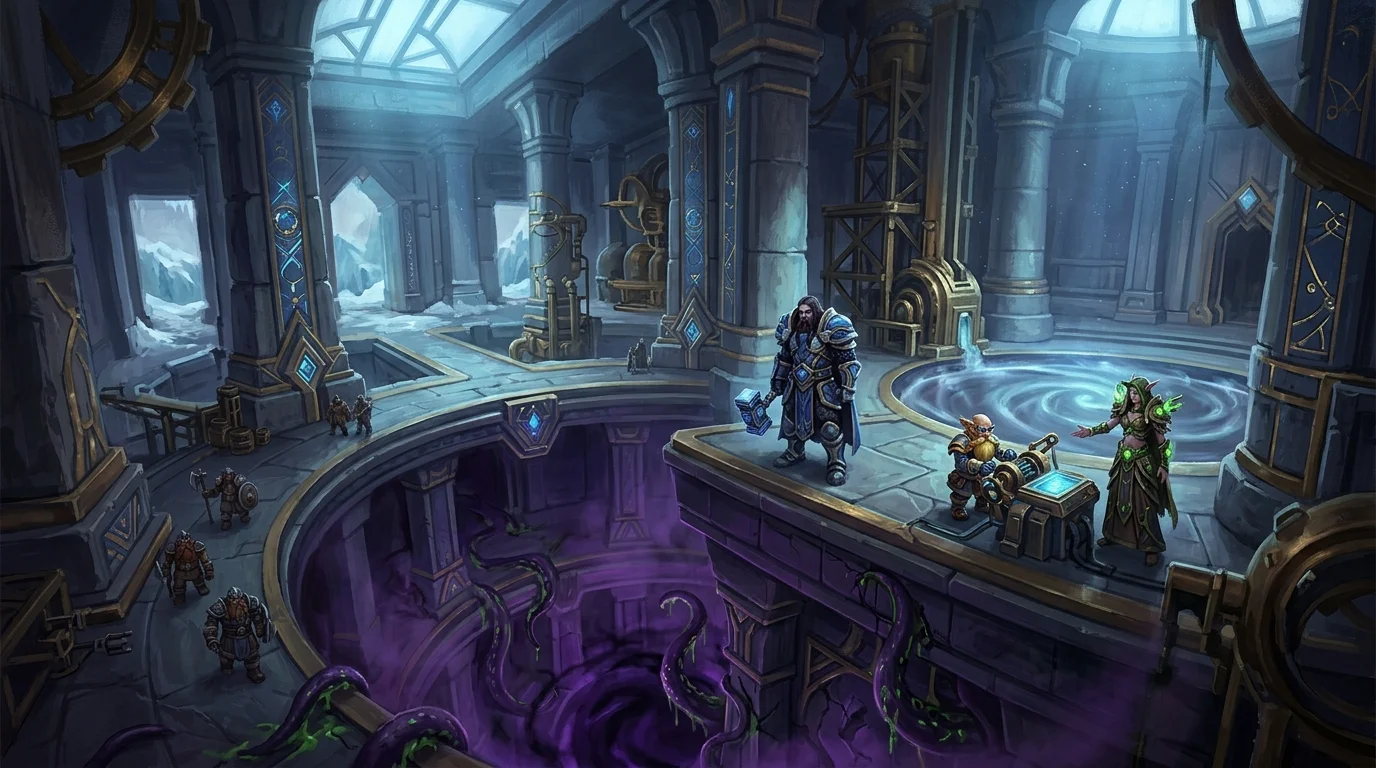
Ulduar was never just a pretty dungeon
Many people remember Ulduar as:
- excellent raid
- absurd setting
- memorable bosses
- iconic hard modes
But, in lore, Ulduar is much more than that. She is a central piece of the history of the titans in Azeroth and one of the greatest proofs that the Old Gods do not win by strength alone. They win by corroding entire systems from within.
What is Ulduar and why the titans built it
Ulduar is an immense titan-forged complex in Northrend. And his most important function was never to guard treasures. It was to serve as a prison for Yogg-Saron.
This detail completely changes the way the place looks. Ulduar is not a glorious temple built just to display titanic power. It's a containment facility.
In other words:
- the titans ordered Azeroth
- left guardians to maintain the system
- and erected structures to prevent the corruption of the Old Gods from escaping
Ulduar represents this harsher side of the titanic order: protection, surveillance and, if necessary, extreme measures.
The Titan Keepers and the balance of the complex
When we talk about the Keepers of Ulduar, we are talking about central figures in the containment machine:
- Thorim -Hodir
- Freya
- Mimiron
They're not just "raid bosses." They are cosmic administrators of an ancient prison, each linked to important parts of Azeroth's order.
This structure matters because it shows how the titans didn't leave Azeroth at random. They created hierarchy, role and protocols.
And that's precisely why Ulduar's subsequent corruption is so frightening: we're not seeing just any outpost fall. We are seeing an entire system being infiltrated.
How Yogg-Saron corrupted everything from within
The great point of Yogg-Saron's story is that he doesn't need to run around the world to win. It wins by contaminating perception, memory, loyalty and structure.
His influence in Ulduar goes through:
- Loken corruption
- destabilization of the Keepers
- rupture of internal trust
- progressive degradation of the titan-forged order
This is what sets the character apart. Yogg-Saron is the Old God of the inner rotting of truth. It distorts what is real, manipulates fear and turns guardians into pieces of its own collapse.
That's why Ulduar's story works so well: the horror isn't just physical. It is institutional, psychological and cosmological.
General Vezax, Yogg-Saron and the heart of horror
Even though the Keepers are the most visible face of the raid, General Vezax and Yogg-Saron himself show how far the corruption has gone.
Vezax makes it clear that the deepest core of the complex is already completely marked by the Old God's power. And Yogg-Saron, at the center of it all, represents:
- the prison that almost became a break
- the enemy who speaks through visions and insanity
- proof that the titanic plans were never completely safe
Ulduar leaves a very strong message: the Old Gods can be imprisoned, but they never become a truly simple problem.
Algalon and the threat of reorigination
Here comes one of the most fascinating parts of Wrath's entire lore.
Algalon the Observer doesn't appear because "Titans are evil" or because Ulduar failed trivially. It appears because the titan-forged protocol has been triggered. With Loken's death, the system understands that Azeroth may have lost its main guardian and that the level of corruption needs to be analyzed.
If the analysis were concluded with irreversible systemic corruption, the answer would be devastating: reoriginate the planet, eliminating all current life to preserve the world's deepest structure.
This concept is brutal because it shows an uncomfortable truth of the titanic order:
- titans protect Azeroth
- but their protection is not sentimental
- it can include deleting almost everything to save the larger project
This greatly expands Ulduar's weight in the game's cosmology.
What the battle in Ulduar reveals about the Old Gods
The raid reveals at least five important things:
1. The Old Gods don't just rely on brute force
They work for slow and structural corruption.
2. Titanic systems are not infallible
Even gigantic installations can be infiltrated.
3. The cosmic order of the titans has an impersonal side
If necessary, protocol accepts sacrificing the present to preserve the plan.
4. Keepers can fail
And when they fail, the damage escalates very quickly.
5. Azeroth has always been in precarious balance
Heroes aren't just killing bosses. They are preventing collapse on a planetary scale.
Why Ulduar remains so important to the lore
Ulduar is one of the pieces that helps prepare future expansions because it plants huge ideas:
- the fragility of the titanic order
- the depth of the influence of the Old Gods
- the cost of containment protocols
- the suspicion that the history of Azeroth is greater than faction against faction
In other words: Ulduar isn't just patch 3.1 content. It is a window to understand the entire cosmic board.
Final summary
Ulduar was built as a prison for Yogg-Saron. The Titan Keepers existed to administer and protect this system. But the Old God corrupted the structure from the inside out, showing that his greatest weapon has always been the infiltration of truth, memory and order. With Loken's death, Algalon was called into action, and the possibility of reorigination made it clear that the Titans had taken extreme measures to deal with systemic corruption.
This is what makes Ulduar so remarkable: she shows not only the horror of the Old Gods, but also the frightening toll of the titanic order itself.
And when a raid manages to expand the entire universe like this, it stops being just a good raid. It becomes a fundamental piece of Warcraft lore.
Posts Recomendados
The origin of Azeroth: Titans, forging the world and birth of the Old Gods
Before any war, before any race, there were the Titans. They forged Azeroth — but the Old Gods were already there, corrupting the world before their arrival.
Dark Heart: How Dragonflight Paved the Way for The War Within
Dark Heart turns Dragonflight's ending from epilogue into prologue. Learn why patch 10.2.7 is the direct bridge to The War Within and the Worldsoul Saga.
Argent Crusade, Ebon Blade and the fall of the Lich King
The Lich King's fall came from two responses to Scourge horror: Tirion's purified crusade in the Argent Crusade and the Ebon Blade's bitter redemption.
Arthas before the fall: from prince of Lordaeron to the path of ruin
Arthas before the fall was Lordaeron's heir and a symbol of the kingdom's hope. Understanding his ruin explains why the tragedy of WotLK works so well.