
Quel'Thalas never existed in empty territory
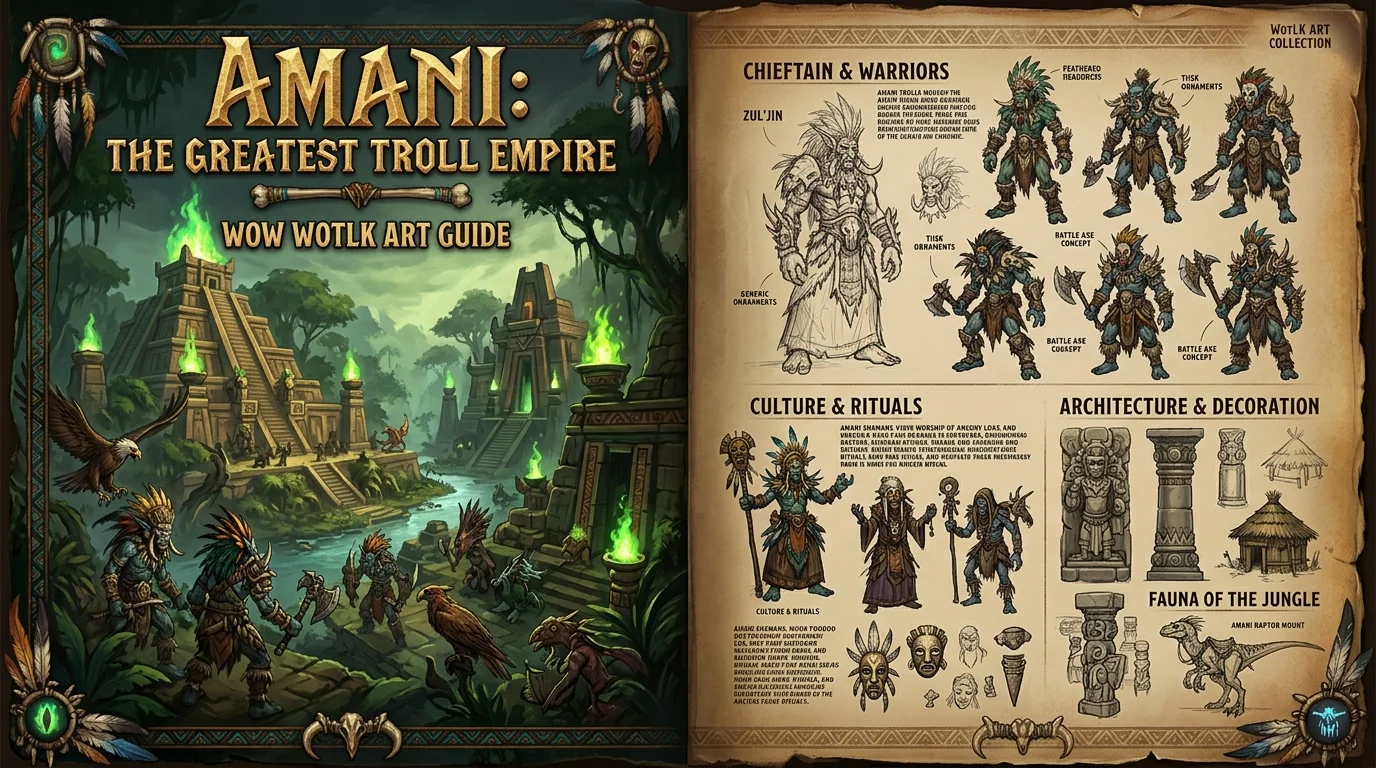
When a player thinks of the Amani, they almost always think of Zul'jin or Zul'Aman first. But the Amani's place in the lore is much greater than that. They are the historical backdrop to the existence of Quel'Thalas and one of the most enduring examples of how Warcraft constructs territorial conflict with long memory.
The Amani do not view elves as bothersome neighbors. They see them as invaders installed on land that already had an owner. And this detail changes everything.
The empire at its peak
Territory and power
The Amani were one of the largest troll empires in the Eastern Kingdoms. Before the narrative of the human kingdoms dominated this part of the map, they were the ones who gave the region its political, military and spiritual scale.
What defined them
Military strength, territorial identity and deep religious bond with the loa. The empire was not just an armed domain. It was a civilization that saw its land as a direct extension of its history and legitimacy.
The conflict with the high elves
The founding of Quel'Thalas
When the high elves settle in the region and found Quel'Thalas, for the elves that is the building of a kingdom. For the Amani, it is a territorial loss and a civilizational affront.
Why this conflict never became a “resolved past”
Because it was never ended by reconciliation. It was ended by defeat, expulsion and military containment. This produces the kind of resentment that doesn't go away over time. It just changes shape.
The Alliance and the destruction of the empire
The weight of the Second War
In the Second War, the Amani pragmatically aligned themselves with the Horde to face their historical enemies. The end result, however, is yet another defeat, now with the Alliance crushing what was left of their regional greatness.
The historical effect
After that, the Amani cease to be an empire and become an armed memory. They still exist, they still resist, but they no longer dictate the direction of the region as they used to.
Zul'jin as the ultimate symbol
More than a raid leader
Zul'jin is important because he condenses the Amani trauma into a single figure. He is resistance, wounded pride, and a total refusal to accept elven legitimacy in Quel'Thalas.
What he represents
Not just revenge. He represents the inability — or refusal — to forget that there was a world before the elves dominated that region.
The accumulated hatred that still defines the Amani
Why does this hatred persist
Because it is not abstract. It is territorial, dynastic, religious and historical. It’s not “we don’t like them.” It’s “they exist where we existed.”
What does this mean for Midnight
Quel'Thalas returning to the center of the story naturally reignites the Amani question. The people who never accepted losing the forest are once again relevant at a time when the entire region becomes a cosmic battlefield.
What the Amani add to the lore
The Amani remember that the story of the elves of Quel'Thalas does not begin with the elves. And this detail forces the reader to see the Warcraft map as layers of occupation, war and memory, not as neutral borders.
This is why they remain important. Even defeated, they remain a living reminder that the elven kingdom was built on an ancient wound.
Minimum recommendation
To truly understand the Amani:
- see Quel'Thalas also from a troll perspective
- treat Zul'jin as a historical symbol, not just an antagonist
- connect the Second War and Midnight into the same arc of resentment
- remember that the conflict with the elves is territorial before it is racial
- read the Amani as a defeated empire that never accepted defeat
Posts Recomendados
Legacy of the Amani: the trolls of Quel'Thalas and the hatred accumulated over centuries
Legacy of the Amani doesn't treat the Amani and Quel'Thalas as a generic backdrop: the tale turns centuries of war into personal, political memory.
The Amani in the context of Midnight
Midnight puts Quel’Thalas back at the center of the world, and the Amani with it: a people who never accepted losing the forest, where Light and Void meet.
Magtheridon: the pit lord of Hellfire Citadel
Who is Magtheridon: the pit lord who ruled Outland, lost the Black Temple to Illidan and became the blood source for fel orcs in Hellfire Citadel.
Saurfang and Dranosh: father and son of the Horde
Varok and Dranosh Saurfang: the son hidden in Nagrand, his death at the Wrathgate, the Deathbringer in ICC and the father who takes him home. Full arc.