
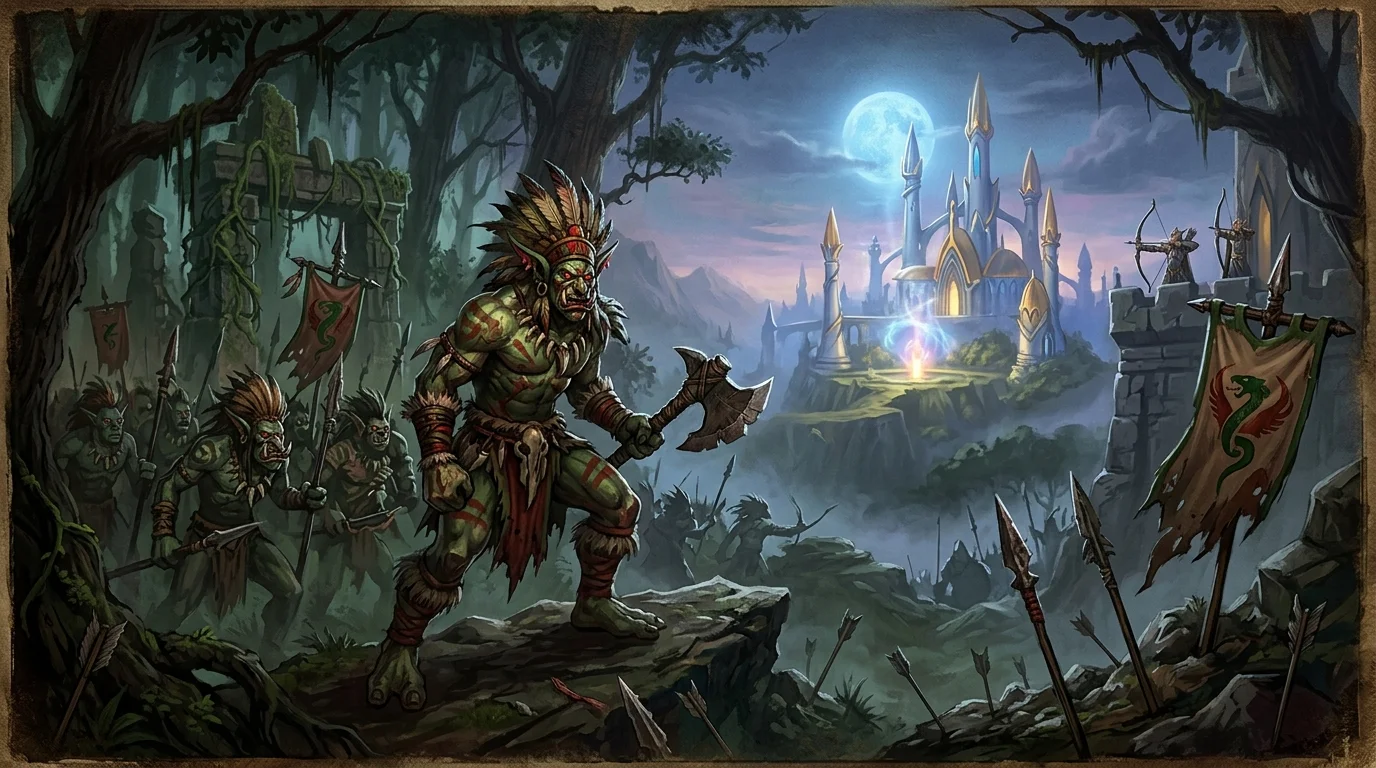
Legacy of the Amani: the trolls of Quel'Thalas and the hatred accumulated over centuries
When the story of Quel'Thalas is told from the other side
For a long time, the story of the Amani in World of Warcraft almost always appeared through the eyes of their enemies. The elves count the founding of Quel'Thalas as a triumph. The Alliance treats Zul'Aman trolls as a recurring threat. And the blood elves, when they look at the Amani, see above all a past of war that justifies permanent defense.
Legacy of the Amani does the opposite. The tale pushes the camera deep into Amani's pain and shows that the conflict is not a distant echo: it still organizes identity, leadership, pride and resentment in the present. This is precisely what makes the text so important for the Midnight cycle.
What happens in Legacy of the Amani
The short story follows Zul'jarra, daughter of leader Amani, at a time of political pressure and internal succession. She not only carries the expectation of leading a people in decline: she also carries the weight of inheriting a historical memory made up of defeats, humiliation and tribal fragmentation.
The main crisis does not exist in a vacuum. Zul'jarra's authority is tested because the Amani no longer live in a position of strength, and every decision about identity, war and survival involves the question that has never been buried: what did Quel'Thalas take from them and what remains to be recovered?
Why the focus on Zul'jarra matters
The choice of a young protagonist is intelligent because it avoids turning the tale into a simple repetition of Zul'jin's past. Instead of just revisiting the old Amani rage, the narrative shows what happens when a new generation inherits an old hatred without inheriting the same world.
The Amani perspective on blood elves and Quel'Thalas
To the Amani, Quel'Thalas is not just a neighboring elven kingdom. It is material proof of a historic loss. Where the elves see ancestral home, the Amani see land taken, consolidated invasion and cultural erasure.
Resentment is not abstract
The tale works because it doesn't treat Amani hatred as a tribal slogan. He shows this feeling as something:
- territorial, because the dispute over land was never forgotten;
- cultural, because the elven presence redefined the region's own memory;
- personal, because each generation grows up hearing that what exists today was built on an old wound.
This is the great strength of the text: it gives the Amani back a bitter humanity. They are not just presented as rabid enemies, but as a people who have learned to organize around a loss that has never been repaired.
Historical hatred as a concrete heritage
A lot of Warcraft lore works with very old conflicts, but it doesn't always manage to make those conflicts feel alive. Legacy of the Amani succeeds.
How the story materializes this hatred
Resentment appears as a leadership criterion, as an identity filter and as a way of interpreting the present. The past does not remain in symbolic ruins: it structures alliances, distrust and the very idea of what it means to continue being Amani.
This makes the text more interesting than a simple “trolls versus elves” story. The tale talks about something harder: what happens when a people survive long enough to transform loss into the foundation of their existence.
And the threat of the Void?
The short story does not fully resolve Amani's position towards the Void, but this is precisely one of the most important signs of why it was published close to Midnight.
What he suggests
Instead of offering a closed answer, the story leaves a central tension in the air:
- the Void is a threat big enough to require repositioning;
- but the hatred of elves is too deep to disappear just because a greater enemy has appeared.
In other words: the question is not just whether the Amani will fight the Void. The real question is whether they can face a new threat without abandoning the emotional logic built against Quel'Thalas over centuries.
This ambiguity is great for Midnight because it prevents the Amani from being treated as automatic allies or one-dimensional villains.
Why Blizzard published this story in parallel with Midnight
This tale exists to prepare the ground. Not only geographical, but emotional and political.
The clearest sign in the tale
By publishing Legacy of the Amani at the same time as repositioning Quel'Thalas and its regions at the center of the narrative, Blizzard is saying that Midnight will not just be “elves against the Void”. It will also be a return to much older tensions:
- dispute over territory;
- competing historical memory;
- resentments that survived entire expansions;
- unlikely alliances and peaces that may fail.
In other words, the story expands the theater of war. Midnight doesn't just inherit Xal'atath's cosmic menace. It also inherits ethnic, cultural and regional conflicts that have always been there.
What Legacy of the Amani adds to the lore
The greatest merit of the short story is to rebalance the narrative. Quel'Thalas has always had a lot of space in official history. Not the Amani. Here, for the first time in a long time, they stop being just a hostile context and once again exist as a wounded, proud and politically relevant civilization.
What does this change
After this story, it becomes more difficult to look at Zul'Aman and the Amani as “another troll threat”. The text places the people back on the moral map of Warcraft. Not to exonerate him, but to show that his violence has history, memory and internal logic.
Why this story matters so much to those who will play Midnight
Anyone who arrives at Midnight without reading Legacy of the Amani will still understand the main campaign. But it will miss something important: the notion that the conflict in Quel'Thalas does not begin in the Void.
It already existed. The Void merely enters a landscape that was already filled with resentment, ruin, and disputed memory.
Minimum recommendation
Read Legacy of the Amani as a tale about historical heritage, not just trolls. The central point is not to ask whether the Amani “are right”, but to understand how centuries of defeat shape an entire people. When Midnight pushes Quel'Thalas back to the center of the world, this text helps remember that the region never belonged to just one narrative.
Posts Recomendados
Quel'Thalas: elven past, tragedy and the slow post-Scourge reconstruction
Quel'Thalas is home to a people who fell from arcane glory into deep mourning and set out to rebuild a home that was never the same. Learn the story.
Silvermoon: the city that hides its scars behind magic and pride
Silvermoon is sold as an elven jewel and showcase of sin'dorei elegance, yet half the city lies in ruins. Learn the contrast between brilliance and wound.
Magtheridon: the pit lord of Hellfire Citadel
Who is Magtheridon: the pit lord who ruled Outland, lost the Black Temple to Illidan and became the blood source for fel orcs in Hellfire Citadel.
Saurfang and Dranosh: father and son of the Horde
Varok and Dranosh Saurfang: the son hidden in Nagrand, his death at the Wrathgate, the Deathbringer in ICC and the father who takes him home. Full arc.