
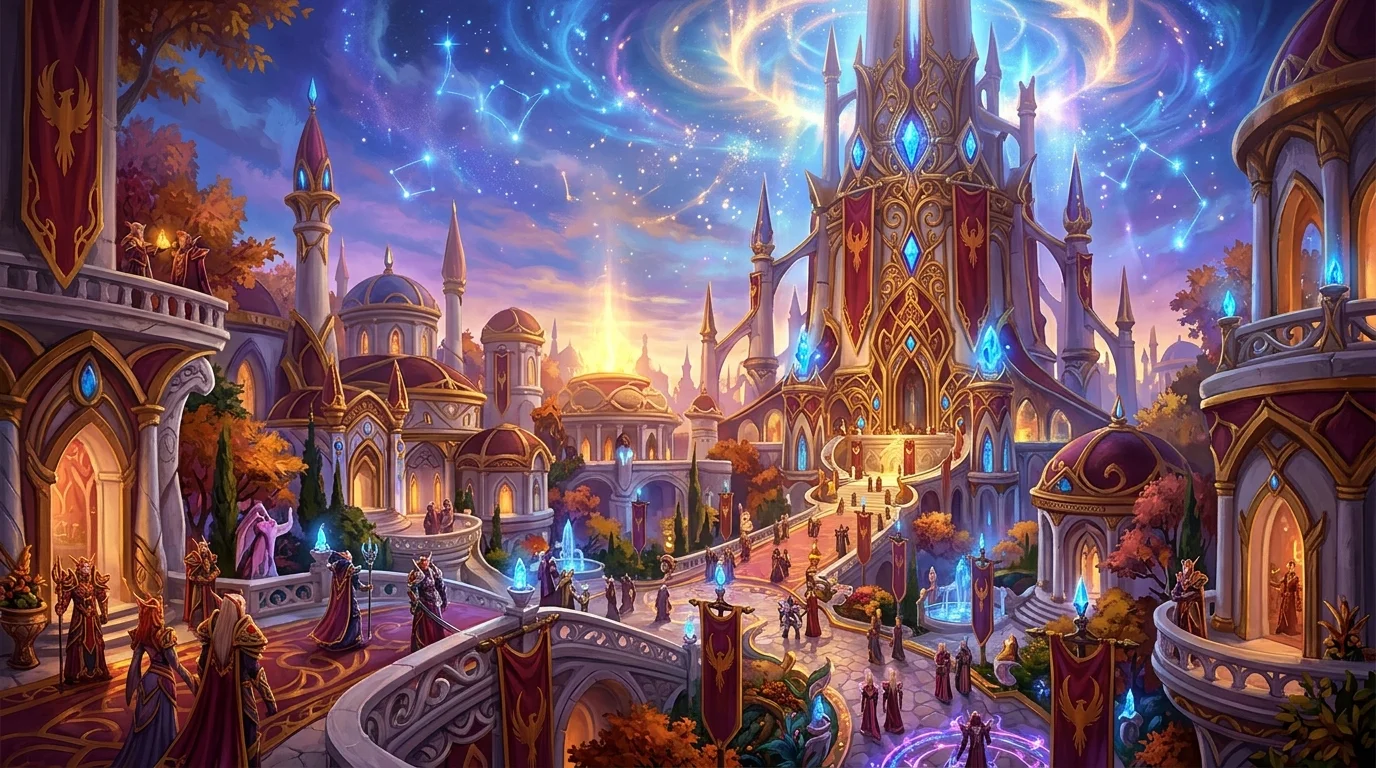
Silvermoon is too beautiful to be read just as "the blood elf capital"
Silvermoon has always been presented as an architectural jewel. This is right, but it is incomplete. The city works best when you see two versions of it at once: the shiny capital that the blood elves show off to the world and the mutilated city that was never fully resolved.
This contrast is the heart of Silvermoon's lore. The place did not lose value because it was injured. It gained density precisely because it existed as beauty that never stopped reminding us of destruction.
The original Silvermoon was a project of civilizational grandeur
What made it unique
Silvermoon wasn’t just “pretty.” It was the urban translation of the high-elf ideal: magic integrated into architecture, elegant monumentality, a sense of order and an aesthetic identity of its own, immediately recognizable in Azeroth.
It was, in many ways, material proof that Quel'Thalas was not the periphery of the world. It was a self-assured civilization.
The symbolic value
Capitals matter because they condense the image that a people have of themselves. Silvermoon, at its peak, told the world that the elves of the east were not exiles trying to survive. They were heirs of a refined and lasting culture.
The destroyed half never stopped defining the city
What Arthas did
In the Scourge's invasion, Silvermoon is crossed by the trail of devastation that would become the Dead Scar. The city loses not only fighters and infrastructure. It loses continuity. What was once an entire urban fabric becomes a broken space.
The west falls into ruins. The east is rebuilt. And this cut was never a simple visual detail.
Why does this matter so much
Because the city stops being just the capital and also becomes a permanent reminder of the attack. In Silvermoon, the landscape doesn't let people forget.
More than a literal illusion, Silvermoon projects greatness onto the wound itself
What blood elf pride does to the city
The most interesting point here is less “there is a specific magic hiding everything” and more the symbolic function of the city. Silvermoon always operates as a showcase of continuity, order and sophistication. The reconstructed part exists as the official face. The ruined part remains an uncomfortable truth right next to it.
This is extremely sin'dorei. The people do not choose to live only in defeat. They choose to show that they are still beautiful, cultured and politically relevant — even when the scar remains open.
The effect of this
Silvermoon starts to function almost as a staging of resistance. Not in a false sense, but in a political sense: the city says “we’re still here” before any character even opens their mouth.
Silvermoon is more than just a setting: it is a political and cultural center
What happens there matters for the entire race
Silvermoon is where government, prestige, historical memory and the public image of what it means to be a blood elf are concentrated. When Lor'themar, Rommath, Halduron, or the sin'dorei elite move politically, the city is at the center of that decision.
That's why it was never “just an old city forgotten by the engine”. In lore, Silvermoon has always been one of the most strategic places in the blood elf identity.
The cultural role
The city also maintains the connection between refinement, magic and racial pride. Even wounded, it remains the place where sin'dorei try to prove to themselves that they have not become just bitter survivors.
Midnight finally forces Silvermoon to face what it has carried for decades
What changes
With Midnight, Silvermoon returns to the center of the narrative and Quel'Thalas is once again treated as the main space. Officially, the expansion places the Void's invasion upon the kingdom, reintroduces the region as a revamped whole, and maintains Silvermoon as its resplendent capital.
What does this mean in terms of theme
This matters because the city stops being a nostalgic backdrop and becomes a living problem again. The reality that Silvermoon has carried for so long — ruin, pride, incomplete reconstruction, and existential threat — must finally be faced head on.
What Silvermoon represents within the lore
| Element | What it reveals | |----------|------------------| | Architectural beauty | Cultural greatness of the high elves and the sin'dorei | | Dead Scar and ruins | Permanent memory of the Scourge invasion | | Part rebuilt | Effort to survive and preserve prestige | | Political role | Center of blood elf power | | Midnight | Time to confront the wound instead of just skirting it |
Silvermoon is fascinating because it never became whole again
This is precisely what makes the city work. If it had been completely restored, it would have lost some of its weight. If it had been abandoned, it would have lost its identity. Silvermoon exists in a tense middle ground: enough splendor to inspire pride, enough ruin to prevent amnesia.
Few Warcraft capitals tell as much about their people as Silvermoon. It is at the same time a monument, a scar and a declaration of permanence.
Minimum recommendation
If you want to read Silvermoon in more depth:
- start with the city as a symbol of elven heyday
- treat the Scourge's destruction as a structural cut, not a mere visual detail
- see reconstruction as a political gesture of pride and survival
- understand that the city has always functioned as a center of blood elf identity
- read Midnight as the moment when Silvermoon stops hiding its own wound
Posts Recomendados
Quel'Thalas: elven past, tragedy and the slow post-Scourge reconstruction
Quel'Thalas is home to a people who fell from arcane glory into deep mourning and set out to rebuild a home that was never the same. Learn the story.
Lordaeron: From the Glory of the Greatest Human Realm to the City of the Undead
Lordaeron was the north's greatest human kingdom: there the Plague won from within, Arthas killed his father and the Forsaken built a new identity below.
Saurfang and Dranosh: father and son of the Horde
Varok and Dranosh Saurfang: the son hidden in Nagrand, his death at the Wrathgate, the Deathbringer in ICC and the father who takes him home. Full arc.
Dalaran in Northrend: why the city flew
Dalaran in Northrend: why the Kirin Tor took the city into the sky over Crystalsong, who rules it and what the Violet Hold keeps locked. See the summary.