
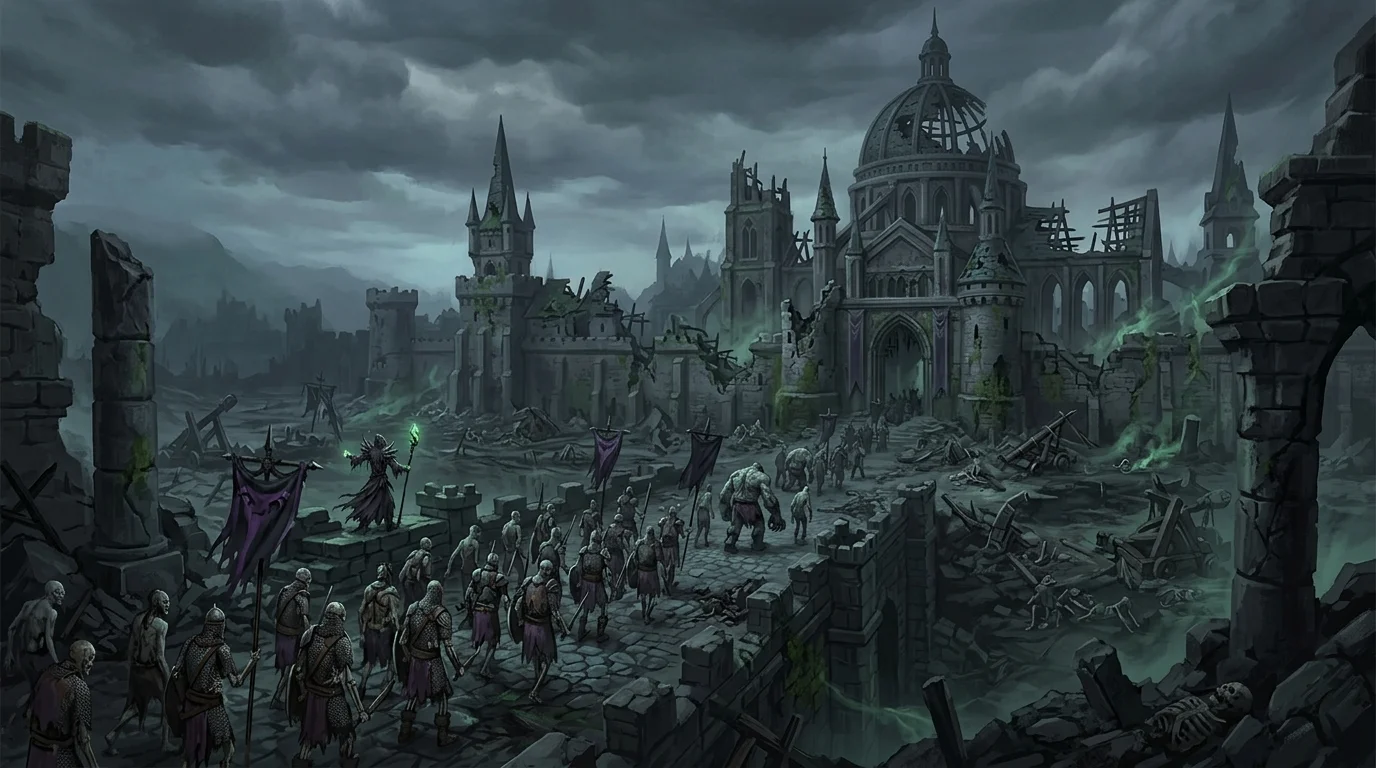
Lordaeron: From the Glory of the Greatest Human Realm to the City of the Undead
Lordaeron matters because it is the place where the ruin found its address
Warcraft loves to talk about big drops, but Lordaeron is different. It wasn't just a defeated kingdom. It was a political, military and symbolic center undone from the inside out. When you think about corruption, plague, betrayal and ruined memory, almost everything converges there.
And the strongest thing is that the city never really ceased to exist. It only changed owner, function and meaning. The palace of the greatest human kingdom ended up giving rise to the underground capital of the undead. Few scenarios tell so much about Azeroth without having to say a word.
At its height, Lordaeron was the human heartland of the north
What the kingdom represented
Lordaeron was more than a pretty capital. It was an axis of power. The kingdom of Terenas II epitomized human stability, political centrality, and the legacy of the Lordaeron Alliance.
It was a place that seemed too safe to fall. And that's exactly why his downfall works so well narratively.
What was there beyond the throne
There was bureaucracy, religion, aristocracy, army, commerce and a sense of permanence. Lordaeron seemed like the kind of place that would survive any crisis. Prague proves otherwise.
The fall didn't happen all at once
Prague won in slow motion
This is an important detail. Lordaeron doesn't just fall when Arthas returns home as champion of death. The kingdom was already being eroded before: sick villages, widespread fear, broken trust and political decisions unable to contain something that did not follow the normal logic of war.
That's what makes the collapse so heavy. The people did not see a simple invasion. He saw normality rot.
The collective trauma
The great strength of the story of Lordaeron is that it shows that the ruin was not instantaneous. She was witnessed. And when a people sees its own order gradually crumbling, the scar becomes deeper.
Arthas' regicide ends an entire era
The decisive moment
When Arthas returns and kills Terenas II, Warcraft isn't just showing a son murdering his father. It is brutally ending the legitimacy of the old kingdom. It is the act that transforms crisis into the end of an era.
There, Lordaeron stops being a kingdom in collapse and becomes a territory conquered by death.
Why does this moment still weigh so much
Because he concentrates everything in one image: the heir returning home not to save but to finish the work of ruin.
Undercity is the Forsaken's response to the story that drove them out of their own lives
What did they do with the ruins
The Forsaken didn't just occupy an empty seat. They turned the catacombs beneath the ancient capital into their own city. This is important because Undercity has never been about simply reusing scenery. It was a declaration of identity.
They built a new people literally on the remains of the old human order.
The meaning of this
Undercity is the inverted mirror of Lordaeron. Above: memory of monarchy, glory and fall. Below: bitter survival, autonomy and resentment.
Post-BfA, Lordaeron becomes ruin upon ruin
What the Battle for Lordaeron does
Battle for Azeroth pushes the scenario to a new stage of devastation. The chemical plague released by Sylvanas makes the region even more marked by contamination and abandonment.
But stopping there would be oversimplifying.
The current state is more complex than "turned gray"
Afterwards, the game resumes Lordaeron in lines such as Return to Lordaeron and the Forsaken inheritance arc. This does not erase the destruction. But it shows that Lordaeron remains disputed as a symbol, memory and destiny. It's not just dead land. It's a place that no one can leave forever.
What Lordaeron represents today
| Layer | What does it mean | |--------|---------------------| | Peak Human Realm | Order, power and political centrality | | Fall for Prague | Vulnerability of civilization | | Death of Terenas | Symbolic end of the old world | | Undercity | Reinvention of the Forsaken beneath the ruins | | Post-BfA | Toxic memory, but still alive and disputed |
Lordaeron is a city about the impossibility of returning to the way it was
This is why the scenario remains fascinating. Lordaeron cannot be restored as if nothing had happened. The city carries too much trauma for that. But it also cannot be forgotten. She is too important to disappear from the narrative.
At its core, Lordaeron is the perfect Warcraft map: ancient glory, moral ruin, death, persistence, and the fight for the right to tell one's own story.
Minimum recommendation
If you want to understand Lordaeron without reducing everything to “city of the undead”:
- start at the height of the kingdom under Terenas II
- treat the Plague as a process of collapse, not a single event
- see Arthas's regicide as the symbolic end of an era
- understand Undercity as a Forsaken political project
- read post-BfA as a dispute for memory, not simple abandonment
Posts Recomendados
Quel'Thalas: elven past, tragedy and the slow post-Scourge reconstruction
Quel'Thalas is home to a people who fell from arcane glory into deep mourning and set out to rebuild a home that was never the same. Learn the story.
Silvermoon: the city that hides its scars behind magic and pride
Silvermoon is sold as an elven jewel and showcase of sin'dorei elegance, yet half the city lies in ruins. Learn the contrast between brilliance and wound.
Saurfang and Dranosh: father and son of the Horde
Varok and Dranosh Saurfang: the son hidden in Nagrand, his death at the Wrathgate, the Deathbringer in ICC and the father who takes him home. Full arc.
Dalaran in Northrend: why the city flew
Dalaran in Northrend: why the Kirin Tor took the city into the sky over Crystalsong, who rules it and what the Violet Hold keeps locked. See the summary.