
Quel'Thalas: elven past, tragedy and the slow post-Scourge reconstruction
Quel'Thalas was not just attacked: it was broken as a civilization
When talking about Quel'Thalas, many people first remember the blood elves, Sunwell or the golden aesthetic of Eversong. All of this matters, but it comes later. What defines the kingdom is the mix of ancient splendor and collective trauma.
Quel'Thalas was one of the largest elven projects ever built outside of Kalimdor. After Arthas' invasion, it stopped being just a homeland and became a monument of mourning. Reconstruction exists, of course, but it was never complete. And maybe it couldn't be.
At its height, Quel'Thalas was the great elven house of the east
What the kingdom represented
Founded by the high elves after their migration north from Lordaeron, Quel'Thalas was organized around the Sunwell, magic, refined architecture, and a long-standing sense of historical continuity. It was not an outpost. It was a mature, powerful and deeply confident kingdom.
The alliance with Arathor also makes an important point: Quel'Thalas was not isolated from the world. It influenced human history directly by sharing arcane knowledge at a decisive moment.
What did it build
This past matters because it gives scale to the later tragedy. The bigger the civilization, the deeper the wound when it stops believing in its own permanence.
Arthas doesn't just destroy a capital: he opens a scar from south to north
The route of devastation
The Scourge's invasion crosses Quel'Thalas towards the Sunwell and leaves behind the kingdom's most symbolic mark: the Dead Scar. The campaign doesn't just destroy cities and armies. It tears up the territory physically and spiritually.
Silvermoon falls. Sylvanas is defeated and transformed. The Sunwell is desecrated. And with that, the elven civilization loses military leadership, political center and mystical source at the same time.
The size of the loss
It wasn't just war. It was profanation. This explains why the memory of this attack continues to define the sin'dorei long after.
What was left was a nation in mourning, not just a damaged territory
Collective mourning
This is the point that is most worth reinforcing. After the Scourge, what remains of Quel'Thalas is not simply “a kingdom with ruins”. It is a traumatized society, with enormous population loss, magical dependency in crisis and identity needing to be remade.
This is where the name blood elves comes from. The people begin to define themselves by the wound.
The political effect
When a civilization even changes its name because of the tragedy, it becomes clear that the attack was not peripheral. It was foundational for the next phase of the race.
Reconstruction happened, but it was always partial
What was recovered
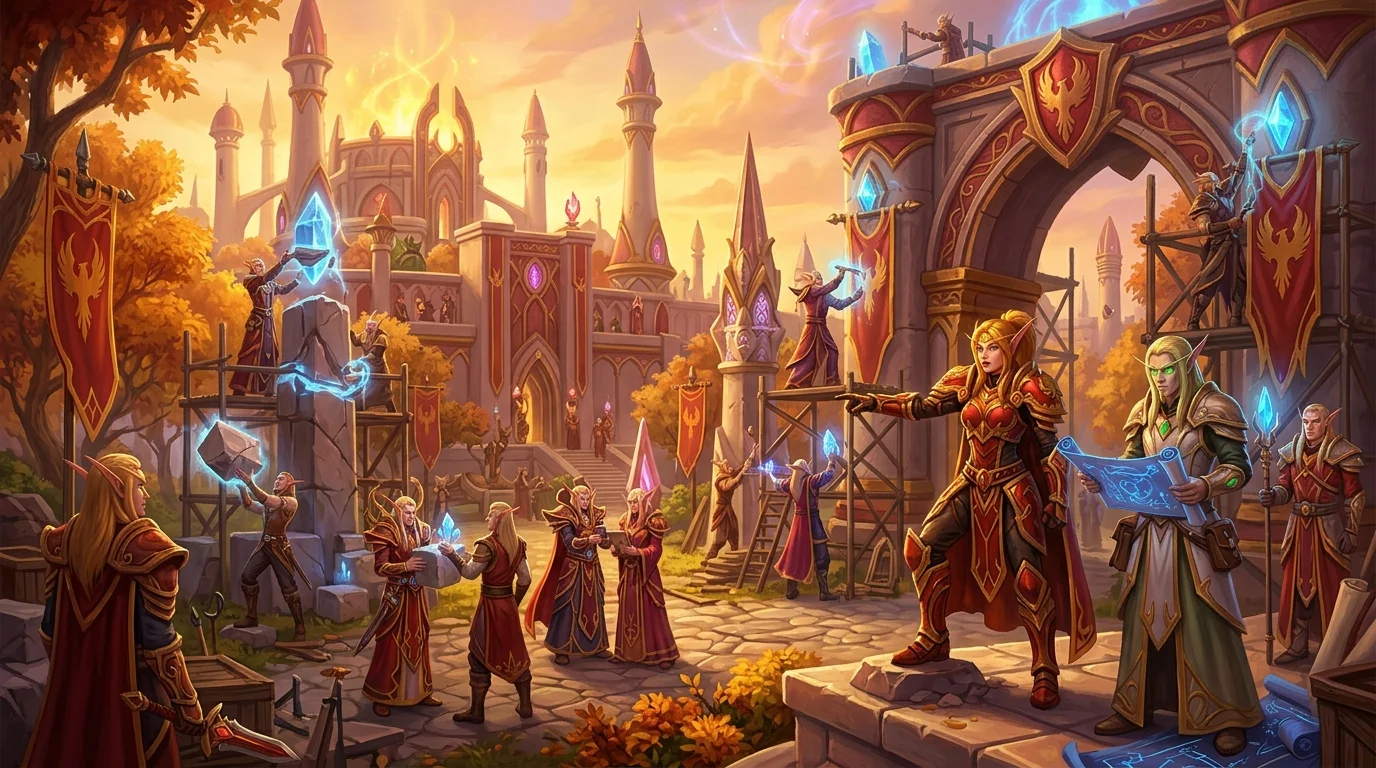
The blood elves rebuilt important parts of civilian life, restored much of eastern Silvermoon, rebuilt institutions and, over time, saw Sunwell reborn. This gave back breath and pride.
What never came back completely
Even so, the reconstruction did not erase the Dead Scar, the memory of the fall, nor the fact that a large part of the kingdom remained marked by death, ruin, and absence. Quel'Thalas continued to exist, but no longer as the inviolable paradise of the past.
Midnight puts Quel'Thalas back at the center of the story
What changes now
Midnight does something that many people have been waiting for for years: it puts Quel'Thalas back at the center, not as a nostalgic backdrop, but as the main stage. Officially, the expansion deals with the Void's invasion of Quel'Thalas and reintroduces the region with Eversong Woods and Ghostlands combined and reworked, with Silvermoon as the capital.
Why is this so important
Because this return is not just visual. It's narrative. Quel'Thalas is once again treated as an entire, living, threatened, and historically central kingdom — not just a frozen memory of The Burning Crusade.
What Quel'Thalas represents today
| Story Layer | What it shows | |--------------------|------------------| | Peak Elven Kingdom | Confidence, refinement and arcane power | | Arthas Invasion | Total rupture of territory and identity | | Sunwell desecration | Spiritual and magical loss at the same time | | Blood elf reconstruction | Persistence without complete return to the past | | Midnight | Recentralization of the kingdom in the face of a new existential threat |
Quel'Thalas remains an incomplete homeland — and that's what makes it strong
The kingdom never went back to being exactly what it was. But that doesn't make it any smaller. It makes it more human, in the best possible sense. Quel'Thalas came to exist as a civilization that rebuilds while bearing an open scar.
This is perhaps the great theme of the place: not nostalgia for lost perfection, but insistence on continuing even when the home can no longer be recovered in one piece.
Minimum recommendation
If you want to understand Quel'Thalas in depth:
- start with the high elf peak and the importance of the Sunwell
- treat the invasion of Arthas as a civilizational tragedy, not just a military one
- see the name “blood elf” as a direct response to collective grief
- understand the reconstruction as real, but incomplete
- read Midnight as the moment in which the kingdom returns to the center of history
Posts Recomendados
Silvermoon: the city that hides its scars behind magic and pride
Silvermoon is sold as an elven jewel and showcase of sin'dorei elegance, yet half the city lies in ruins. Learn the contrast between brilliance and wound.
Lordaeron: From the Glory of the Greatest Human Realm to the City of the Undead
Lordaeron was the north's greatest human kingdom: there the Plague won from within, Arthas killed his father and the Forsaken built a new identity below.
Magtheridon: the pit lord of Hellfire Citadel
Who is Magtheridon: the pit lord who ruled Outland, lost the Black Temple to Illidan and became the blood source for fel orcs in Hellfire Citadel.
Saurfang and Dranosh: father and son of the Horde
Varok and Dranosh Saurfang: the son hidden in Nagrand, his death at the Wrathgate, the Deathbringer in ICC and the father who takes him home. Full arc.