
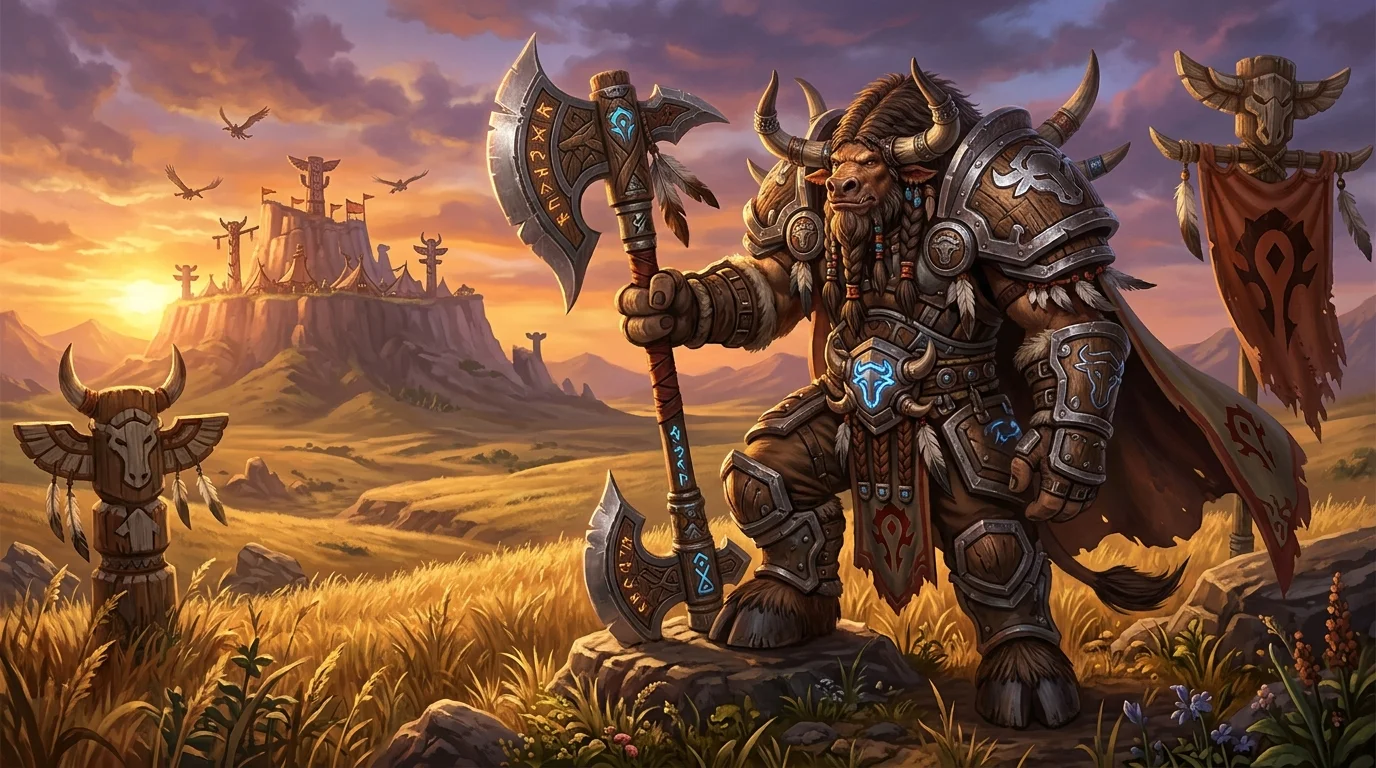
Baine Bloodhoof: the tauren leader between honor, diplomacy and his father's heritage
Baine was never the loudest leader of the Horde
In World of Warcraft, there is a type of character who dominates the scene through raw power, aggressive charisma or fiery speech. Baine Bloodhoof was never that character. And perhaps precisely for this reason he is one of the most important leaders in the modern history of the Horde.
Son of Cairne Bloodhoof, Baine inherited much more than a title. He inherited a traumatized people, a threatened Thunder Bluff, a Horde entering an increasingly militarized phase and the burden of proving that calm is not weakness. While other leaders responded to chaos with more chaos, Baine almost always tried to respond with conscience.
That's what makes him such a different figure. Baine does not represent the Horde of conquest. It represents the Horde that still tries to remember why it was created.
Cairne's death and what Baine inherited
The coup that changed everything
Baine takes over at one of the worst possible times. Cairne Bloodhoof dies after the mak'gora against Garrosh Hellscream, in an episode contaminated by Magatha Grimtotem's betrayal. The impact was not just political. It was spiritual.
Cairne wasn't just a tauren chieftain. It was a moral reference. His death left a void that no speech could fill. And Baine did not inherit a stable throne: he inherited a people in mourning, a contested leadership, and a Horde already bent on brutality.
The son who had to mature quickly
What defines Baine from the beginning is that he doesn't try to imitate Cairne in an artificial way. He understands his father's heritage, but does not become a copy of him. Your first great test is not to defeat an external enemy; is to survive the political implosion that comes after Cairne's death.
Thunder Bluff enters a crisis, the Grimtotem try to take power, and Baine needs to prove that he can lead without the mythical weight that his father had. This beginning explains a lot about the character: Baine learns early that leading is not about appearing invincible. It's not breaking when everything around is already breaking.
Baine as voice of honor within the Horde
The leader who chose not to live on revenge
One of Baine's most important traits is that he could have been defined by revenge against Garrosh. There was plenty of reason for that. Even so, he chooses another path.
In the Cataclysm stories, Baine is portrayed as someone who deliberately does not pursue immediate revenge for Cairne's death, because he understands that a disunited Horde would be a disaster for everyone. This decision does not show weakness. Shows priority.
The character who said “no” the most times
Over the years, Baine has become almost an uncomfortable conscience of the Horde. He was never the most ambitious in the room, but he was almost always one of the few willing to state the obvious when no one else wanted to say it.
It was like that with Garrosh. It was like that with Sylvanas. It was like this whenever political logic tried to justify the unjustifiable.
This is the central point of the character: Baine is not important because he wins every dispute. He is important because he maintains a moral center when the Horde itself seems to forget that it should have one.
Tauren philosophy in practice
Speak before hurting
Tauren philosophy has always had a very strong relationship with balance, ancestry, respect for the land and collective responsibility. Baine is perhaps the leader who most translates this into political decision.
He tends to seek dialogue before war, containment before spectacle, repair before destruction. In a universe like Warcraft, this often makes it feel “less epic” than explosive characters. But this reading is superficial.
In practice, Baine experiences a more difficult form of courage: maintaining principles when the environment rewards impulsiveness. He doesn't solve everything with words, of course. But it always tries to ensure that violence is the last resort, not the first reflex.
A tauren ruling amid the orc noise
This also explains why Baine so often seems out of place within Horde politics. Tauren tradition values continuity, memory, and responsibility. The Horde, on the other hand, was at various times pulled by leaders who rewarded speed, preventive war and demonstration of force.
Baine is the friction between these two visions. And that friction is part of its value.
The arrest of Sylvanas and the price of maintaining consciousness
The breaking point
Baine spends years trying to keep the Horde within some moral boundary. In Battle for Azeroth, this finally takes a direct toll.
After Sylvanas' authoritarian escalation, Baine crosses a line he considers non-negotiable and ends up imprisoned under Orgrimmar, with imminent execution. This moment matters a lot because it transforms into concrete action something that had been clear for a long time: anyone who was still trying to act with honor within the Horde was becoming an obstacle to Sylvanas' regime.
What Anduin risked to save him
Baine's rescue also says a lot about him. Anduin considers that he has a moral debt to the tauren and participates in the movement to save him. This reinforces an idea that has accompanied Baine for years: he manages to generate respect even on the other side of the war because he is seen as someone trustworthy, not just as “a reasonable enemy”.
Most importantly, this episode shows that Baine is not a passive moderate. When he has to choose between political comfort and conscience, he accepts paying the price.
Shadowlands wasn't prison — it was another trauma
What really happens next
There's a common confusion here: Baine wasn't imprisoned by Sylvanas in Shadowlands. The prison linked to Sylvanas takes place at the end of Battle for Azeroth. In Shadowlands, what happens is different: Baine is kidnapped along with Anduin, Jaina and Thrall and taken to the Maw.
This difference is important because it shows two distinct stages of his arc. First, Baine is punished for resisting within Horde politics. Later, in Shadowlands, he becomes one of the leaders drawn into a cosmic conflict that goes beyond the dispute between factions.
What does this add to the character
Shadowlands doesn't reset Baine as much as BfA, but it does amplify his attrition. He stops being just a leader tired of the degradation of the Horde and becomes someone marked by yet another experience of impotence, imprisonment and violence on a larger scale.
What Baine represents to the Horde
The conscience that no one wants to hear
Every collective at war begins to treat its own conscience as an inconvenience. Baine occupies exactly that place in the Horde: remembering limits when everyone prefers results.
That's why he's so narratively important. He does not exist to be the “coolest” leader of the faction. It exists to ask how much of the Horde is left when honor, word and responsibility become negotiable details.
Cairne's most faithful heir — but his way
Baine honors Cairne not by repeating his gestures, but by preserving the core of what his father stood for. He believes that strength without wisdom becomes tyranny. Leadership without listening becomes fear. And that a people without moral memory becomes just another army.
This type of character rarely dominates trailers or cinematics. But it is precisely this type of character that prevents a faction from completely losing its own soul.
Why Baine works so well despite being underestimated
There are more popular, more dramatic and more visually iconic leaders. Still, few have aged as well as Baine within modern lore.
It works because it represents something rare in Warcraft: moral stability without naivety. Baine knows the world is brutal. You know that war is sometimes inevitable. You know that political alliances require concessions. Even so, he continues to act as if some limits still need to exist.
In a universe where so many people fall to anger, ambition or trauma, Baine stands out for remaining whole.
Minimum recommendation
If you want to truly understand Baine Bloodhoof, read the character in this order:
- start with Cairne's death and the crisis that explodes in Thunder Bluff
- Watch how Baine deals with Garrosh without letting revenge define his leadership
- track your position during Battle for Azeroth, when honor stops being a speech and becomes a real risk
- mentally separate two different events: the arrest by Sylvanas in BfA and the kidnapping to the Maw in Shadowlands
- Read Baine for what he really is: not the Horde's flashiest warrior, but the conscience that still keeps the faction from completely losing itself
Posts Recomendados
Varian Wrynn: The Lost King, the Gladiator Lo'Gosh, and the Sacrifice on the Broken Shore
Varian Wrynn wasn't just an aggressive king: he was a man split in two, rebuilt in pain, who died as he lived, on the front line for his people. Read on.
Lor'themar Theron: the regent who never wanted the throne and became the heart of the blood elves
Lor'themar seemed like a stylish sidekick, but he became one of WoW's most consistent leaders because he never ruled as if power were his due.
Saurfang and Dranosh: father and son of the Horde
Varok and Dranosh Saurfang: the son hidden in Nagrand, his death at the Wrathgate, the Deathbringer in ICC and the father who takes him home. Full arc.
Dalaran in Northrend: why the city flew
Dalaran in Northrend: why the Kirin Tor took the city into the sky over Crystalsong, who rules it and what the Violet Hold keeps locked. See the summary.