
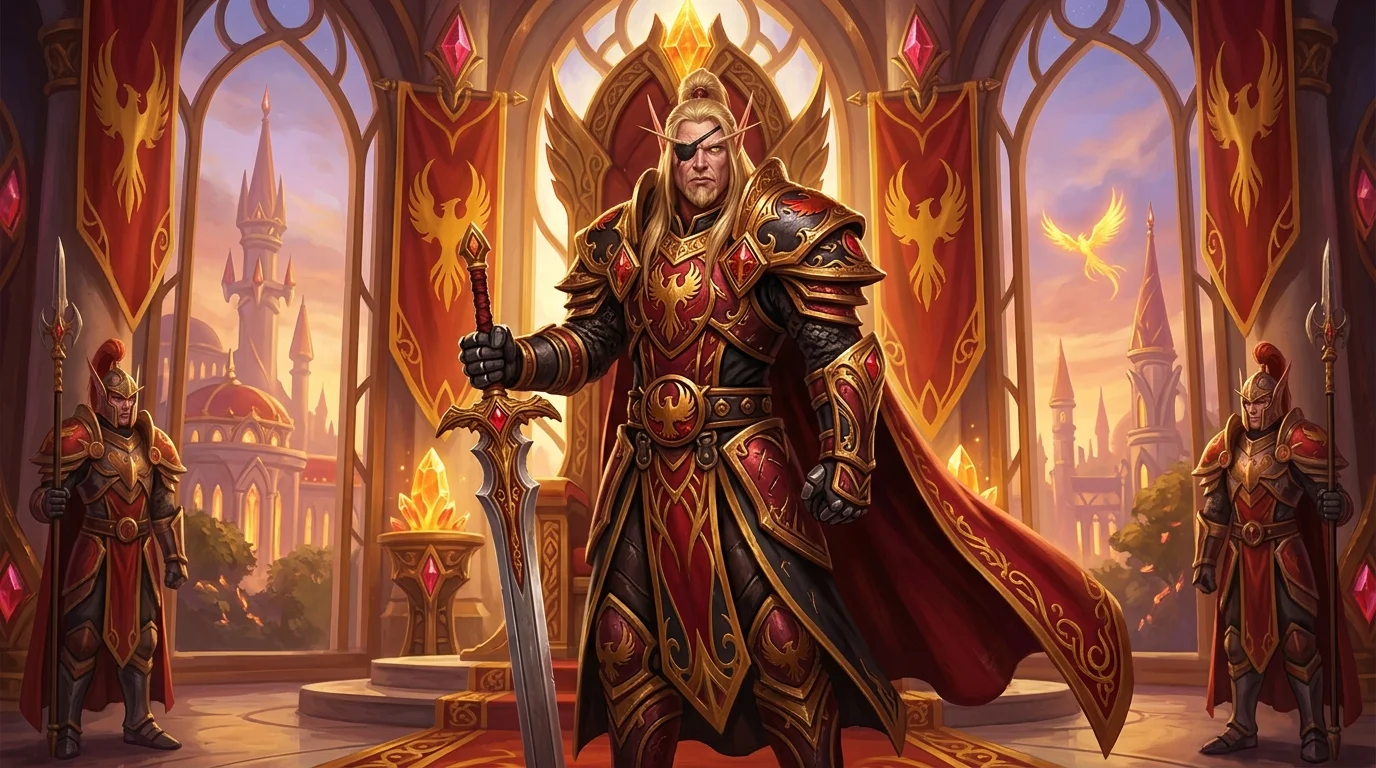
Lor'themar Theron: the regent who never wanted the throne and became the heart of the blood elves
Lor'themar grows in silence — and that's why it works so well
For a long time, Lor'themar Theron was treated by the public as a "minor" leader of the blood elves: present, elegant, efficient, but without the tragic brilliance of Kael'thas or the religious weight of Liadrin. But this reading ignores precisely the best of the character.
Lor'themar is one of the rare WoW leaders who matures without needing massive explosions all the time. He grows by governing. He grows by losing. He grows by holding a traumatized people while almost all the rest of the race is still trying to discover what's left of Quel'Thalas.
The military before the politician
Who was Lor'themar at the beginning
Before becoming regent, Lor'themar was a man of service. His foundation is in the ranks of the Farstriders, in military logic, in defense of the land, and in practical discipline. This matters because it explains much of his later leadership style.
He enters politics neither as a pure idealist nor as a courtly manipulator. He enters as someone used to protecting borders, fulfilling a role and thinking first about collective survival.
Why does this mark the character so much
Lor'themar doesn't look like a classic fantasy king. He looks like someone who took over because someone needed to take over.
This difference shapes everything:
- he talks less than other leaders
- he promises little
- he calculates before acting
- he almost never acts out of theatricality
Leadership by necessity, not by ambition
What happened
After the destruction of Quel'Thalas and Kael'thas' departure for Outland, the sin'dorei urgently needed continuity. Lor'themar takes over as Lord Regent because there was no room for vanity. The kingdom was too broken for that.
Why this is the center of his story
This origin defines the entire character. Lor'themar never enters the role as "fate's chosen". He enters because the world has ended for his people, and someone needs to keep the house standing.
This makes him a very different ruler from characters who treat leadership as an extension of their own ego. Lor'themar rules as one who is always aware that the position came from a tragedy.
What he really inherited from Quel'Thalas
It wasn't just physical ruins
Lor'themar doesn't just inherit a partially destroyed capital. He inherits a nation in mourning, a divided elite, a proud and wounded culture, and an ambiguous relationship with his own allies.
The blood elves weren't just defeated. They were humiliated, hungry for arcane power, resentful of former partners, and trying to decide whether they still existed as a civilization or just as survivors.
His role in all this
Lor'themar's great work was to transform permanence into a project. Before him, there was crisis improvisation. With him, continuity begins to exist.
It's not a clean heroic rebuild. It is a slow, politically difficult and emotionally heavy reconstruction.
Mists of Pandaria: the moment when almost everything changed
What happened
During the Mists of Pandaria arc, Lor'themar comes close to breaking away from Garrosh's Horde and seriously considering a rapprochement with the Alliance. This point is fundamental because it shows that the blood elves' permanence in the Horde was never an automatic or sentimental submission.
It was political calculation. It was historical necessity. And it almost stopped being.
Why this moment matters so much
This is probably the moment in which Lor'themar most reveals his value as a leader.
He is not trapped by empty loyalty. He measures cost, humiliation, opportunity and future. He considers changing blocs because he understands that the survival of his people is worth more than blind loyalty to a corrupt leader.
Even without the change happening, the simple fact that it almost happened reveals a lot about him: Lor'themar has always ruled with pragmatism, not tribal romanticism.
The Purge of Dalaran and the Politics of Resentment
What this phase exposes
The near-return to the Alliance also highlights another important point: blood elves have long memories, and Lor'themar understands this better than almost any other character.
When the Alliance's policy once again touches on the wound of distrust, the rapprochement project collapses. It is not just a momentary diplomatic failure. It is confirmation that old wounds are still open.
What did this do to Lor'themar
This stage hardens his style even more. He was already cautious. After that, he becomes even less willing to hand over the people's future to other people's promises.
Thalyssra and the diplomatic side that became a legacy
What changes with the Nightborne
The Nightborne's entry into the Horde and the relationship between Lor'themar and Thalyssra show a side of the character that many people took a while to notice: he is not just a crisis manager. He is also a builder of affinities.
There is a very strong logic to this approach. The Nightborne and the blood elves recognize themselves in similar traumas: civilizations marked by isolation, arcane dependence, cultural pride and the need to rebuild without disappearing.
Why is this so important
With Thalyssra, Lor'themar is no longer just the man who holds Quel'Thalas. He also becomes the man capable of designing alliances that make civilizational sense, not just military sense.
This is long-range diplomacy, and it suits the character very well.
What makes Lor'themar such a good leader
It's not excessive charisma. It's not brutality. It's not mysticism. It's not a spectacle.
It's constancy.
Lor'themar is the type of ruler that improves player reading when the player stops looking for only explosive characters. It works because:
- almost never reacts on pure impulse
- thinks first about collective stability
- protects sin'dorei autonomy firmly
- accepts changing course when reality demands it
- doesn't need to turn every decision into an epic performance
The heart of blood elves is precisely in this
Lor'themar became the heart of the blood elves because he embodies what the race needed to become to survive.
Not the haughty elves of their heyday. Nor the fanatics in ruin. Nor the traitors seduced by immediate greatness.
He represents the part of civilization that accepted to continue living after the tragedy without pretending that the tragedy never happened.
Why he grew in silence
Lor'themar's rise is silent because his narrative function is also silent: keeping an entire race afloat amid crises that could have reduced it to a prop.
This rarely generates the same attention as a big villain or big fall. But looking back, it's clear that he's one of the most well-sustained leaders of WoW's modern era.
Minimum recommendation
If you want to truly understand Lor'themar, follow this line:
- see who he was before politics: a man of service and discipline
- understand what he inherited after the fall of Quel'Thalas
- read Mists of Pandaria as the point at which he almost changed the fate of the sin'dorei
- observe how he uses diplomacy without giving up autonomy
- see Thalyssra and the Nightborne as proof that his legacy is not just survival, but cultural continuity
Lor'themar never needed to scream to grow. He just had to continue being the man who showed up when everything else fell apart.
Posts Recomendados
Quel'Thalas: elven past, tragedy and the slow post-Scourge reconstruction
Quel'Thalas is home to a people who fell from arcane glory into deep mourning and set out to rebuild a home that was never the same. Learn the story.
Silvermoon: the city that hides its scars behind magic and pride
Silvermoon is sold as an elven jewel and showcase of sin'dorei elegance, yet half the city lies in ruins. Learn the contrast between brilliance and wound.
Saurfang and Dranosh: father and son of the Horde
Varok and Dranosh Saurfang: the son hidden in Nagrand, his death at the Wrathgate, the Deathbringer in ICC and the father who takes him home. Full arc.
Dalaran in Northrend: why the city flew
Dalaran in Northrend: why the Kirin Tor took the city into the sky over Crystalsong, who rules it and what the Violet Hold keeps locked. See the summary.