
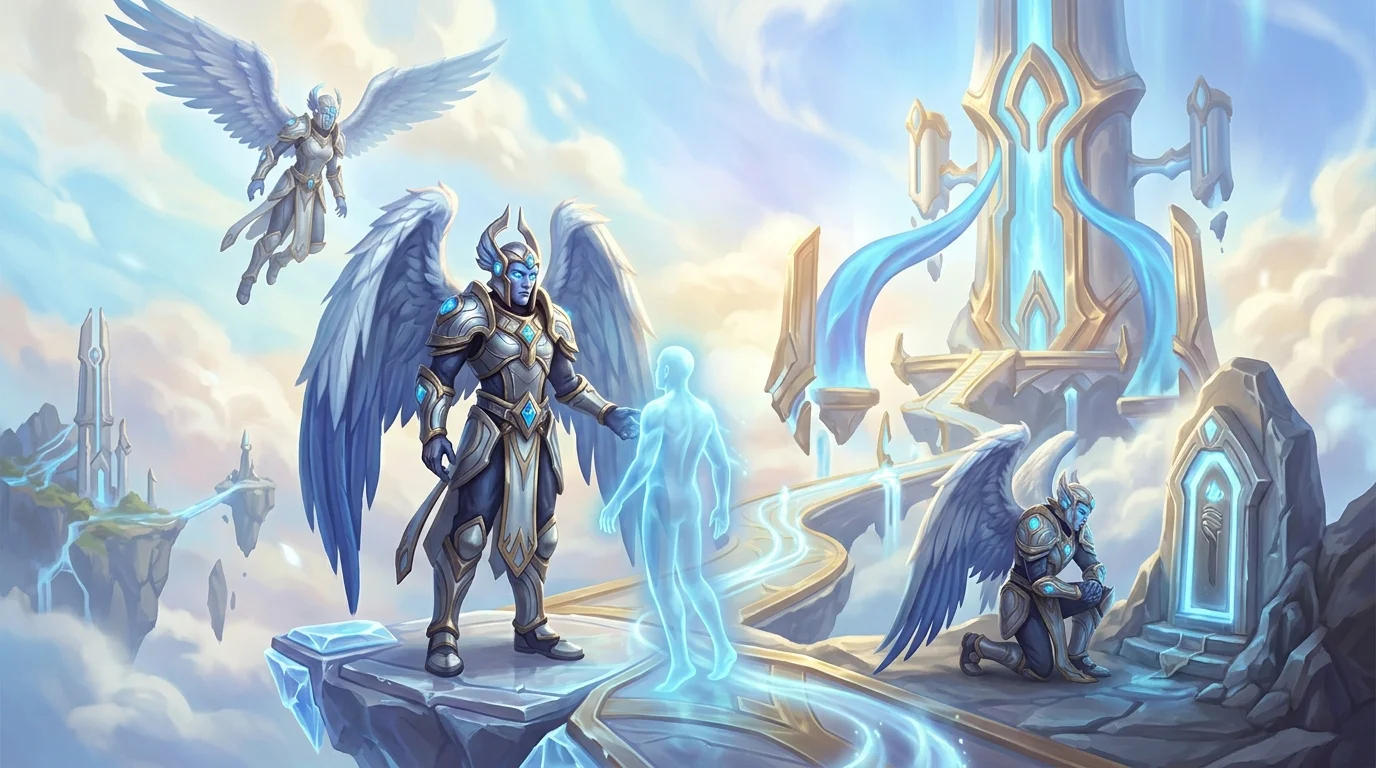
Bastion seems like the purest kingdom in Shadowlands — and for that reason it is one of the most unsettling
At first glance, Bastion is bright, orderly and serene. The souls that arrive there are called to service, discipline and transcendence. But the brilliance of the kingdom hides a difficult question: what needs to be left behind to serve so perfectly?
This is where Bastion gets interesting. The kingdom's problem is not open evil. It's an ethical cost.
Bastion's role in cosmology
Service after death
Bastion welcomes souls inclined to duty, courage, discipline and service. The proposal is that they continue to be useful to the cosmos as kyrian, guiding souls and sustaining the order beyond.
Organized virtue
The kingdom does not value individualism. Values detachment, constancy and clarity of mission. In theory, this protects the service from favoritism, anger and attachment.
The purification ritual
Delete to serve better
To ascend, the soul must give up painful memories, bonds and traits that could compromise its impartiality. This is where Bastion's tension begins.
The logic of the system
The Kyrian argument is coherent: anyone who carries too much attachment may fail in their duty. But the question remains: to what extent does erasing someone's history still preserve the person they chose to serve?
The Forsworn and the internal crisis
Refusal also has logic
The Forsworn are Kyrian and aspirants who reject this total erasure. They do not appear as a caricature. They arise from the friction between duty and identity.
The kingdom reveals its crack
Their existence proves that Bastion is not perfect consensus. It is a system pressured by a radical demand for emotional obedience.
Uther as central case
What was erased and what resisted
Uther is the best example that memory doesn't disappear cleanly. Even when the system attempts to purify the soul for duty, trauma, injustice, and moral wounding continue to exist on some level.
Why this matters
Uther shows that identity is not a removable accessory. When Bastion tries to treat memories as impurity, he encounters the limits of his own model.
The central question of Bastion
Is duty without identity still virtue?
This is the question that defines the kingdom. Bastion is not just about discipline. It's about the risk of transforming virtue into standardization.
If serving requires erasing too much, what is left of moral choice? And if the soul continues to serve, but no longer recognizes where it came from, is this ascension or domestication?
What Bastion represents
| Element | What it reveals | |----------|--------------| | Kyrian | service as supreme ideal | | Purification | detachment elevated to system | | Forsworn | the political cost of erasure | | Uther | ritual-resistant memory | | Bastion | virtue under ethical tension |
Minimum recommendation
Bastion works best when you read the kingdom as a debate about duty, not as blue skies without conflict.
The zone doesn't just ask who serves.
He asks what a soul needs to lose to be able to serve like that.
Posts Recomendados
Revendreth as a Redemption Study: What the Venthyr Really Do to Souls
Revendreth is the realm of proud and guilty souls, run by the Venthyr. His promise is redemption; its danger is to transform atonement into a system of power.
Magtheridon: the pit lord of Hellfire Citadel
Who is Magtheridon: the pit lord who ruled Outland, lost the Black Temple to Illidan and became the blood source for fel orcs in Hellfire Citadel.
Saurfang and Dranosh: father and son of the Horde
Varok and Dranosh Saurfang: the son hidden in Nagrand, his death at the Wrathgate, the Deathbringer in ICC and the father who takes him home. Full arc.
Dalaran in Northrend: why the city flew
Dalaran in Northrend: why the Kirin Tor took the city into the sky over Crystalsong, who rules it and what the Violet Hold keeps locked. See the summary.