
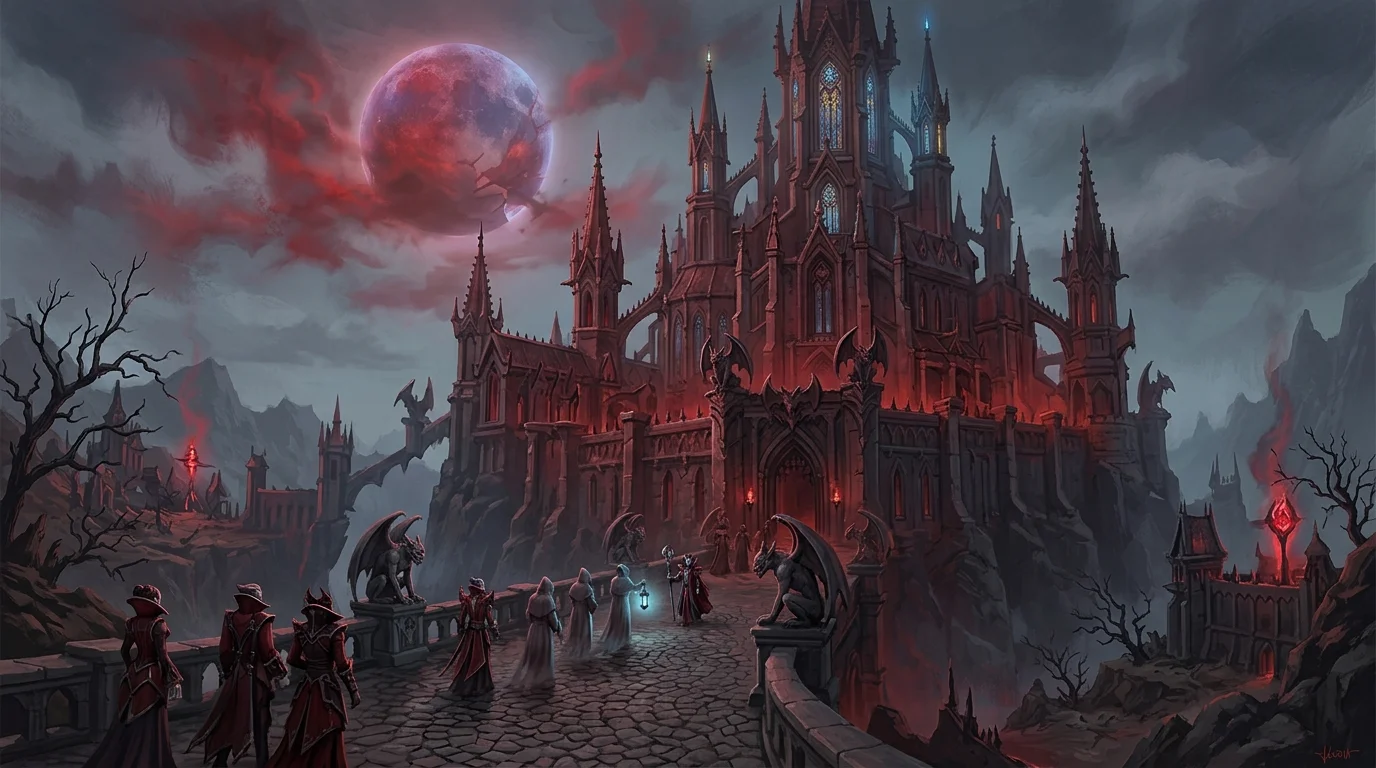
Revendreth as a Redemption Study: What the Venthyr Really Do to Souls
Revendreth is a moral idea before being a gothic aesthetic
It's easy to remember Revendreth for the castles, the vampiric atmosphere and the immense figure of Denathrius. But the heart of the kingdom is different: Revendreth exists to break pride, confront guilt and try to redirect souls who did a lot of harm in life.
That's why the place is so interesting. He doesn't work with innocence. It works with guilt, insistence, resistance and the most difficult question in Shadowlands: can someone who doesn't want to change be saved?
Revendreth's place in cosmology
The kingdom of atonement
Revendreth welcomes souls marked by excess, cruelty and pride. The objective is not to punish them through pure torture. It is to force them to face their sins and, if possible, reform them.
Redemption with deadline and pressure
The problem is that the process is not gentle. The venthyr system mixes ritual, humiliation, psychological pressure and anima drainage. The promise is transformation. The risk is abuse legitimized by salvation language.
What Venthyr Really Do
Blame administrators
Venthyr are aristocratic overseers of an atonement system. They guide, judge, test and harvest anima. In theory, this process strengthens the kingdom and gives the soul a chance to reform.
Redemption and usefulness
The central ambiguity is here: Revendreth wants to save souls, but he also depends on them. When a system needs to extract something from the sinner to continue functioning, the line between reform and exploitation becomes dangerous.
Sire Denathrius and the collapse of trust
The founder who betrays his own purpose
Denathrius was supposed to be a guarantee of order. Instead, he reveals himself to be a traitorous ally of Zovaal, diverting anima and sabotaging the balance of the Shadowlands.
What does this reveal
His betrayal exposes the gravest possible flaw: even a kingdom created to deal with pride and deviance can be ruled by someone dominated by both.
The power structure in Revendreth
Harvester, Stoneborn and Dredgers
Revendreth is not just Venthyr nobles in castle. The kingdom works in layers: district reapers, stoneborn as an elite force, and dredgers as a hard-working, expendable base.
Reform is also institutional
When Denathrius falls, the issue is not just about changing rulers. It means rethinking the entire structure. A kingdom of redemption cannot continue to be sustained by arbitrariness, terror and tacit servitude.
Revendreth's central question
Can you redeem those who don't want to be redeemed?
That's the best question in the kingdom. Revendreth offers no simple answer. Some souls learn, others resist, others manipulate the system, others fall apart.
This is what makes Revendreth more than just a “vampire zone”. He is a moral experiment staged as aristocratic bureaucracy.
What Revendreth stands for
| Element | What it reveals | |----------|--------------| | Venthyr | ritual administration of guilt | | Sinstone | objective memory of sins | | Denathrius | corruption at the top of the system | | Stoneborn/Dredgers | hierarchy and structural cost | | Renathal and the rebellion | redemption also for the kingdom itself |
Minimum recommendation
Revendreth works best when you read kingdom as a debate about redemption rather than just stylish punishment.
The point is not “who suffers”.
The point is who really changes — and who turns guilt into an instrument of power.
Posts Recomendados
Bastion and the Price of Duty: What the Kyrian Give Up to Serve
Bastion promises purity, service and ascension, but to become Kyrian the soul must give up deep memories and pain. Is duty still virtuous at such a cost?
Maldraxxus and the militarization of death: the five houses and the logic of survival in the afterlife
Maldraxxus is the army of the Shadowlands: strength, ambition and necromancy defend the afterlife or rot it when command turns corrupt. Learn more.
Magtheridon: the pit lord of Hellfire Citadel
Who is Magtheridon: the pit lord who ruled Outland, lost the Black Temple to Illidan and became the blood source for fel orcs in Hellfire Citadel.
Saurfang and Dranosh: father and son of the Horde
Varok and Dranosh Saurfang: the son hidden in Nagrand, his death at the Wrathgate, the Deathbringer in ICC and the father who takes him home. Full arc.