
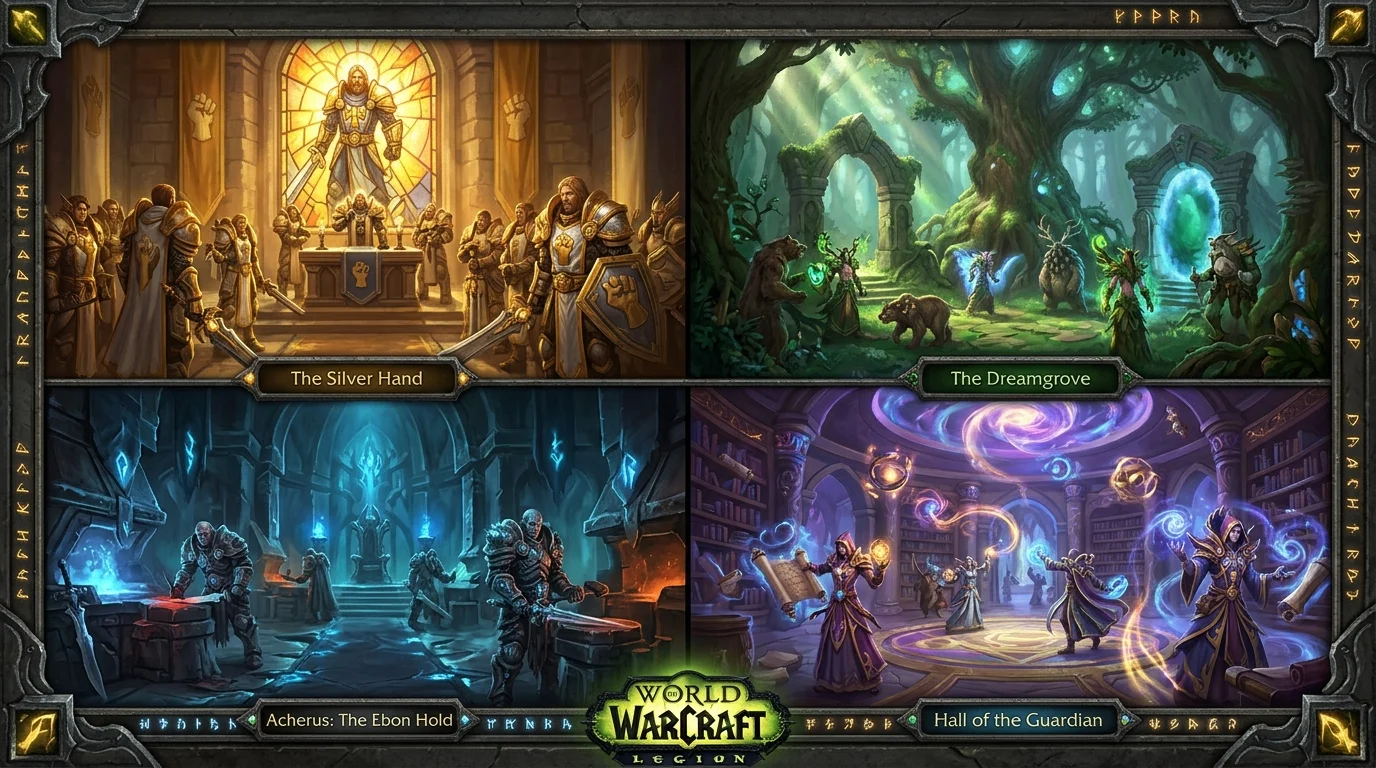
Legion's big idea
Legion starts from a simple and brilliant premise: the Burning Legion is too big to fit into just the old faction frames. Horde and Alliance continue to exist, but they are no longer enough to organize the sense of resistance. To face the enemy, each class needs to rediscover its own tradition and mobilize its own war.
This is where Class Halls are born as the best practical expression of class fantasy that the game has ever had.
Each class gets a house, memory and function
Class Halls are not just pretty bases. They function as a declaration of identity. Each space says something about what that class considers sacred, strategic, or natural. Paladins do not come together in the same tone as rogues. Mages don't plan war like shamans. And this finally appears in concrete form.
Legion understands that class is not just about rotation. It's an institution.
Leaders and why they matter
Another success was to link these orders to coherent leadership. Darion with the death knights, the Illidari with their echoes of Illidan, paladins carrying the weight of Tirion and the entire tradition of the Light, druids and hunters anchored in their own tutelary figures. Not every arc had the same brilliance, but almost everyone was right when they said: class is also genealogy.
When there is the right leadership, the fantasy gains legitimacy.
Each order had more than “kill the Legion”
This is perhaps the best thing about the system. The orders were not just mini-armies repeating the same objective. Each had internal issues: recovering artifacts, restoring prestige, reorganizing rituals, healing historical wounds, dealing with one's past or reinventing the present.
That's why the expansion seemed bigger than it was. You weren't just experiencing the war on Azeroth. He lived the specific war of his class.
Why it worked so well in that context
The Class Halls worked because Legion was full crisis expansion. When the world is on the brink of cosmic collapse, it makes sense for deep traditions to step out of the background and into the forefront. In more “local” or more strongly regional expansions, repeating this would be more difficult.
In other words: the system was also incredible because it found the exact context.
Why was it never repeated in the same way
Repeating Class Halls would require, once again, investing in class identity as the central narrative axis. This costs a lot in production, writing, art and systemic coherence. Legion succeeded because it chose to go all-in on this fantasy. Other expansions preferred to return to a more unified focus.
It's a shame, but it also explains why the system remains special. It didn't become routine and, therefore, it aged better.
Minimum recommendation
If you want to understand why Legion is so loved by so many people, look at the Class Halls. They did something rare: they convinced the player that their class was not just a combat role, but a living order with a history, duty, and voice of its own.
Posts Recomendados
Demon Hunters and Illidan's legacy: the class that sells its soul to save the world
Demon hunters are Warcraft's class of voluntary sacrifice: to defeat evil, they accept carrying part of it within themselves. Learn Illidan's legacy.
How each class sees war in Azeroth: perspectives and identity conflicts
The class fantasy in WoW is pure lore: each class enters the same battlefield for different reasons and interprets war through a different moral lens.
Saurfang and Dranosh: father and son of the Horde
Varok and Dranosh Saurfang: the son hidden in Nagrand, his death at the Wrathgate, the Deathbringer in ICC and the father who takes him home. Full arc.
Dalaran in Northrend: why the city flew
Dalaran in Northrend: why the Kirin Tor took the city into the sky over Crystalsong, who rules it and what the Violet Hold keeps locked. See the summary.