
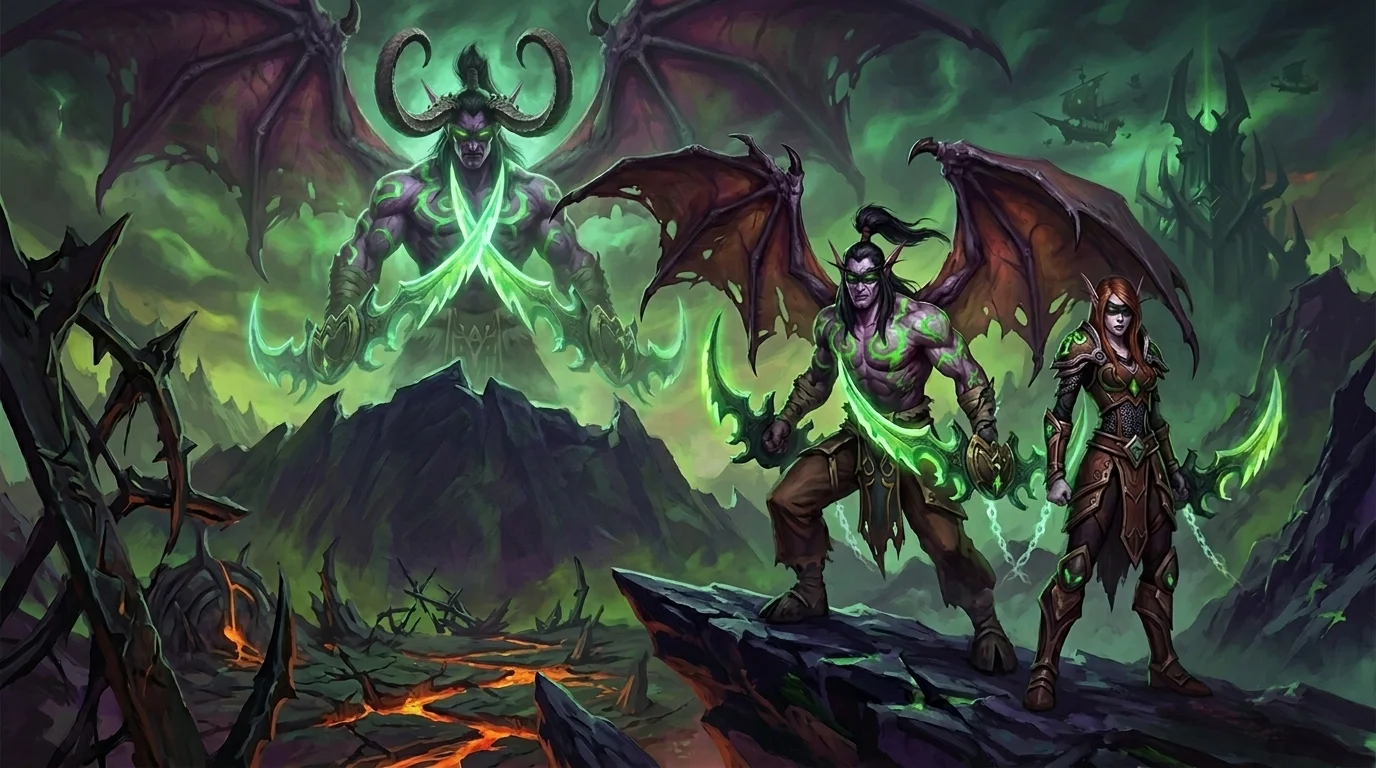
Demon Hunters and Illidan's legacy: the class that sells its soul to save the world
Consuming evil is not the same as serving it
The heart of the demon hunter fantasy is the difference between corruption and instrumentalization. They do not use gall because they have been seduced by it. They use it because they concluded that certain enemies can only be defeated by those who accept mutilating their own purity. This is the central thesis inherited from Illidan.
This is why the class is so strong in lore. She lives on the border between heroism and monstrosity without trying to appear comfortable.
The creation ritual
Becoming a demon hunter is not about learning a technique. It is going through a process that destroys the previous identity and rebuilds it around extreme discipline, pain and obsession. The aspirant sacrifices his body, stability and social reputation before even proving that he will survive.
This puts the class in a unique place. Almost no one on Azeroth sees a demon hunter and thinks “there’s a safe hero”. They think “there’s someone willing to pay the price that I wouldn’t pay”.
Demonic vision and the exchange of eyes
Blinding the physical eyes to see gall energy, demons and hidden patterns is a deeply symbolic gesture. The demon hunter gives up seeing the world like others to see it as permanent war. Perception changes, and with it the way of belonging also changes.
They fail to fully participate in normality. They exist to monitor what others would prefer not to face all the time.
The Illidari arrested and returned to the world
Time in prison is an important part of their identity. As Azeroth continued to spin, the Illidari remained frozen as contained danger and deferred instrument. When Legion returns them to the stage, they reappear not as new, but as ancient promise finally released.
This reinforces the feeling of displacement. Demon hunters are too useful to ignore and too strange to fully embrace.
Accepted, but never trusted
Few classes experience this tension so clearly. Demon hunters can fight alongside heroes, save cities and defeat cosmic threats, but they continue to be viewed with suspicion. And, perhaps most importantly, they rarely seek acquittal. They don't expect to be loved. They hope to be needed.
This sets them apart from many traditional heroic fantasies. Their reward is not recognition. It's effectiveness.
Illidan's legacy
All of this only exists because Illidan created an entire philosophy around cost. His legacy is not just “hunting demons.” It is to support the idea that, in some wars, moral purity can be a form of impotence. Demon hunters live this thesis in their bodies.
It is a dangerous but coherent legacy. And it is precisely this dark coherence that makes the class unforgettable.
Minimum recommendation
If you want to understand demon hunters beyond aesthetics, stop seeing them as “rogues with horns and gall”. They are, in lore, the class of deliberate sacrifice: people who chose to partially lose themselves to prevent the world from being completely lost.
Posts Recomendados
Illidan: the novel that retold the story of the Lord of the Illidari from his perspective
The novel Illidan doesn't absolve its hero, but it changes the question: what if what we call his fall was preparation for the right war? Learn more.
Class orders in Legion: when each class organized its own war
Class orders in Legion made each class feel like a living tradition, with its own headquarters, leadership, memory and goals within the same war.
Saurfang and Dranosh: father and son of the Horde
Varok and Dranosh Saurfang: the son hidden in Nagrand, his death at the Wrathgate, the Deathbringer in ICC and the father who takes him home. Full arc.
Dalaran in Northrend: why the city flew
Dalaran in Northrend: why the Kirin Tor took the city into the sky over Crystalsong, who rules it and what the Violet Hold keeps locked. See the summary.