
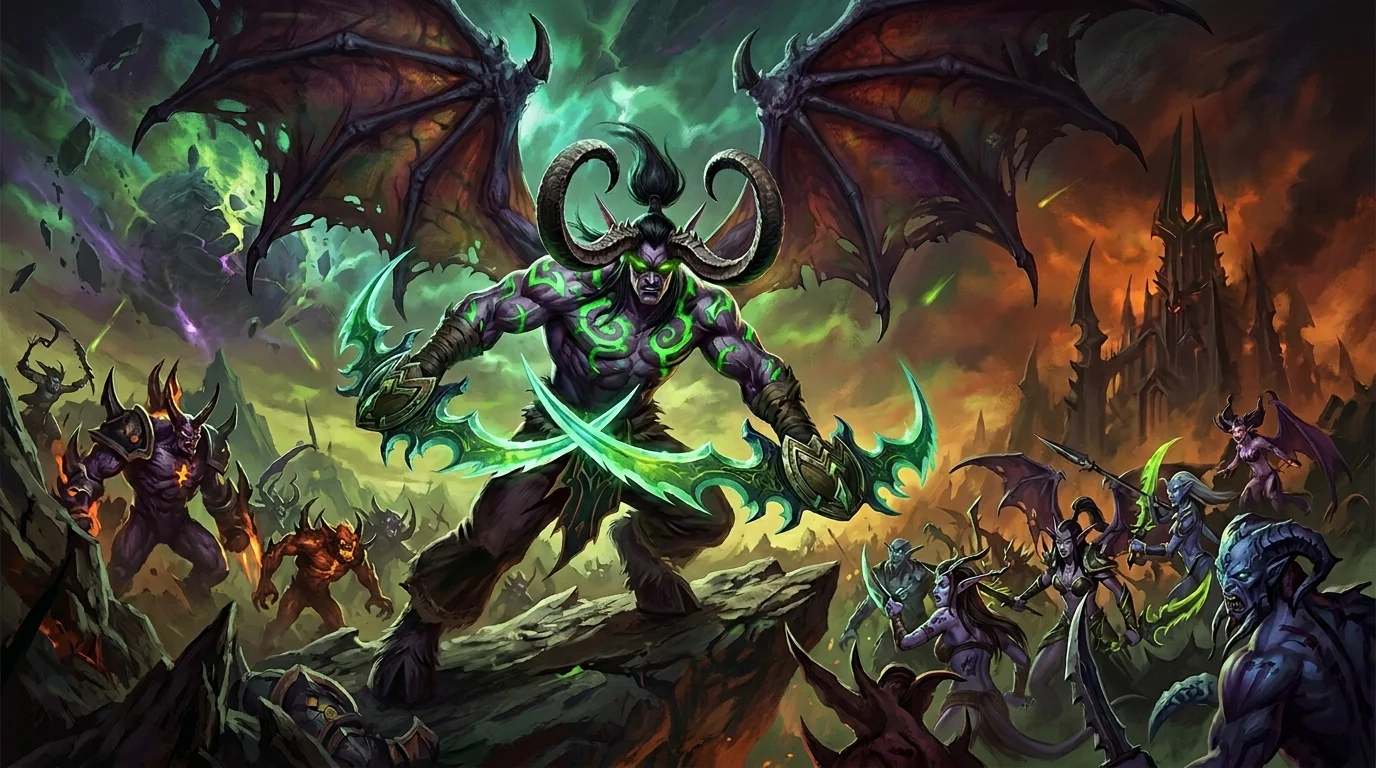
Illidan: the novel that retold the story of the Lord of the Illidari from his perspective
The book that changes TBC reading
Illidan works because it does what few tie-ins can: it doesn't repeat the game, it rearranges the game. The Burning Crusade featured Illidan primarily as a powerful antagonist in Outland. The novel asks whether that was the whole story or just the part that others were able to see.
This shift changes everything. The reader leaves the book without being able to treat Illidan as a simple raid villain.
What romance does differently
The book's greatest strength is placing the reader close to Illidan's logic. Not to make it pleasant. To make it intelligible. He remains tough, manipulative, willing to go beyond intolerable limits. The difference is that now we understand that this came from a project: preparing the war against the Legion long before Azeroth was ready for it.
It is this strategic advance that redefines the character.
The secret mission against the Legion
The novel insists on a central idea: Illidan was not just accumulating power in Outland out of vanity. He gathered resources, allies and instruments because he saw the Burning Legion as a war that was impossible to win with comfortable morality. Fel orcs, naga, exiled blood elves, demon hunters — everything falls into the same mindset of extreme warfare.
That doesn't make his methods clean. Make them coherent.
Maiev from Illidan's perspective
Another merit of the book is adding tragedy to the conflict with Maiev. From Illidan's eyes, she's not just an obsessive stalker; it is also the face of a past that will never let it escape. At the same time, that look doesn't erase the damage he caused to her and the night elf people.
The novel is strong because it avoids simplification. It does not ask the reader to choose the easy side. It asks you to accept that two people destroyed by the same past can remain right and wrong at the same time.
The Illidari as a conscious choice
One of the most important points is the way the book frames the Illidari. They do not appear as simple masses enslaved by a tyrant. They appear as a group created under a clear philosophy: to use the Legion's horror against the Legion itself, accepting mutilation, stigma and the risk of corruption as the price.
This brings demon hunters closer to an almost religious vocation. Not of purity, but of deliberate sacrifice.
Misunderstood hero or dangerously necessary man?
The novel greatly improved Illidan's image, but the most honest reading is not “in fact he was always a perfect hero”. The correct reading is more interesting: Illidan saw too soon a war that was too big and agreed to deform himself to face it. This made it necessary — and also dangerous.
It is precisely this ambiguity that makes the book work so well.
Minimum recommendation
Read Illidan if you want to review TBC with different eyes. The novel does not erase the character's atrocities, but it shows that calling everything personal ambition was understanding only half the problem. And half, in this case, was too little.
Posts Recomendados
The Tomb of Sargeras: the audio drama that connects the end of TBC to the beginning of Legion
The Tomb of Sargeras shows Khadgar, Maiev and Illidan's body at the point where TBC stops being the past and becomes the plan for Argus. Learn more.
Demon Hunters and Illidan's legacy: the class that sells its soul to save the world
Demon hunters are Warcraft's class of voluntary sacrifice: to defeat evil, they accept carrying part of it within themselves. Learn Illidan's legacy.
Magtheridon: the pit lord of Hellfire Citadel
Who is Magtheridon: the pit lord who ruled Outland, lost the Black Temple to Illidan and became the blood source for fel orcs in Hellfire Citadel.
Saurfang and Dranosh: father and son of the Horde
Varok and Dranosh Saurfang: the son hidden in Nagrand, his death at the Wrathgate, the Deathbringer in ICC and the father who takes him home. Full arc.