
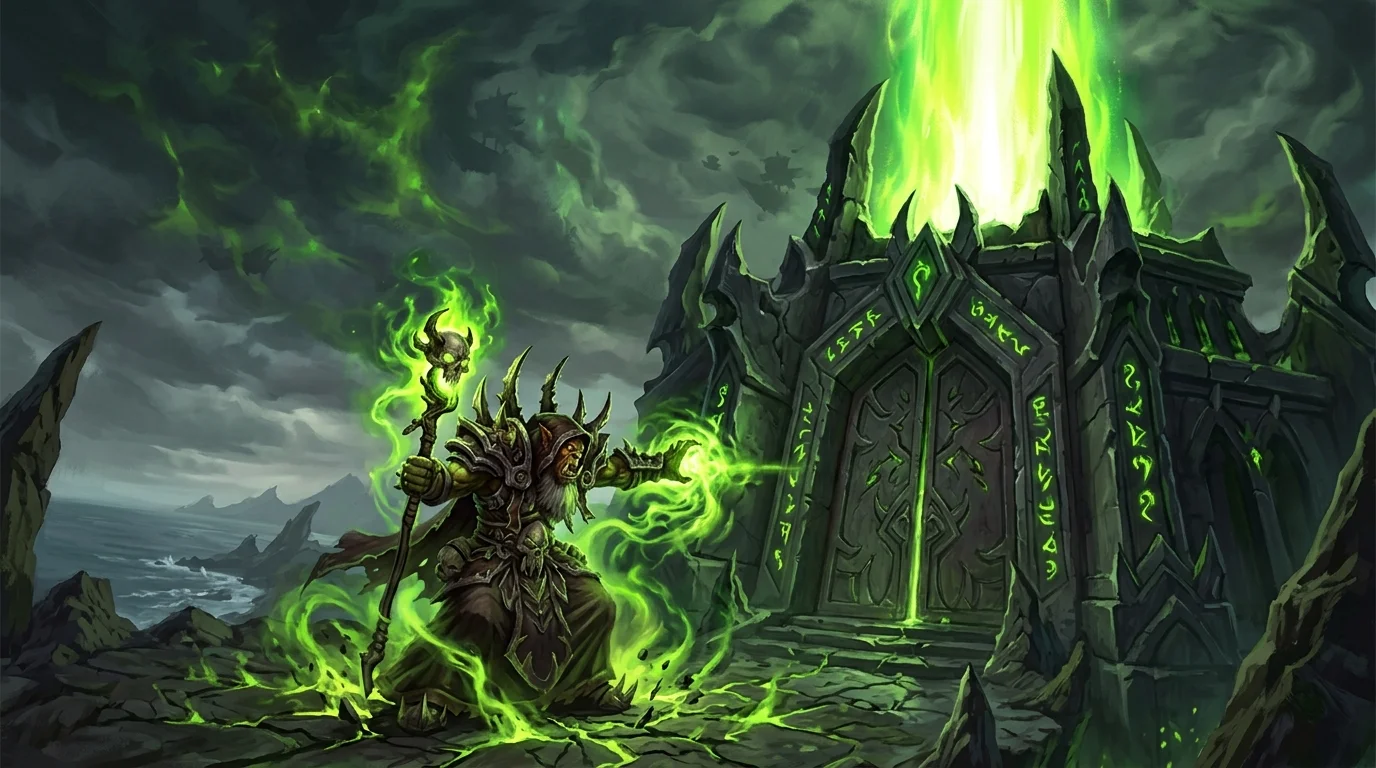
The Tomb of Sargeras: the audio drama that connects the end of TBC to the beginning of Legion
The prologue that ties together two expansions
The Tomb of Sargeras works best when read as a transitional piece. It’s not just “another promotional media” for Legion. It is the point at which Illidan's defeat in The Burning Crusade stops being a closed ending and starts to be reinterpreted as an interval. Khadgar understands that the next war will not be won with armies alone, but with someone willing to go further than traditional heroes can.
This is why the audio drama is so important: it transforms Illidan's body from a trophy of the past to a centerpiece of the future. Without this bridge, his return in Legion seems like a spectacle. With this bridge, it looks like planning.
What happens in the audio drama
The plot follows Khadgar chasing Gul'dan from Draenor to the Broken Isles to prevent the Tomb of Sargeras from becoming an open door for an even greater invasion. Along the way, he needs to deal with the history of the place itself and with the distrust of Maiev Shadowsong and the Wardens. In the end, Gul'dan wins: he breaks the tomb's seals, defeats Khadgar and opens the way for the Legion's third invasion. Maiev falls back to reinforce the Vault of the Wardens, where Illidan's body lies — which Gul'dan steals soon after, at the start of Legion.
The entire drama works on this tension: Khadgar arrives late and alone. He understands that, in the face of the Legion, comfortable morality is not enough. War calls for extreme instruments.
What existed in the Tomb of Sargeras before Gul'dan
The Tomb was a place of containment long before Gul'dan arrived. Aegwynn defeated Sargeras' avatar and sealed him there because the risk was too great to ignore and too great to simply destroy. The place carried ancient power, night elf ruins and an almost ritual function as a prison.
This changes the reading of Legion. Gul'dan doesn't open “just one tomb”. It breaks a lock that existed to prevent exactly what happens: the transformation of the place into a portal and bridgehead for the return of the Burning Legion.
Why Khadgar needed Illidan
Khadgar realizes something that almost everyone on Azeroth prefers to deny: Illidan was morally disastrous, but strategically coherent. He was already thinking about all-out war against the Legion when the rest of the world was still tied up in local disputes, personal suspicions and incomplete readings about Outland.
Bringing Illidan back was not a sentimental gesture. It was admitting that the plan to reach Argus, hurt the Legion at its source and fight outside conventional logic needed someone who would accept paying costs that other heroes would refuse.
Maiev Shadowsong and the tension between duty and revenge
Maiev is essential because it prevents the audio-drama from becoming a simple “easy redemption” of Illidan. For her, watching Illidan was never a bureaucratic detail. It was mission, identity and personal wound. When, later in Legion, the idea of bringing Illidan back gains strength, the conflict is not just tactical: it is moral.
That's where the story gets good. Maiev represents the memory of all the damage Illidan caused. Khadgar represents the brutal necessity of the present. Neither is completely wrong. And Legion was born precisely from this friction.
How the story closes TBC and opens Legion
The great merit of The Tomb of Sargeras is to clear the passage between two moments that, in pure play, may seem misaligned. In TBC, Illidan ends up as a defeated antagonist. In Legion, he reemerges as a decisive figure in a larger war. The audio drama explains this change without erasing the ambiguity of it.
In the end, what this work says is simple: Azeroth won too many battles by thinking small. To truly face the Legion, it would be necessary to revisit even the defeated enemies and ask if the world had misunderstood who they were.
Minimum recommendation
If you want to understand Illidan's return cleanly, read The Tomb of Sargeras before rereading the Legion arc. It's the best bridge between the end of TBC and the beginning of the war for Argus — and it makes Khadgar seem more lucid than any trailer has managed to show.
Posts Recomendados
Illidan: the novel that retold the story of the Lord of the Illidari from his perspective
The novel Illidan doesn't absolve its hero, but it changes the question: what if what we call his fall was preparation for the right war? Learn more.
Harbingers: Gul'dan, Khadgar and Illidan — the three trailers that prepared Legion
Harbingers didn't set up Legion with empty spectacle, but with motivation, weariness, ambition and retrospect. Learn why the shorts still work so well.
Magtheridon: the pit lord of Hellfire Citadel
Who is Magtheridon: the pit lord who ruled Outland, lost the Black Temple to Illidan and became the blood source for fel orcs in Hellfire Citadel.
Saurfang and Dranosh: father and son of the Horde
Varok and Dranosh Saurfang: the son hidden in Nagrand, his death at the Wrathgate, the Deathbringer in ICC and the father who takes him home. Full arc.