
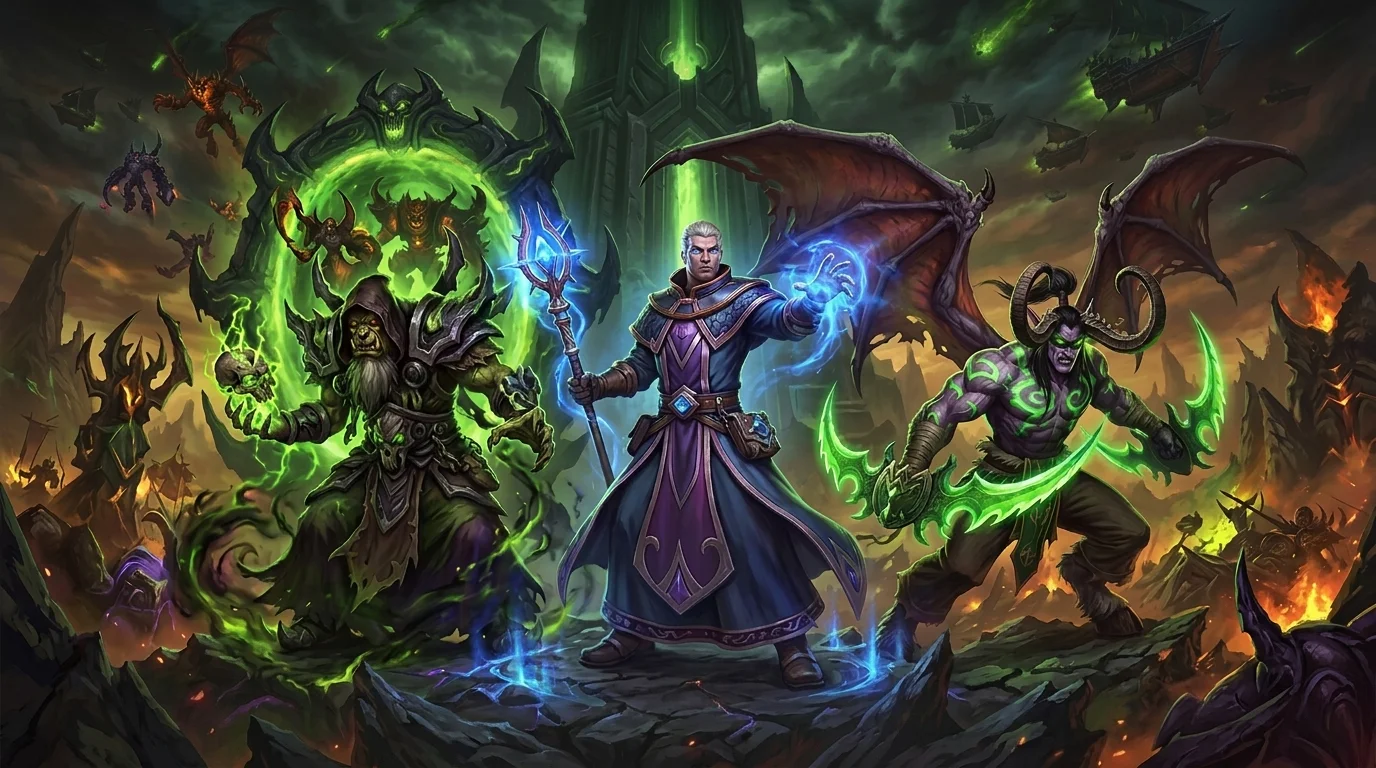
Harbingers: Gul'dan, Khadgar and Illidan — the three trailers that prepared Legion
Legion needed motivation, not just green fire
When the Burning Legion returns, the risk is always the same: everything seems too big and too little personal. Harbingers avoided this problem. Instead of selling Legion solely on demonic invasion and visual impact, the series chose three characters who represent three different ways of responding to the disaster.
Gul'dan, Khadgar and Illidan aren't just promotional pieces. There are three expansion reading keys.
The Harbingers format
Harbingers works as a miniseries of shorts focused on characters central to Legion. The idea is simple: before the war starts on a full scale, show the mind of those who are already moving the board.
Why the format works
It avoids the common mistake of a generic trailer. Each video has its own identity, conflict and rhythm. This means that the audience doesn’t arrive at Legion thinking just “the Legion is back”, but also:
- who serves it;
- who tries to contain it;
- who intends to use war for a greater purpose.
Gul'dan: corruption as origin and destination
The Gul'dan episode is perhaps the most direct in the task of contextualizing the threat.
What he condenses so well
In just a few minutes, the short reactivates all of the character's logic: weakness transformed into resentment, resentment converted into a pact, a pact elevated to absolute ambition. Gul'dan is not just a powerful warlock. This is someone who exchanged belonging for power and never knew how to exist outside of that logic.
Why this matters for Legion
Because Legion needed Gul'dan to be more than the Legion's messenger. Harbingers guarantees this. It gives the character back a clear emotional origin and makes his presence on Azeroth feel inevitable, not arbitrary.
Khadgar: the exhausted wizard who still continues
Khadgar's short is perhaps the least “explosive” and that is precisely why it works so well.
What it reveals
Khadgar is not presented as a triumphant archmage. He appears as someone tired, aged by duty and the accumulation of catastrophes. This gives the character a different dignity. He is not the fantasy of the invulnerable sage. It is the veteran who continues because someone needs to continue.
The value of this in Legion
This approach helps Legion gain narrative credibility. When Khadgar enters the scene, the player feels like he is standing next to someone who has seen too much tragedy and still chose to stay.
Illidan: recontextualization rather than simple return
The Illidan episode is perhaps the most important in the series in terms of historical repositioning.
What does he do
He takes everything that has been fragmented since The Burning Crusade and rearranges the character's image. Illidan stops looking like just the anti-hero defeated in an ancient raid and is once again seen as a figure of project, fanaticism, sacrifice and obstinacy.
Why this was essential
Without this short, many people would arrive at Legion still stuck on an old Illidan reading. Harbingers fixes this. Not erasing his excesses, but replacing them within a greater logic: Illidan always believed that the extreme price was justifiable in the face of an extreme threat.
What Harbingers does better than regular trailer
The great merit of the series is showing motivation. It's not enough to know that Gul'dan is corrupt, that Khadgar is powerful and that Illidan has returned. The audience needs to feel why everyone enters Legion with such a different position.
Axes that the series builds
- Gul'dan: submission to power and hunger for more.
- Khadgar: tired responsibility.
- Illidan: radicalism as a mission.
These three axes explain the expansion better than much expository text.
Harbingers is more effective than many trailers because it thinks character first
It's easy to make a beautiful Legion trailer. Green sky, portals, giant demons, armies. Harbingers chooses not to depend on it.
The real gain
You enter Legion feeling like the war already had a history before it exploded in front of you. This is what separates loud expansion from memorable expansion.
Khadgar's place in the trio
Many people remember Gul'dan and Illidan more, but Khadgar is a central piece because he represents the player's perspective on the crisis. He is neither a servant of the Legion nor a warrior willing to sacrifice everything. He is the exhausted mediator between disaster and resistance.
Without Khadgar, the series would lose balance.
The legacy of Harbingers
Even years later, Harbingers continues to work because its shorts don't just rely on release hype. They remain good as standalone character pieces.
Minimum recommendation
See Harbingers as Legion's psychological prologue. The value of the series is not only in “preparing for expansion”, but in showing that a good war needs clear minds behind it. Gul'dan, Khadgar and Illidan define Legion precisely because they carry three incompatible responses to the same catastrophe.
Posts Recomendados
Gul'dan, Hellfire Citadel and the bridge to Legion
Gul'dan takes over the end of Warlords of Draenor. Hellfire Citadel does not just close the war on Draenor: it delivers the enemy who reopens Legion.
Illidan: the novel that retold the story of the Lord of the Illidari from his perspective
The novel Illidan doesn't absolve its hero, but it changes the question: what if what we call his fall was preparation for the right war? Learn more.
Magtheridon: the pit lord of Hellfire Citadel
Who is Magtheridon: the pit lord who ruled Outland, lost the Black Temple to Illidan and became the blood source for fel orcs in Hellfire Citadel.
Saurfang and Dranosh: father and son of the Horde
Varok and Dranosh Saurfang: the son hidden in Nagrand, his death at the Wrathgate, the Deathbringer in ICC and the father who takes him home. Full arc.