
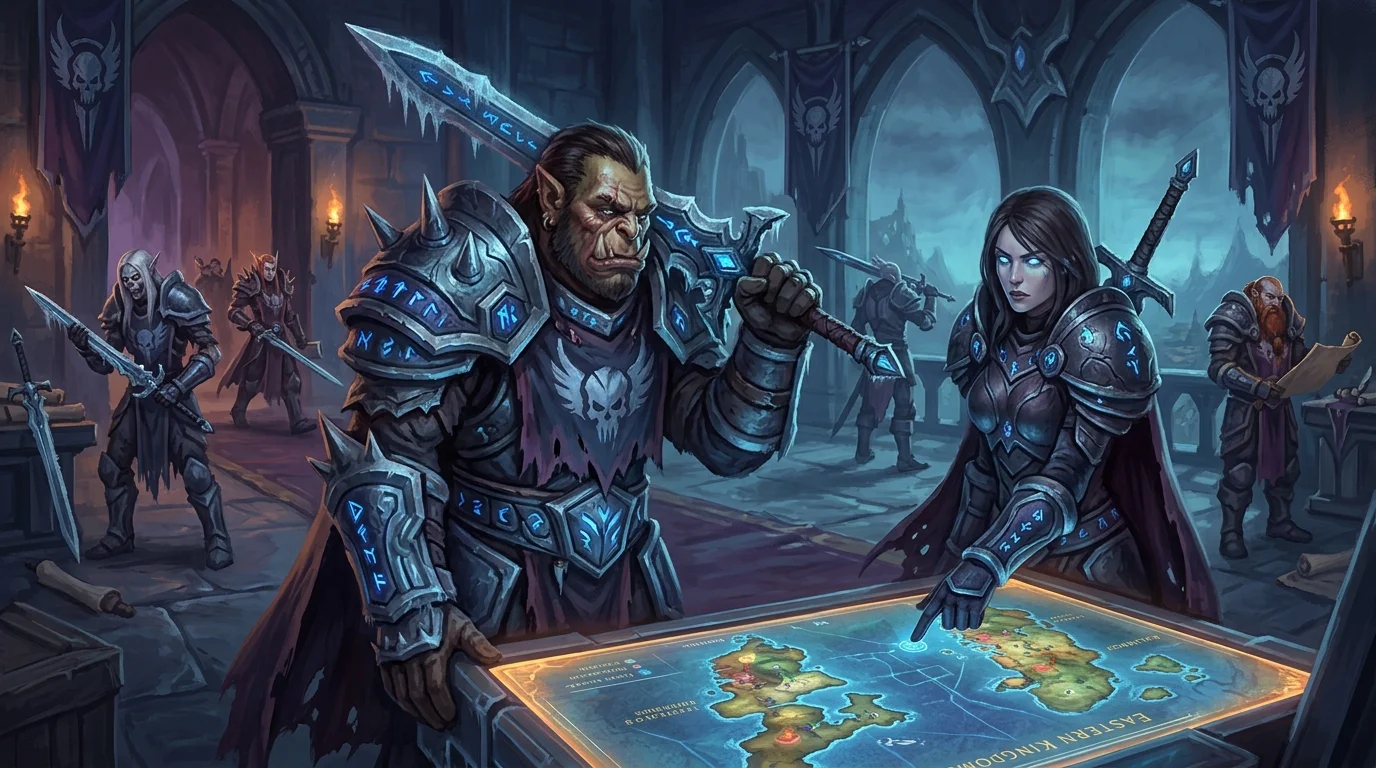
Death Knights after Arthas: who they are when the Lich King is no more
The question that defines post-Wrath DKs
The death knights' biggest identity crisis is not power or combat. It's purpose. They were created to serve, kill and obey. When Arthas falls, liberation does not produce inner peace. Produces functional void. What does someone made to be a weapon do when the hand that wielded it disappears?
This is the great strength of the Ebon Blade: transforming survivors into order.
The problem of existing without the master
Many heroes lose an enemy and move on. Death knights don't. They lose the structure that explained why they were made. This does not erase guilt, memory or compulsion. It only removes the centralization of violence. The result is a class condemned to construct ethics after having been manufactured to live without it.
This makes DKs one of the most adult fantasies in Warcraft.
The Ebon Blade as an answer
Knights of the Ebon Blade addresses this void by offering something better than obedience: chosen mission. It is not complete redemption, nor a return to a previous life, nor full social acceptance. It's direction. Under Darion Mograine and later in different campaigns, the death knights began to act as an autonomous force that still uses dark means, but in the name of protecting Azeroth.
This change matters a lot. The DKs stop being remnants of the Scourge and become an order with their own agenda.
Death in Shadowlands
Shadowlands deepens the fantasy of the class because it touches on the domain of death itself. When the machinery of the afterlife goes into crisis, the DKs stop being just experts in military necromancy and start to look like people who inhabit an epistemological frontier: they deal with death as a job at a time when death itself is broken.
This makes the class even stranger — and more relevant.
Souls, runeblades and obligations
There is also the ethical dimension of weapons. Death knights are not warriors with just any dark sword. They carry runeblades, echoes, soullinks, and ritualized violence. This creates an inevitable question: does using this power impose duties? The lore rarely responds directly, but the best reading is that it does.
DKs are not free to live as if nothing has been done in their names or by their hands.
What does it mean to be a death knight today
Today, the death knight is something between useful hero, disciplined corpse and guardian that will never be completely comfortable for anyone. He is no longer a servant of the Lich King, but he is also not a “normal” champion of Azeroth. It exists in a moral middle zone.
And maybe that's what makes the class so good. It does not promise purity. It promises continuity under unbearable weight.
Minimum recommendation
Read the post-Arthas death knights as a study of autonomy, not as simple “former villains now good”. Their drama is more interesting: learning to act on their own after being forged precisely to choose nothing.
Posts Recomendados
Ashbringer: the comic that tells the complete saga of the sacred sword
Few Warcraft works unite faith, tragedy, betrayal and redemption as well as Ashbringer. The comic is the emotional backbone of the entire Mograine lineage.
Class orders in Legion: when each class organized its own war
Class orders in Legion made each class feel like a living tradition, with its own headquarters, leadership, memory and goals within the same war.
Saurfang and Dranosh: father and son of the Horde
Varok and Dranosh Saurfang: the son hidden in Nagrand, his death at the Wrathgate, the Deathbringer in ICC and the father who takes him home. Full arc.
Dalaran in Northrend: why the city flew
Dalaran in Northrend: why the Kirin Tor took the city into the sky over Crystalsong, who rules it and what the Violet Hold keeps locked. See the summary.