
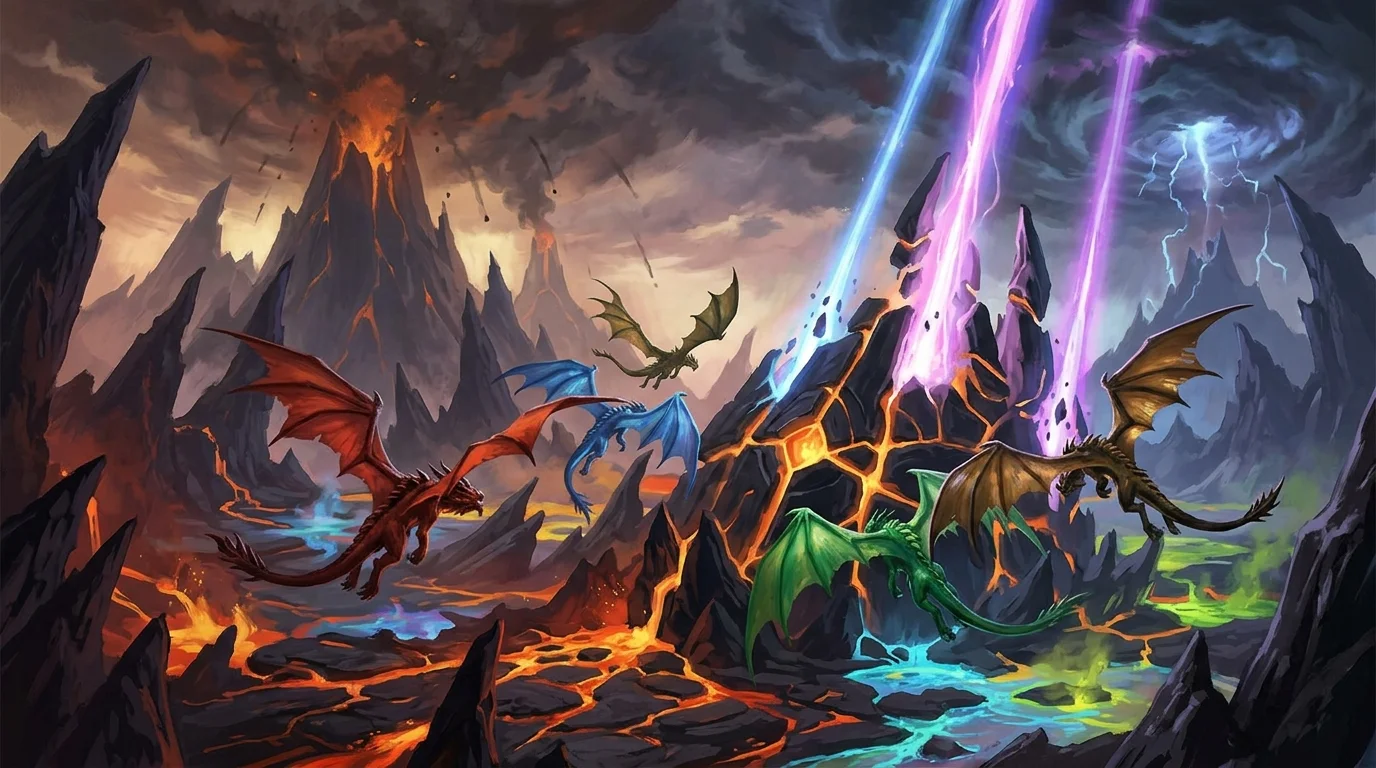
Dragon Isles: Historical Overview of a Continent That Slept for Millennia
A continent that was not forgotten — it was suspended
The Dragon Isles seem, at first glance, to be just the “ancestral home of dragons”. But this definition is too small. The continent is, in practice, a living archive of draconic history: birth, glory, war, guilt, withdrawal and an attempt at a new beginning.
After the War of the Ancients, more than 10,000 years ago, the flights left the isles, and the dragon world went into retreat. It wasn't just a physical escape. It was a civilizational retreat. The islands, bound by ancient magics, oaths, and structures created for flight, have remained dormant for eons, as if waiting for their owners to finally be ready to return.
Why the Dragon Isles were left behind
The retreat after the era of Aspects
The islands were not abandoned for lack of value. They were left behind because they represented a time that dragons could no longer sustain.
After Cataclysm, the Aspects defeated Deathwing, but paid the price with the loss of the titanic status that defined their era. This changes everything. Without that cosmic centrality, returning to the Dragon Isles was not just “returning home”. It was facing a place that reminded them of what they had been and what they no longer were.
A continent trapped in its own vocation
The Dragon Isles have always been shaped for the workings of the dragonflights. They were not a neutral continent. They were a territory in tune with oaths, legacy, elemental magic and centers of power linked to dragons. When the flights withdraw, the continent does not die — but enters a kind of suspension.
This is why the feel of Dragonflight works so well: the entire expansion feels less like an achievement and more like a reactivation.
What kept the islands asleep
Oathstones, legacy and accumulated magic
Oathstones are not just flashy altars. They condense the logic of the flights: duty, identity and bond with the continent. When this system weakens, the islands fall into dormancy along with the draconic order that supported them.
Therefore, the reactivation of the Dragon Isles is not a simple geographic event. It’s not “a continent reappeared”. It's a mesh of ancient powers pulsing again.
Dormancy is not death
This is the most important point. The Dragon Isles were not dead. They were waiting. And this transforms the continent into a character.
Every abandoned structure, every semi-active fortress, every zone taken over by ancient memories conveys the same idea: the story of dragons is not over; it just stood still for too long.
The four zones and what each one says about the flights
Waking Shores: rebirth
Waking Shores is the most obvious zone in its symbolic function. Lava, stone, eggs, wakefulness, reconstruction. Everything there talks about the beginning after the collapse.
It's the right place to start because there Dragonflight makes its theme clear: dragons are not reclaiming an empire intact. They are trying to wake up an ancient world already full of cracks.
Ohn'ahran Plains: heritage
The plains are less about power and more about continuity. It is the area where heritage coexists with mourning, with the cycle and with the idea that a living tradition is not a stopped tradition.
That's why centaurs work so well there. They are not “just natives”. They are proof that the islands continued to produce culture even without the active presence of the Aspects.
Azure Span: magic
Azure Span is the space where the arcane memory of blue dragons and ancient ruins gains most weight. The area mixes natural vastness with places where the magical past seems to have never really gone away.
It shows an important facet of the islands: it is not just a land of flight and nesting. It is also a continent of lost libraries, enchanted ruins, and frozen knowledge.
Thaldraszus: memory
If Waking Shores is rebirth, Thaldraszus is institutional memory. It is there that the idea of draconic civilization appears in its most explicit form.
Valdrakken, Tyrhold and the spaces linked to the bronze dragonflight and the high legacy of the flights make it clear that the Dragon Isles were not just natural territory. They were symbolic capital.
What Awoke the Dragon Isles
There is no single simple magic button. The awakening comes from the combination of the return of ancient forces, the reactivation of the draconic legacy and the realization that the world once again needs that continent.
Dragonflight works precisely because the awakening is narrative and symbolic at the same time. The islands awaken as the dragons are forced to face their past—and this includes Neltharion's failures, wounds from the Aspects, forgotten oaths, and ancient enemies returning to action.
The Dragon Isles as a character
Few continents in WoW have as cohesive an identity as the Dragon Isles. Northrend revolves around the war against the Lich King. Pandaria revolves around emotion, memory and balance. The Dragon Isles is all about legacy.
The entire continent seems to ask the same thing all the time: what is left of a people when the cosmic role that defined them is gone?
This is the great strength of the scenario. The islands are not just the stage where dragons return. They are the material form of their crisis.
What's left after Dragonflight
After the main campaign, the Dragon Isles stop being just “the lost home of the flights” and become something more difficult and more interesting: a living, reoccupied, politically relevant and emotionally charged territory.
They are no longer a museum. They become the future.
And this is perhaps the greatest victory of the expansion. Dragonflight didn't just give the dragons back a map. It gave them back a place where they can exist without depending on the former greatness of the Aspects.
Minimum recommendation
If you want to truly understand Dragonflight, don't treat the Dragon Isles as a generic continent divided into four maps. See each zone as a part of the draconic psyche: birth, inheritance, magic, and memory. When you look at it like this, the entire continent stops being a setting and becomes a character.
Posts Recomendados
Ohn'ahran Plains: centaurs, the spirit of Ohn'ahra, and the heritage of the plains
The Ohn'ahran Plains are more than an open Dragonflight zone: they speak of heritage, grief and continuity, with centaurs amid tradition, strife and wind.
Zaralek Cavern: Neltharion's buried laboratory and what it still hides
Zaralek Cavern is where Dragonflight opens up Neltharion's legacy and shows the Earth-Warder's past wasn't just corrupted, but methodically buried.
Magtheridon: the pit lord of Hellfire Citadel
Who is Magtheridon: the pit lord who ruled Outland, lost the Black Temple to Illidan and became the blood source for fel orcs in Hellfire Citadel.
Saurfang and Dranosh: father and son of the Horde
Varok and Dranosh Saurfang: the son hidden in Nagrand, his death at the Wrathgate, the Deathbringer in ICC and the father who takes him home. Full arc.