
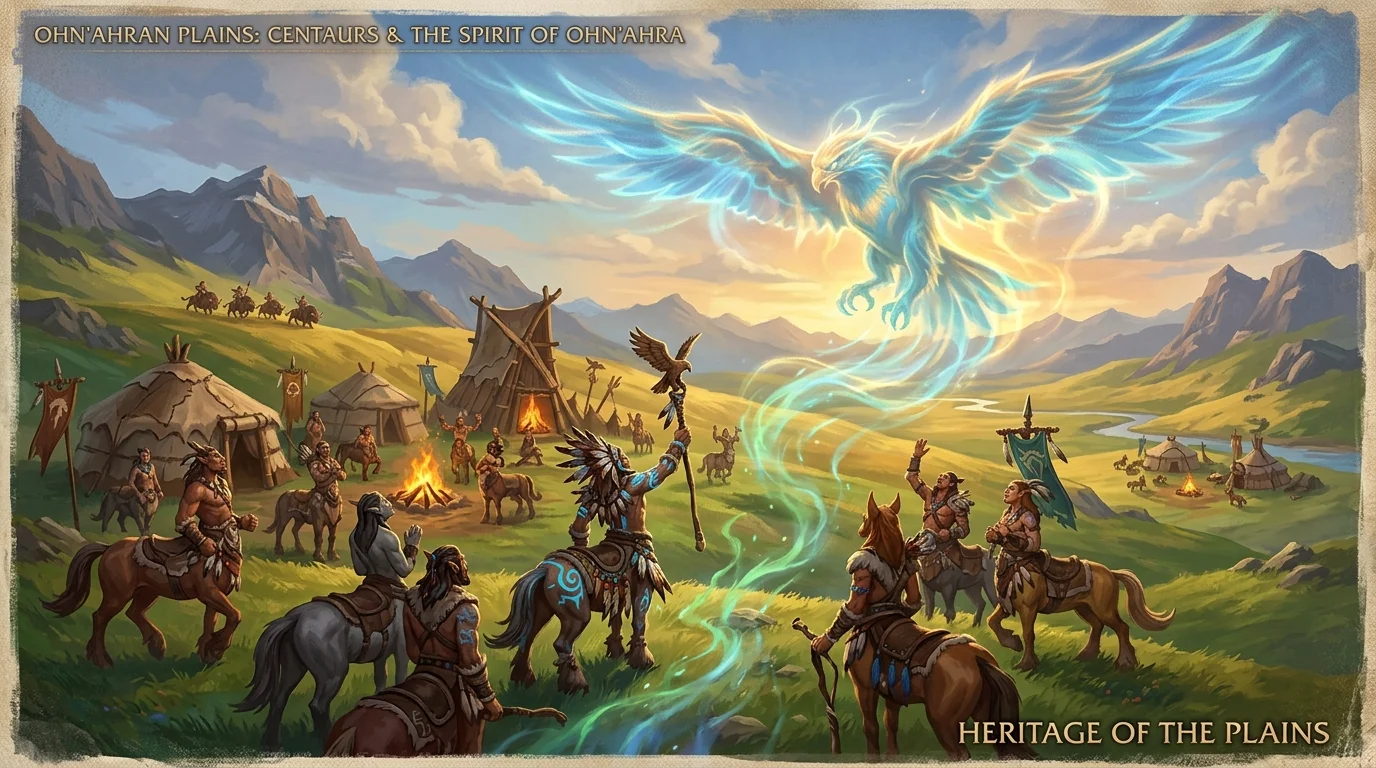
Ohn'ahran Plains: centaurs, the spirit of Ohn'ahra, and the heritage of the plains
The zone where Dragonflight slows down to talk about legacy
Ohn'ahran Plains is one of the most important areas in Dragonflight because it changes the pace of expansion. Instead of throwing the player straight into titanic ruins or cosmic crises, the zone insists on something older and more organic: people, territory, rite, spirit and loss.
It is a wide, ventilated, lively region, but never truly “light”. Beneath the beauty there is a constant question: what is left of a people when the spirit that guided them begins to disappear?
What are the Ohn'ahran Plains
The zone is the great expanse of grasslands, rivers, cliffs, and open skies of the Dragon Isles. It is, at the same time, a physical land and a spiritual landscape. This matters because the territory is not just where the centaurs live. It's how they think.
The plains shape their culture: mobility, hunting, respect for memory, reading the wind and ties to lineage. It is no coincidence that this is the region where tradition and improvisation coexist all the time.
Centaurs and the logic of clans
Maruuk, Shikaar, Nokhud and the internal tension
The region's centaurs are not a homogeneous mass. Dragonflight makes a point of showing that clans share heritage, but they don't share the same answer to the future.
This is the most interesting point of their design. Unity exists, but it is always negotiated. And that's precisely why the Nokhud threat works: it doesn't come out of nowhere. It emerges from the real possibility of a clan deciding that tradition is not enough and that raw power can resolve things better.
Living culture, not ethnic museum
The biggest success in the area is not to transform the centaurs into “exotic people on the map”. They have politics, disputes, pride and their own way of interpreting the past. This avoids that decorative faction feeling.
The centaurs of the Ohn'ahran Plains are a functional civilization. They don't exist to comment on dragons. They exist on their own.
Ohn'ahra and the role of the wind spirit
Ohn'ahra is not just a venerated entity. It is the idea of guidance transformed into spiritual presence. Wind, in this context, is not a neutral element. It is memory, path, ancestry and meaning.
That's why Ohn'ahra's weakening weighs so heavily. When a people organizes part of its identity around a guiding spirit, the crisis of that spirit is not just religious. It's civilizational.
The area understands this very well. The disappearance of security that Ohn'ahra symbolizes becomes collective mourning even before it becomes a military problem.
The Nokhud threat and the weight of choice
The Nokhud do not just function as “the aggressive clan”. They represent the possible deviation from any warrior tradition when honor stops being a brake and becomes an excuse.
By aligning itself with Raszageth, the clan chooses not only conquest, but a utilitarian reading of its own legacy. It's as if they were saying: if we inherit strength, then strength is enough. And that's exactly where the zone gains depth.
The conflict is no longer good versus bad. It becomes a dispute over what to do with a common inheritance.
What this zone says about the cycle and grief
Perhaps the great strength of Ohn'ahran Plains lies here. Unlike zones that treat loss as a starting point for revenge, this one treats loss as something that needs to be experienced.
The collective mourning for the Ohn'ahra crisis is not just a backdrop. It organizes the way the narrative moves. Characters must decide whether to toughen up, break through, or continue.
This is a very elegant way of talking about cycles. Not the mechanical cycle of “die and be reborn”, but the moral cycle of a culture that needs to go through pain without ceasing to be itself.
The role of the plains within Dragonflight
Within the expansion, Ohn'ahran Plains fulfills an essential function: proving that the Dragon Isles are not just draconic territory. They are a mosaic of histories, peoples and spiritual ecologies.
Without this zone, Dragonflight would run the risk of being read solely as a saga of Aspects, Incarnates and a titanic legacy. With it, expansion gains ground. Win people. Get wind.
Why Ohn'ahran Plains stays in memory
Because it does something rare in WoW: it takes a visually beautiful zone and turns it into inheritance text without getting pedantic.
You leave there remembering open horizons, hunts, rites and an immense sky, but also remembering a society trying to survive the disappearance of what guided it.
It's an area about geography, yes. But above all it is a zone about continuity.
Minimum recommendation
If you want to read Ohn'ahran Plains the right way, don't treat the centaurs as a secondary faction in Dragonflight. See the area as a study in tradition in crisis. Then Ohn'ahra, the Nokhud and the other clans stop being “regional content” and become one of the best heritage stories of the expansion.
Posts Recomendados
Dragon Isles: Historical Overview of a Continent That Slept for Millennia
The Dragon Isles are the physical memory of the dragonflights: a continent that slept with its creators and woke to collect what was left unresolved.
Zaralek Cavern: Neltharion's buried laboratory and what it still hides
Zaralek Cavern is where Dragonflight opens up Neltharion's legacy and shows the Earth-Warder's past wasn't just corrupted, but methodically buried.
Magtheridon: the pit lord of Hellfire Citadel
Who is Magtheridon: the pit lord who ruled Outland, lost the Black Temple to Illidan and became the blood source for fel orcs in Hellfire Citadel.
Saurfang and Dranosh: father and son of the Horde
Varok and Dranosh Saurfang: the son hidden in Nagrand, his death at the Wrathgate, the Deathbringer in ICC and the father who takes him home. Full arc.