
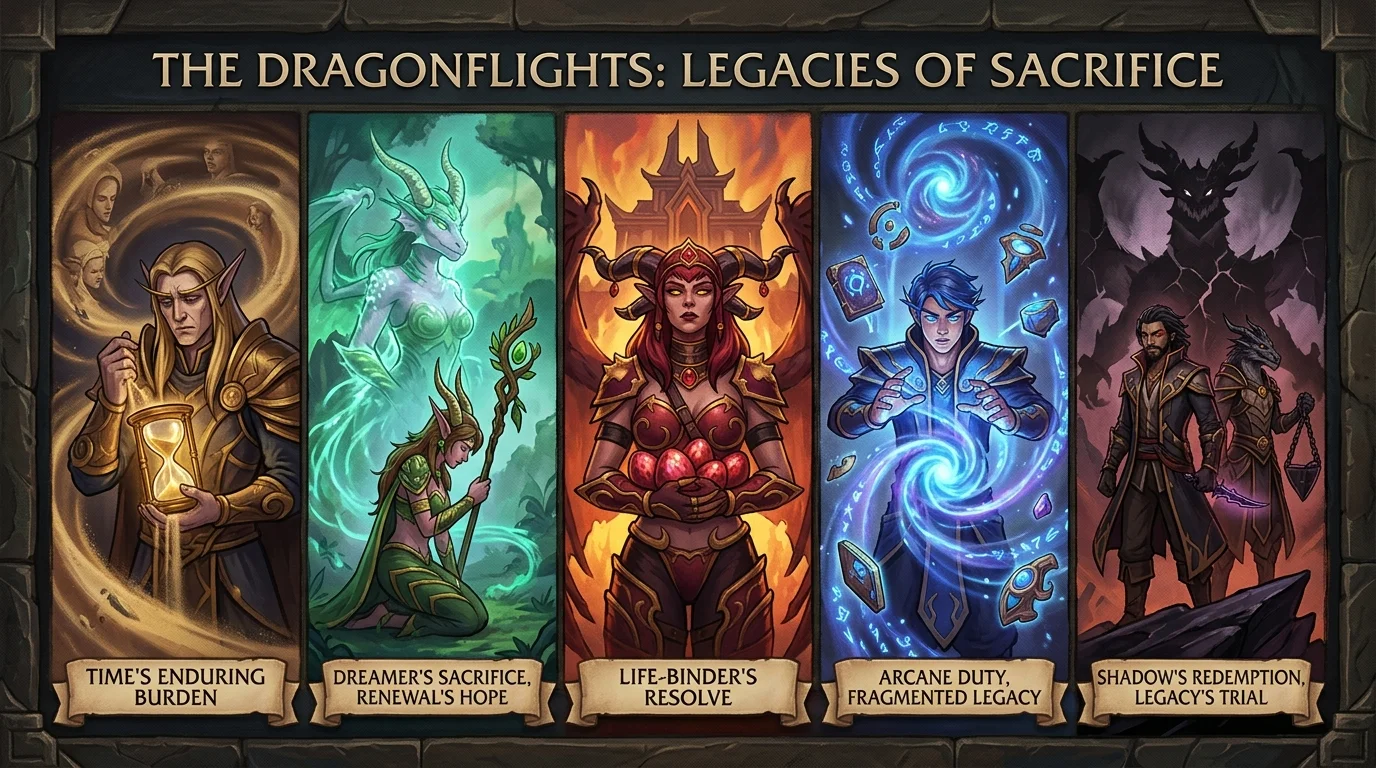
Dragonflight: Legacies — the animated videos and sacrifice of each Aspect
Before Dragonflight asked for hope, it asked for memory
When Dragonflight: Legacies came out before the expansion, many people treated the series as a simple recap to get back to the dragon theme. But it does more than that. The shorts don't exist just to remind you who the Aspects are. They exist to remind you how much each person lost before the adventure even began.
The series uses Emberthal and Nozdormu as a narrative framework to revisit the draconic past. And this detail matters, because the focus is never just on the glorious past. The focus is on the broken legacy that still weighs on those who are left.
The format of Legacies
The series was released as a set of three animated shorts tied to the Dragonflight prequel, in which Nozdormu takes the dracthyr Emberthal through moments of the past: the birth of the Aspects, Neltharion's betrayal with the Demon Soul and, finally, the origin of the dracthyr themselves. Rather than trying to tell the entire story of dragons in one straight line, it chooses emblematic fragments.
Why the format works
Each chapter works on memory and consequence. You don’t watch to find out “what happened” in the most basic sense. You watch to understand what still hurts.
This is the key to Legacies: the past does not appear as an encyclopedia, but as an active wound.
Alexstrasza: life as duty and as mourning
Among all the Aspects, Alexstrasza has always been the figure most associated with life. This looks nice on the surface. The problem is that, in Warcraft, being a guardian of life almost always meant witnessing death up close.
What the series shows of her
Alexstrasza's presence in Legacies works on the contrast between function and suffering. She is the face of preservation, but she has lived through war, slavery, loss of clutches, and centuries of responsibility that have never abated.
This prepares the player to see her in Dragonflight not only as “the Queen of Dragons”, but as someone who has already paid too much for her own role.
Nozdormu: knowing the future is a punishment
Nozdormu has always been one of the most tragic characters in lore. Not because he is the most emotional, but because he was condemned to experience his own fall.
The burden that the series highlights
As narrator of the shorts, Nozdormu makes the central point of the bronze dragonflight clear: the problem is not seeing time. The problem is watching time and still being unable to save everything that matters.
This tension is fundamental to Dragonflight because it gives weight to the threat of Murozond without turning Nozdormu into a simple “time bomb”. What exists there is fear, responsibility and impotence.
Ysera: death seen from the other side
Ysera's death in Legion was already one of the game's strongest moments. Legacies does not return to that scene, but it shows Ysera at the beginning of it all, alongside the other future Aspects, which gives the loss another lens.
Why this hurts more in Dragonflight
When the past is revisited after Ardenweald, Ysera's death stops being just a tragic shock and becomes part of a larger cycle. Seeing her origin helps make this emotional transition. Ysera is no longer just the fallen Aspect; she is also proof that dragons cannot continue living just as they were.
Kalecgos and the blue lineage
Kalecgos never inherited a stable lineage. He inherited ruin. He inherited Malygos' shadow. He inherited a shattered flight.
The arc of reconstruction
Kalecgos does not appear in the shorts, which show Malygos before his fall. What the series leaves implicit is that rebuilding the blue dragonflight is not restoring the past. It's accepting that the past is over. Kalecgos represents precisely that: the attempt to rebuild a people without repeating the logic that destroyed them.
This makes him a perfect counterpoint to an expansion that insists on the theme of legacy. Not every legacy needs to be preserved in its entirety. Some need to be rewritten.
What Legacies emotionally prepares for Dragonflight
This is the most important point of the series. Legacies is not just for explaining. It serves to make the player arrive at Dragonflight with the correct emotional state.
The real effect of the series
After watching, the Dragon Isles no longer seem like just “the continent of dragons”. They look like:
- a place of return;
- a territory of memory;
- a mourning scenario;
- a late chance for reconstruction.
Without this preparation, the expansion runs the risk of looking just pretty. With this preparation, it gains weight.
The sacrifice of each Aspect
The entire series revolves around one idea: draconic power has always taken a toll.
Alexstrasza sacrificed peace.
Nozdormu sacrificed tranquility.
Ysera sacrificed presence.
Kalecgos inherited the task of rebuilding what another Aspect broke.
What this changes
This prevents Dragonflight from being read as a simple return to the “fantastic classic” of Warcraft. The expansion is not just about renewal. It's about renewal after exhaustion, failure and guilt.
Why Legacies works so well
The series understands one essential thing: for the return of the dragons to work, the audience needed to feel that this return was not light. It was late, necessary and melancholic.
Legacies does this without needing too much exposition. It uses memory as a dramatic tool, not as a wall of dates.
Minimum recommendation
Watch Dragonflight: Legacies before thinking of the expansion as an exploration adventure. The series exists to remind you that the Dragon Isles are not just a new map: they are a continent built on loss, legacy and trying to start over. Without that weight, Dragonflight just looks pretty. With it, the expansion gains a soul.
Posts Recomendados
Alexstrasza: Queen of Dragons, protector of life and the cost of every war
Alexstrasza symbolizes life, hope and protection, but her story also holds slavery, loss and sacrifice. Who is she once she is no longer an Aspect?
Dragon Isles: Historical Overview of a Continent That Slept for Millennia
The Dragon Isles are the physical memory of the dragonflights: a continent that slept with its creators and woke to collect what was left unresolved.
Magtheridon: the pit lord of Hellfire Citadel
Who is Magtheridon: the pit lord who ruled Outland, lost the Black Temple to Illidan and became the blood source for fel orcs in Hellfire Citadel.
Saurfang and Dranosh: father and son of the Horde
Varok and Dranosh Saurfang: the son hidden in Nagrand, his death at the Wrathgate, the Deathbringer in ICC and the father who takes him home. Full arc.