
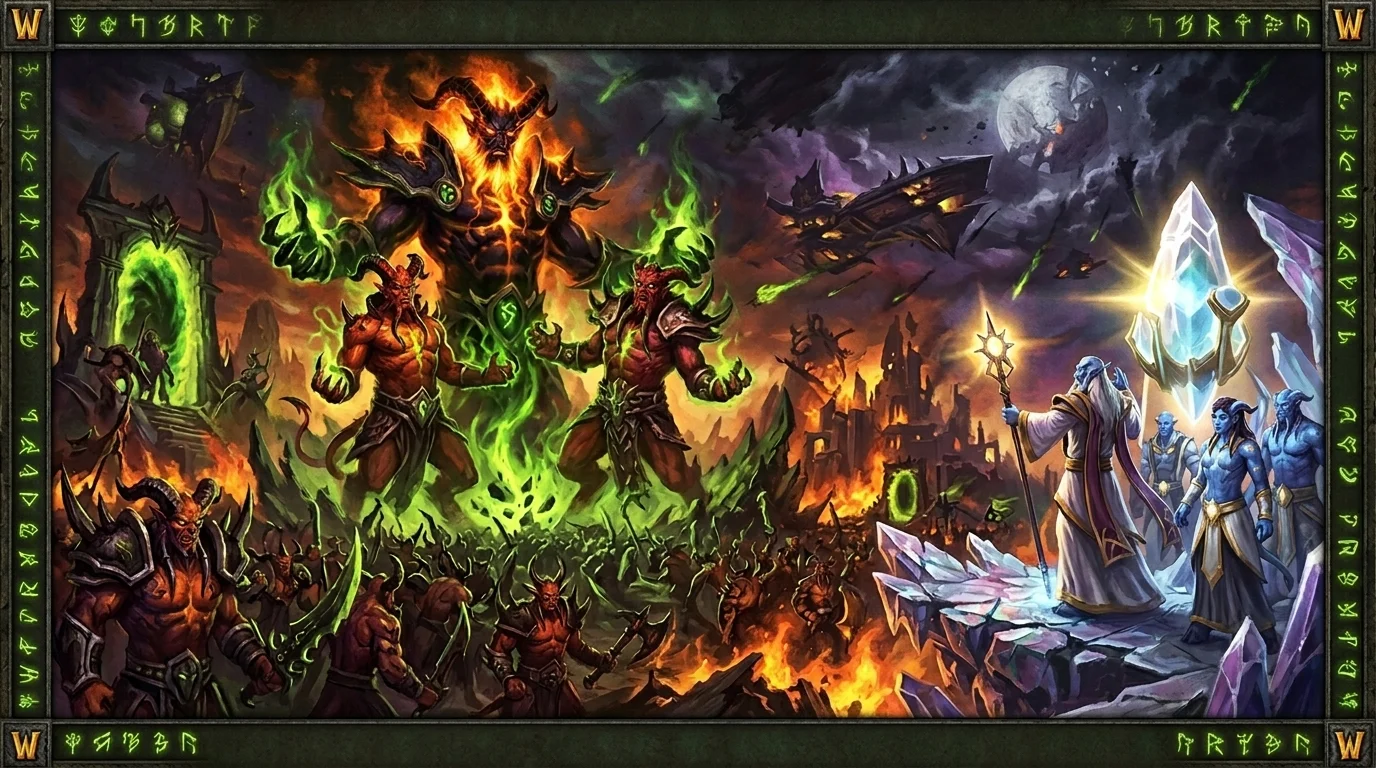
Argus didn't fall because she was weak. It fell because it was grand enough to attract the wrong attention
When the lore talks about the eredar, many people first think of Kil'jaeden, Archimonde and the Burning Legion. The problem is that this is the end of the story, not the beginning. Before the corruption, the eredar were a sophisticated civilization, extremely advanced in magic and knowledge, living on Argus as one of the most brilliant people in the cosmos.
Their tragedy works because it is not the story of barbarians seduced by raw power. It is the story of an intellectual and magical elite convinced that they could accept an impossible offer without paying the ultimate price. From there are born the man'ari, the exiled draenei and the wound that will run through the entire history of Warcraft.
Argus before corruption
What the eredar were
Argus was more than a home planet. It was the center of a refined, powerful and extremely talented culture in the use of magic. The eredar do not appear in the lore as a people struggling to survive on the fly. They appear as an already consolidated, proud and intellectually superior civilization.
That's what makes their fall so important. Sargeras did not offer power to a desperate people. He offered expansion, certainty and greatness to a civilization that already saw itself as above the rest.
Why this matters
Without this point, the story becomes just “some accepted evil”. With him, the fall of Argus becomes something more complex: the conviction that intelligence and power are enough to control forces that, in practice, end up controlling you.
Sargeras' proposal and the division of the people
Who accepted and who refused
When Sargeras sought out the eredar leaders, he offered cosmic power, knowledge, and a new role in the universe. Kil'jaeden and Archimonde accepted. Velen refused, guided by his prophetic vision and the warning received from the naaru.
This decision divides the people into two irreconcilable destinies. On the one hand, those who become instruments of the Legion. On the other, those who flee and start living as draenei — literally, “the exiles”.
What this choice reveals
The division of the eredar is not just political. It is spiritual and civilizational. Kil'jaeden and Archimonde choose power at absolute cost. Velen chooses flight, the loss of his homeland and a war lasting millennia.
Man'ari: the corrupted eredar
What does it mean to become man'ari
The man'ari are the eredar who accepted Sargeras and were corrupted by demonic energy. They are not a separate race from the beginning. They are the result of the transformation of an entire people into the elite of the Burning Legion.
This is why man'ari carry a particular weight in the lore. They serve as the perfect mirror of the draenei. Same origin, opposite destinations.
Why they are more than “strong demons”
The man'ari represent the triumphant version of the wrong choice. They receive the promised power, but at the cost of serving a project of universal annihilation. There is no real personal victory there. There is only utility within the Legion machine.
Kil'jaeden and Archimonde as Velen's opposites
Three leaders, three responses
Velen, Kil'jaeden, and Archimonde encapsulate the fate of the eredar. Velen represents renunciation, vision and moral survival. Kil'jaeden represents relentless pursuit, grudge, and calculation. Archimonde represents open destruction, pride, and overwhelming strength.
What does this do to the draenei arc
The draenei war was never just about physical escape. It was an escape from the two former equals who came to personify everything that Velen refused to be.
The final destruction of Argus in Legion
Returning to the lost home
When the heroes finally arrive on Argus in Legion, they do not find the idealized homeland of the draenei. They find a ruined world, militarized and converted into the engine of the Legion's war. It is a painful return because there is no home to recover in the way it existed before.
What the end of Argus means
The defeat of Argus the Unmaker and the fall of the Legion axis ends a millennia-long cycle. But closure does not erase the loss. What remains for the draenei is the bitterest truth possible: the war ended without returning the world that started it.
What does this arc change in the reading of the draenei
Once you understand Argus, the draenei no longer seem like just “space paladins” or noble refugees. They become an entire civilization trying to survive the fact that their history began with a correct moral choice and ended in persecution, exile, and permanent longing.
This is what makes the eredar one of the strongest people in lore. The fall of Argus is not just the birth of the Legion's villains. It is also the birth of one of the most tragic people in Warcraft.
Minimum recommendation
To better understand this arc:
- see Argus as the simultaneous origin of draenei and man'ari
- treat Kil'jaeden and Archimonde as reflections of the same decision rejected by Velen
- reread Legion as a return to the founding trauma of the draenei
- connect Argus to the larger cosmic war, not just the story of the Burning Legion
- use this context to understand why Velen always seems to carry a grief much older than any expansion
Posts Recomendados
Lightforged Draenei
Lightforged Draenei aren't just brighter-looking draenei: they are a people shaped by millennia of war, discipline and total sacrifice for the Light.
Argus and the Collapse of the Eredar: The Draenei Homeworld in Ruins
Argus was the eredar's intellectual and magical center. Under Sargeras, it became the Legion's war factory and the site of the draenei's painful return.
Magtheridon: the pit lord of Hellfire Citadel
Who is Magtheridon: the pit lord who ruled Outland, lost the Black Temple to Illidan and became the blood source for fel orcs in Hellfire Citadel.
Saurfang and Dranosh: father and son of the Horde
Varok and Dranosh Saurfang: the son hidden in Nagrand, his death at the Wrathgate, the Deathbringer in ICC and the father who takes him home. Full arc.