
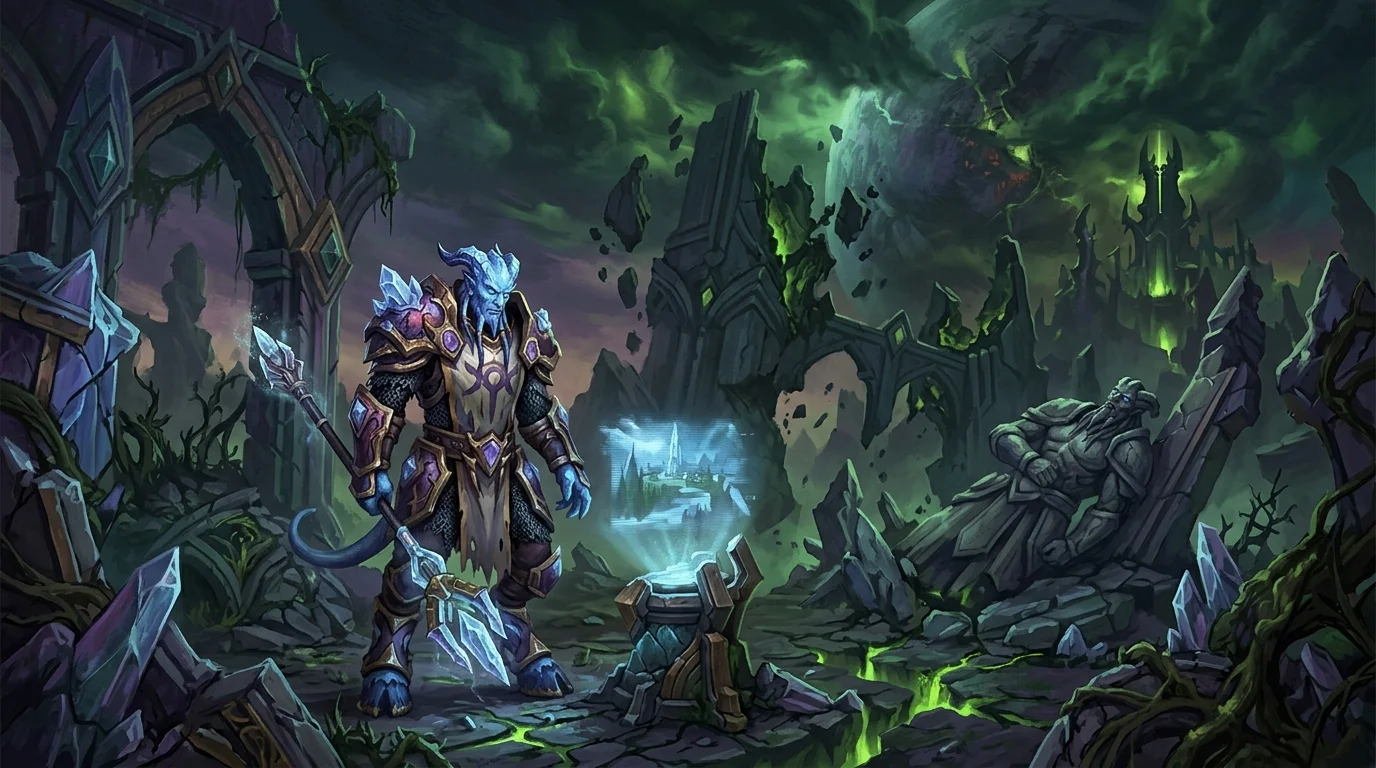
Argus and the Collapse of the Eredar: The Draenei Homeworld in Ruins
Argus isn't just a destroyed planet — it's a disrupted civilization
When Legion takes the player to Argus, the impact doesn't just come from the ruined look. It comes from contrast. That place was once one of the greatest civilizations in the known universe. The planet of the eredar does not begin as a green hell. It begins as a center of knowledge, magic and sophistication.
This is what makes Argus hurt so much in the history of the draenei. They're not just facing the Legion. They're coming home too late.
Argus before corruption
The height of the eredar
Before Sargeras, Argus was synonymous with intellectual and arcane excellence. The eredar were not presented as barbarians falling to easy temptation. They were brilliant, organized and powerful.
That's why the fall weighs more. It was not the corruption of a directionless people. It was the capture of an entire civilization by the greatest destructive power in the cosmos.
The choice that left the people
At the heart of this story is the divide between Velen, Archimonde, and Kil'jaeden. When Sargeras offers power, Velen sees ruin and flees with what would later be called draenei. The others accept and transform their home into the Legion's base.
Argus was born, for modern WoW, as a double wound: he lost the planet and he lost the unity of his own people.
How Sargeras transformed Argus
From brilliant world to war machine
Under the Legion, Argus ceases to be the capital of a culture and becomes an infrastructure of conquest. The planet is reconfigured to produce, mobilize and fuel cosmic warfare.
Everything there communicates instrumentalization. The landscape, the armies, the scale of the facilities, and the sky itself all say the same thing: Argus was treated as a resource.
The proto-Titan at the center of horror
The cruelest step in this transformation is the use of the world itself as an anchor for the Legion's cycle of war. Argus is no longer just an occupied planet. It becomes part of the mechanism of demonic resurgence and the continuation of the conflict.
The three zones and what they mean
Krokuun
Krokuun is the entrance through the ruin. It is where the return to the planet begins with visible destruction, resistance and the clash between memory and present.
Mac'Aree
Mac'Aree represents the echo of what Argus once was. It is the area that most preserves the feeling of lost grandeur, of the city, culture and refinement crushed by corruption.
Antoran Wastes
Antoran Wastes is the Legion's absolute front line. It's no longer a reminder of home. It is the military gear exposed, the planet reduced to an apocalypse assembly line.
Returning home after millennia
What the Draenei Really Encounter
The return to Argus does not deliver simple reconciliation. There is no such thing as a “restored home”. What Velen and the draenei find is a planet so deformed that it almost no longer recognizes its own children.
This is why Argus works as one of the saddest stories in Legion. The reunion with the origin happens, but in the form of mourning.
Liberation is not restoration
Defeating the Legion in Argus does not automatically return the past. The most that can be achieved there is to stop the machine and prevent the ruin from continuing to reproduce itself.
The death of Argus the Unmaker
The cosmic weight of confrontation
Argus the Unmaker isn't just a final boss. He represents the maximum degree of corruption: a proto-Titan transformed into an instrument of the Legion's cycle.
Destroying it is preventing the machine from continuing to operate, but it is also recognizing that what existed there as original potential has already been completely deformed.
Bitter victory
This is the key to understanding Argus: the triumph in Legion is real, but it is deeply bitter. Azeroth wins. The draenei survive. But Argus doesn't return.
What Argus represents in WoW
| Element | What does it symbolize | |----------|-----------------| | Pre-Fall Eredar | intellectual and arcane brilliance | | Escape from the draenei | moral survival at enormous cost | | Corrupted planet | civilization converted into machine | | Return of Velen | reunion with grief, not with the past | | Argus the Unmaker | corruption taken to a cosmic level |
Minimum recommendation
Argus works best when you read the planet as a civilizational tragedy, not just as the final setting of Legion.
Expansion does not lead Velen to a clean victory.
It leads to the painful confirmation of all that has been lost.
Posts Recomendados
Velen: ten thousand years running from Kil'jaeden and the prophecy that has always guided the Draenei
Velen is less a powerful wizard and more the leader who carried the Draenei through millennia of flight, faith and loss, eyeing a future few could see.
A Thousand Years of War: Alleria and Turalyon in the centuries they spent in Argus
A Thousand Years of War is essential to understanding Alleria, Turalyon and the Army of Light. Without it, Legion and Midnight lose a layer of depth.
Magtheridon: the pit lord of Hellfire Citadel
Who is Magtheridon: the pit lord who ruled Outland, lost the Black Temple to Illidan and became the blood source for fel orcs in Hellfire Citadel.
Saurfang and Dranosh: father and son of the Horde
Varok and Dranosh Saurfang: the son hidden in Nagrand, his death at the Wrathgate, the Deathbringer in ICC and the father who takes him home. Full arc.