
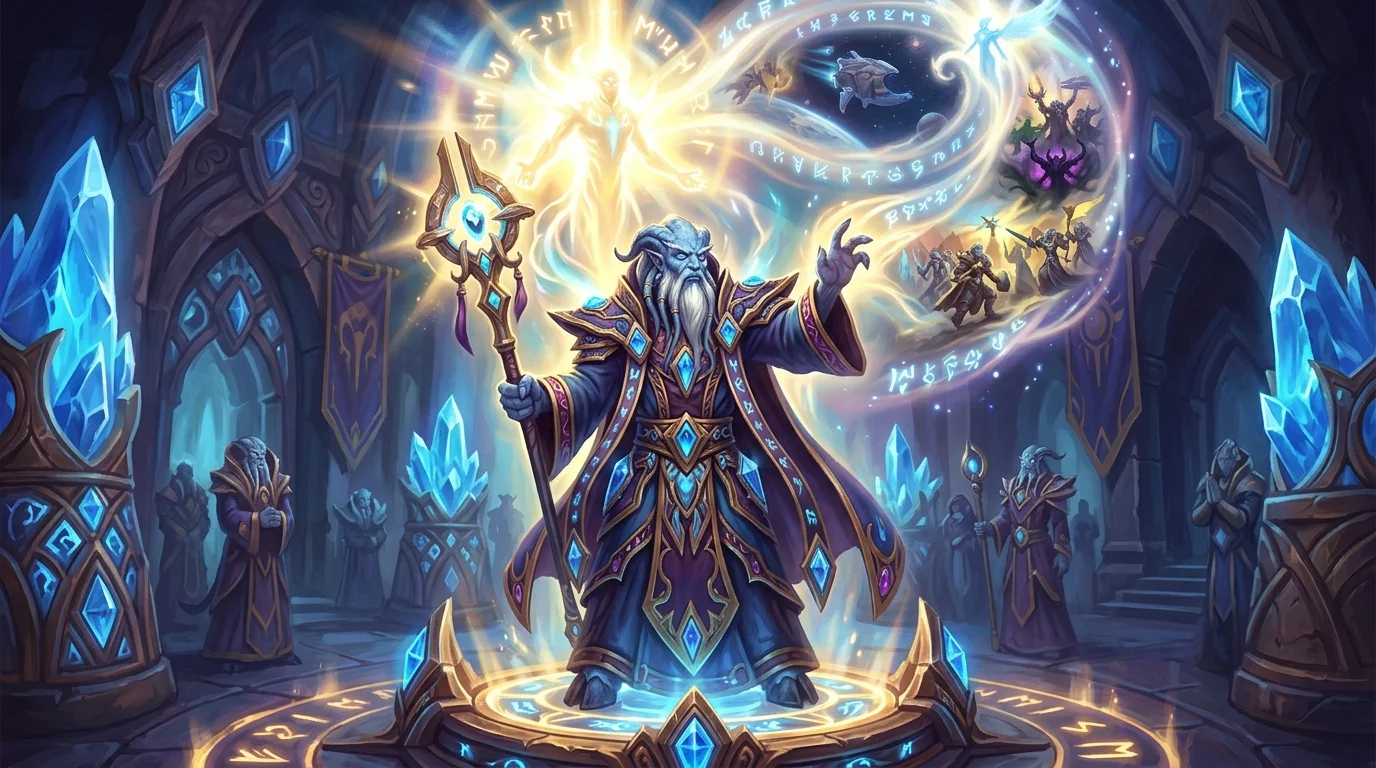
Velen: ten thousand years running from Kil'jaeden and the prophecy that has always guided the Draenei
Velen is not defined by power, but by endurance
When talking about Velen, it is common to treat the character as "the prophet of the draenei" and stop there. But that poorly summarizes what he represents. Velen is not important just because he saw the future. He is important because he saw the horror too soon, believed what he saw when it was easier to deny, and spent entire eons carrying the responsibility for that choice.
His story is less about magic and more about cost. Each vision saves a people, but costs a home. Each escape prevents an extermination, but leaves another world behind.
The moment of choice in Argus
What happened
In the ancient era of Argus, Velen ruled alongside Archimonde and Kil'jaeden among the eredar. When Sargeras offered power and greatness, the three did not react in the same way. Archimonde and Kil'jaeden accepted. Velen refused because he had a clear vision of what his people would become if they followed that path.
This is the central point of the character: Velen does not refuse out of abstract moral pride. He refuses because he sees the entire destiny before others.
Why this matters
Velen's choice doesn't just save himself. It creates the draenei as a people of exile.
From then on, the eredar cease to be a united civilization. Two opposing stories emerge:
- those who embrace the power of Sargeras and become man'ari
- those who flee with Velen and exist as permanent exiles
The birth of the draenei is at once an act of courage and a historic condemnation.
The endless escape and the price of surviving
What happened
After the rupture, Velen leads his people on a millennia-long escape. The draenei do not leave Argus to find immediate peace. They enter a cruel cycle: they arrive in a world, try to start over, are found by the Legion, and run away again.
This repetition is decisive for understanding the character. Velen does not lead a single exodus. He leads a series of losses.
What this did to the draenei
Along this path, the draenei are no longer just a refugee people. They become a civilization shaped by:
- memory of a lost home
- religious and spiritual discipline
- constant fear of being found
- obligation to continue, even after countless deaths
Velen, in this sense, does not lead just one nation. He leads a collective wound that never completely closes.
Prophecy as a gift and as a burden
What happens
The title "Prophet" may seem grand, but Velen's story shows an uncomfortable gift. Seeing the future does not mean controlling the future. It often means just knowing the pain is coming, and still having to move on.
This is why Velen doesn't work as an omniscient character. He sees possibilities, directions, omens. But he still needs to decide in the midst of uncertainty, the doubts of others and the human cost of his own decisions.
The harsher side of prophecy
The prophecy in WoW is often treated by players as a narrative shortcut. With Velen, it works best as a burden.
- he needs to convince people to abandon real homes because of something that hasn't happened yet
- he needs to accept immediate losses in the name of a tomorrow that few can see
- he needs to appear firm while carrying doubts that he cannot share all the time
Velen's greatest strength is not always getting it right. It is continuing to lead his people even when getting it right means suffering before everyone else.
Azeroth was not the end of the escape — it was the beginning of the reckoning
What happened
When the draenei arrive on Azeroth, their escape does not magically end. First comes the clash with Outland and Draenor's ruined heritage. Then the slow reconstruction on Azeroth. Only much later does Velen's story really enter the phase of direct confrontation with his past.
This point culminates in Legion, when the war finally reaches Argus and Velen finds himself faced with the entire cycle he has carried for eons.
The reunion with Kil'jaeden
The final meeting between Velen and Kil'jaeden concludes one of the most tragic relationships in Warcraft. They weren't just legendary enemies. They were former brothers of leadership, men who started from the same origin and went to opposite destinations.
That's why the confrontation weighs so much. It's not just the fall of a great demon general. It is the personal end of a persecution that has defined the Draenei's identity for millennia.
What changes when Kil'jaeden falls
What happens
Kil'jaeden's defeat does not erase the past, but it changes the axis of Velen's life. For the first time in ages, he's not just running from an ancient shadow. The main pursuer fell. The core cycle has been broken.
Why this is so important
This moment repositions the character. Velen is no longer seen only as the man who leads the retreat but also becomes the man who survived to see the chase end.
This changes the reading of the entire character. His prophecy wasn't just for escape. It served to keep alive the possibility of one day facing the past head on.
Velen after Argus: what is left for a prophet?
The right question
After so many visions fulfilled, a good question remains: what does a prophet do when his great cycle seems to be over?
The more honest answer is that Velen remains important less as a "man who predicts" and more as a "man who witnessed." He becomes a living memory of everything his people lost, and also of everything they managed to preserve.
Shadowlands and beyond
Velen does not become the absolute center of later events, and that makes sense. His grand personal arc didn't need to end with yet another grandiose prophecy. After Argus, the character works better as a figure of wisdom, continuity and historical weight than as an engine of war.
This relative silence does not diminish Velen. On the contrary. It shows that, for the first time in a long time, he doesn't need to run ahead of extinction.
Velen's philosophy is more difficult than it seems
What he represents
Velen represents a form of leadership that WoW rarely makes easy: leadership that insists on faith without turning into naivety.
He is no foolish pacifist. He is not a blind fanatic. He is not an impulsive warrior. Nor a short-term politician.
He thinks in centuries. And that makes him less explosive, but much rarer.
The contrast with other leaders
Next to figures like Kil'jaeden, Illidan, Varian, Garrosh or Sylvanas, Velen seems less dramatic. But this calmness is precisely what makes the difference. He is the leader who understands that surviving is not enough; you have to survive without completely losing your identity.
What Velen actually guided
Velen's greatest achievement was not defeating a specific enemy. It was to prevent the draenei from being reduced to a footnote in the Legion's history.
He guided his people through lost worlds, betrayals, culture clashes, cosmic wars, and an almost unbearable wait until the chance to settle scores finally arrived.
This is bigger than a raid victory. It is civilizational preservation.
Minimum recommendation
If you want to understand Velen the right way, read his journey in this order:
- the choice in Argus and the refusal of Sargeras
- the flight of the draenei as the origin of an exiled people
- prophecy as a burden, not an easy superpower
- Azeroth and Argus as a reunion with a past that never died
- the fall of Kil'jaeden as an emotional end to an ancient chase
Velen is one of the few WoW characters whose greatness doesn't come from dominating the battlefield. It comes from continuing to lead an entire people even when the future seems like just an infinite sequence of goodbyes.
Posts Recomendados
Locus-Walker: Alleria's ethereal master and what he knows about the Void
Locus-Walker masters the Void without losing himself, trained Alleria when almost no one understood that power and carries the memory of K'aresh's fall.
Argus and the Collapse of the Eredar: The Draenei Homeworld in Ruins
Argus was the eredar's intellectual and magical center. Under Sargeras, it became the Legion's war factory and the site of the draenei's painful return.
Magtheridon: the pit lord of Hellfire Citadel
Who is Magtheridon: the pit lord who ruled Outland, lost the Black Temple to Illidan and became the blood source for fel orcs in Hellfire Citadel.
Saurfang and Dranosh: father and son of the Horde
Varok and Dranosh Saurfang: the son hidden in Nagrand, his death at the Wrathgate, the Deathbringer in ICC and the father who takes him home. Full arc.