
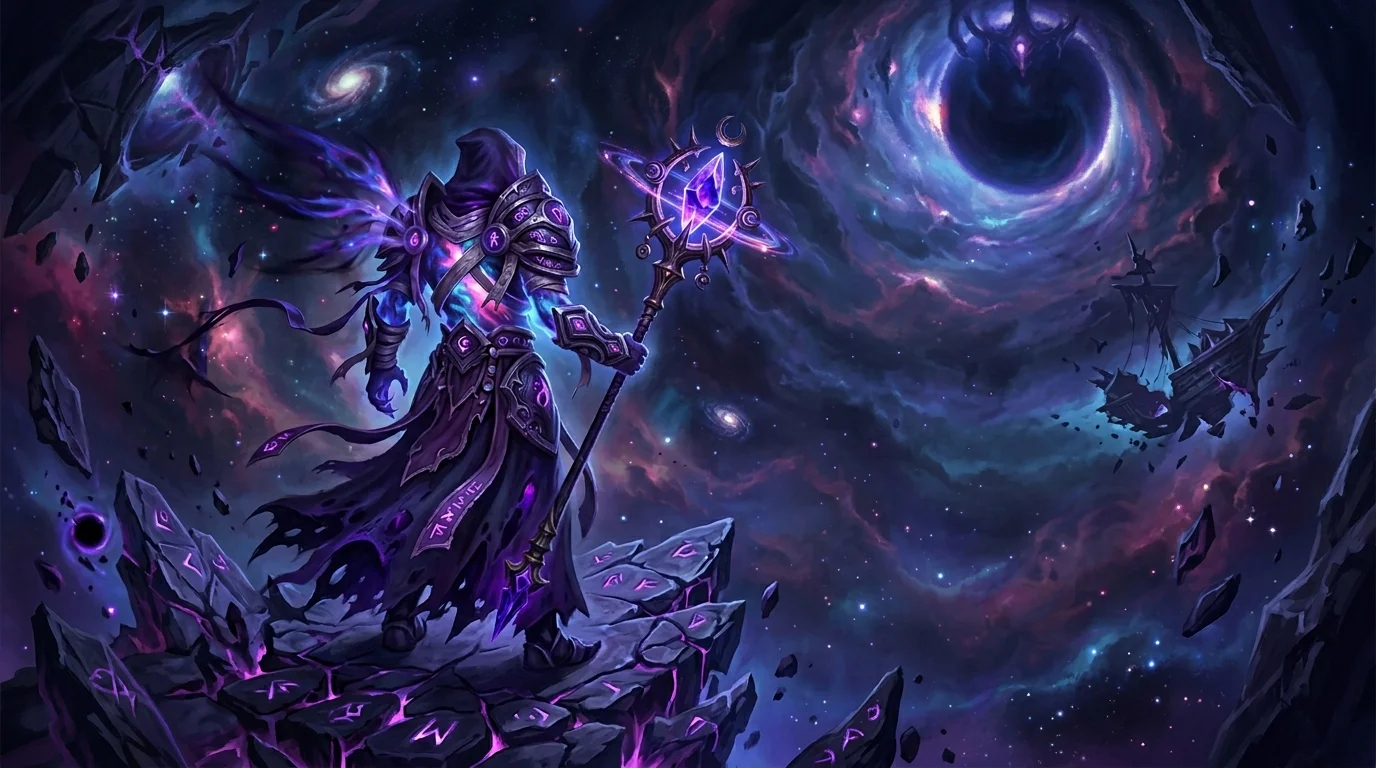
Locus-Walker: Alleria's ethereal master and what he knows about the Void
Locus-Walker is important because Warcraft almost never treats the Void with discipline
At first, Locus-Walker seemed like just that mysterious NPC who showed up to make Alleria “the Void user who still thinks.” Today it became clear that he was much more than that. He is one of the few characters who can talk about the Void without turning everything into instant madness or automatic evil.
This is already a huge role. But it grows even more when K'aresh enters the center of the story. Suddenly, Locus-Walker stops being just a mentor and becomes a key witness to a cosmic catastrophe.
Who is Locus-Walker
The impossible that the character represents
Locus-Walker is an ethereal who has learned to deal with the Void without dissolving into it. In Warcraft, this should be nearly impossible. The usual logic of the universe has always been simple: messed with the Void too much, lost control, identity, or both.
It defies that logic. And that's exactly why Alleria needed him.
Why does this attract so much attention
The existence of Locus-Walker proves that the Void is not just automatic corruption. It is extreme risk, yes, but also knowledge that can be studied with brutal discipline. This changes the way we see the entire cosmic conflict.
Alleria's training was less about power and more about restraint
His method
Locus-Walker does not teach Alleria to “embrace the darkness” irresponsibly. It teaches control, focus and detachment. The point is to use the tool without letting the tool define who you are.
This detail is the heart of the character. For him, the Void does not reward sentimentality. It requires will, clarity and internal limits.
The result
Alleria does not leave his training purified or protected from all risk. It comes out functional. And that, within the Warcraft cosmology, is already huge.
K'aresh turned Locus-Walker into the centerpiece of the saga
What it reveals
In The Doom of K'aresh, Locus-Walker tells Alleria the story of the fall of her homeworld. This is a decisive step because it transforms the character into a bridge between personal experience, cosmic tragedy and the current war against the Void.
K'aresh stops being a distant concept and becomes a memory narrated by someone who saw the world alive before the ruin.
Why does this weigh so much
When a character carries the memory of a destroyed world, he is no longer just wise. Become a survivor with moral authority. Locus-Walker does not speak of the Void as a neutral scholar. Spoken like someone who knows the price of underestimating him.
His philosophy is one of the most interesting in Warcraft
The Void is not "good", but it is not simplistic either
Locus-Walker does not treat the Void as a virtue. He treats it as a dangerous, hungry and useful power only to those who support absolute discipline. This stance is important because it avoids two common extremes:
- the character who thinks darkness is just edgy aesthetics
- the character who reduces everything to “that’s bad and that’s it”
Locus-Walker works in a third way: understanding to survive, not to romanticize.
What does this teach about the universe
Warcraft's cosmology is better when characters like him exist. They show that cosmic forces are also fields of interpretation, choice and limit.
What he still hides matters precisely because he says little
His silence is part of the job
Locus-Walker was never a character with full exposure. He always revealed what was necessary, when he deemed it necessary. This means that some of what he knows about K'aresh, Xal'atath, and the behavior of the Void is still filtered.
This way of acting matches his own philosophy: too much information, too soon, can destroy those who don't yet know how to process it.
Why this matters for the current arc
As Alleria moves into an increasingly central role in the Worldsoul Saga, the weight of what Locus-Walker has told—and what it may not have told her before—automatically grows. The Void's mentor isn't just important because of his past. It is important because it helps to calibrate the future.
What makes Locus-Walker so unique
| Element | Function in lore | |----------|-----------------| | Ethereal that dominates the Void | Breaks the idea of inevitable corruption | | Alleria Mentor | Gives method to the first great heroine of the Void | | Survivor of K'aresh | Links personal drama to cosmic scale | | Disciplined philosophy | Reinterprets the Void as a power of extreme risk | | Secret Keeper | Maintains tension for the next arcs |
Locus-Walker is not a luxury supporting role
He may seem like a side character to anyone who takes a quick look. It is not. Locus-Walker is one of the keys to understanding how Warcraft is treating the Void now: no longer as a generic shadow, but as an ancient, seductive, devastating and intellectually serious force.
That's why it matters so much. He doesn't just know things about the Void. He changed the way the player can think about him.
Minimum recommendation
If you really want to understand Locus-Walker:
- View Alleria Training as Discipline, Not a Power Trick
- treat K'aresh as the emotional center of his story
- read his philosophy as a warning, not as a compliment to the Void
- realize that his silence is part of the character
- understand that Locus-Walker is less a “mysterious mentor” and more an essential witness to the cosmic war
Posts Recomendados
Faerin Lothar: relative of Anduin Lothar and the new voice of faith in Midnight
Faerin Lothar is more than a famous surname: she links human legacy, arathi faith, courage and the Worldsoul Saga's new phase, without empty nostalgia.
Wrathion: the Purified Black Dragon and his plans to save Azeroth on his own
Wrathion acts on a dangerous conviction: if Azeroth must be saved, the method matters less than the result. That makes him fascinating and hard to trust.
Magtheridon: the pit lord of Hellfire Citadel
Who is Magtheridon: the pit lord who ruled Outland, lost the Black Temple to Illidan and became the blood source for fel orcs in Hellfire Citadel.
Saurfang and Dranosh: father and son of the Horde
Varok and Dranosh Saurfang: the son hidden in Nagrand, his death at the Wrathgate, the Deathbringer in ICC and the father who takes him home. Full arc.