
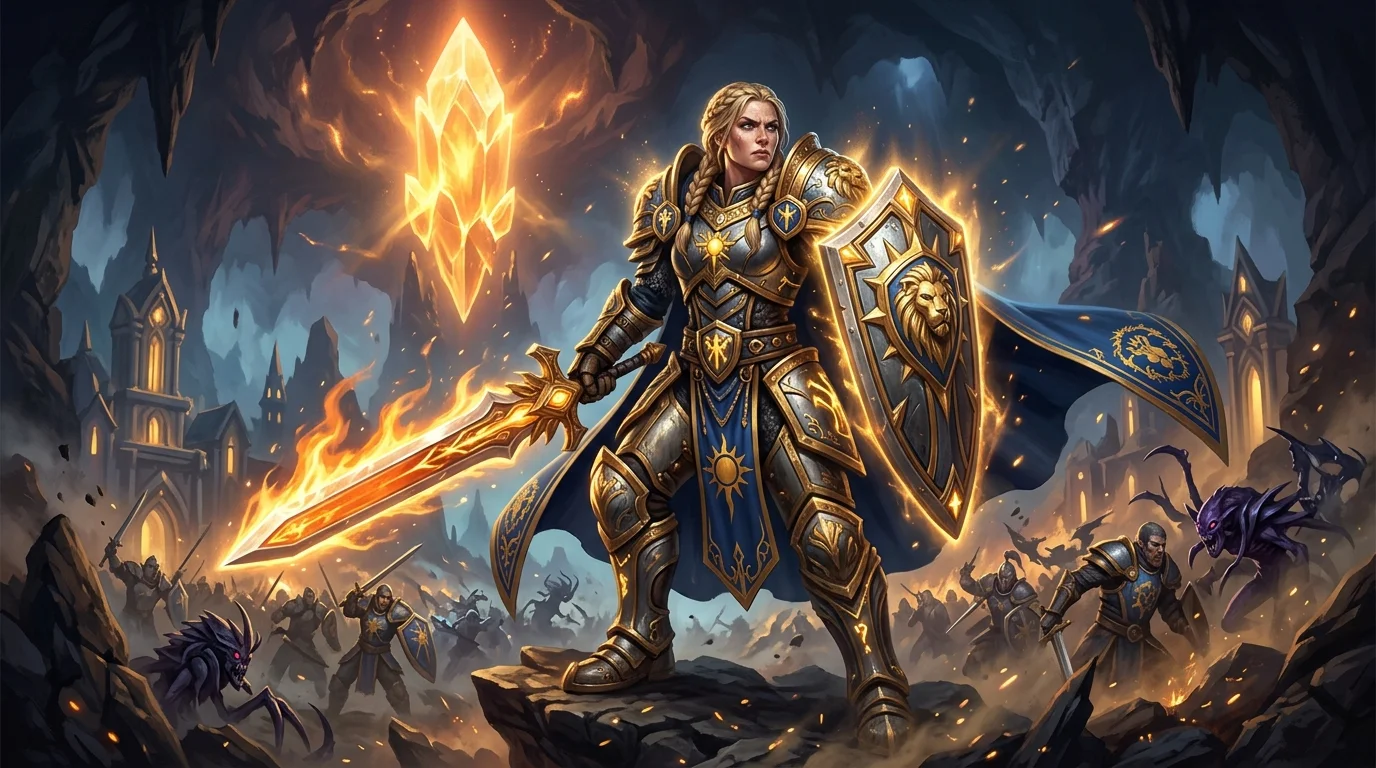
Faerin Lothar: relative of Anduin Lothar and the new voice of faith in Midnight
Faerin only works if you understand that the surname is not enough
When a character named Lothar appears, the immediate temptation is to look back. It makes sense. Anduin Lothar is one of the heaviest names in human memory on Azeroth. The risk, however, would be to turn Faerin into surname fanservice.
The good thing is that the character avoids this. Faerin does not attract attention because he bears the name Lothar. It draws attention because the text insists on asking what it means to deserve this name in a completely different time, in a different people and in the face of a different faith.
Before Faerin, there is the weight of Anduin Lothar
Why this name matters so much
Anduin Lothar was the great human champion of the First and Second Wars, the man who survived the fall of Stormwind, guided the resistance, and became one of the Alliance's greatest symbols of military honor.
This legacy matters because Lothar, in Warcraft, does not just mean nobility. It means resistance in defeat, duty above safety and willingness to carry on war without losing dignity.
The problem with inheriting this
Carrying that surname can be inspiration, but also prison. Any heir to the name runs the risk of becoming just an echo. Faerin works because it tries to respond to this weight with its own voice, not with imitation.
Faerin is not born in Stormwind: it is born in Hallowfall
Context changes everything
Faerin is an Arathi of Hallowfall, born into the noble Lothar family — the same bloodline as Anduin Lothar, whose branch stayed in the old world; she sees herself as a distant relative of his, not a direct descendant. She is part of an isolated culture that has preserved its own relationship to faith, discipline, and identity. This already distances itself from the “core” humans that the player has known since Warcraft II and III.
She is not a Lothar created to repeat the old Covenant. She is a Lothar shaped by the subterranean experience of Hallowfall, the Holy Light filtered through Arathi culture, and a lifetime of being told there is too much darkness to ignore.
What does this create
This combination makes Faerin interesting because it mixes old memory and new context. The surname points to the past. Her experience points to the future of the saga.
Faith & Flame is the text that explains the character better than any summary
What the story makes clear
In Faith & Flame, Faerin is not presented as a ready-made heroine. She is someone who feels an insistent call to face the darkness and who needs to decide what to do with it. The story works precisely because it presents her faith as an intimate experience, not as a slogan.
She leaves Hallowfall with Anduin and the outsiders not out of empty impulse, but because she understands that the faith that formed her demands movement, not comfort.
Why this matters
This is the detail that prevents Faerin from becoming a decorative character. It does not exist just to “represent the Light”. It exists to show how faith can push someone out of safety and into the unknown.
Her role between faith, flame and courage
Her faith is not naivety
Warcraft sometimes confuses faith with absolute certainty. Faerin seems more interesting precisely because it doesn't work like that. Her faith is tested. She feels fear, hesitation, the weight of expectation — and yet she moves forward.
This is stronger than a character who simply never doubts.
The fire in her bow
The idea of flame in Faerin is important because it points to living conviction, not dead tradition. It carries heritage, but does not live in museums.
What Faerin can represent for Midnight
What is already a fact
Officially, Faerin grows in relevance in The War Within, in the short story Faith & Flame and in the arc Legacy of Arathor. Blizzard's text has her leaving Hallowfall with Anduin and the Travelers, and the campaign reinforces her place as an important voice of the Arathi legacy.
What is plausible reading
From now on, Faerin seems built as a thematic bridge to Midnight: a character linked to faith, human legacy and courage against growing darkness. This is not the same as saying that the entire expansion will revolve around it. But it's fair to say that she carries the face of a character made to go through the saga.
What makes Faerin different from empty nostalgia
| Element | Why it works | |----------|------------------| | Surname Lothar | Pulls strong historical memory | | Origin in Hallowfall | Prevents repetition of the old human model | | Personal faith | Gives the character his own voice | | Relationship with Anduin and the outsiders | Places Faerin in the current flow of the saga | | Projection for the future | Make it a bridge, not just a tribute |
Faerin matters because it looks forward
Legacy characters often fail when they exist only to remember who came before. Faerin avoids this hole. She honors Anduin Lothar without trying to be “the new Lothar”. This is much smarter.
If the name carries honor and sacrifice, Faerin responds with something that Azeroth continues to need: spiritual courage to enter regions where sword alone cannot solve.
Minimum recommendation
To read Faerin the right way:
- Start with Anduin Lothar's legacy, but don't stop there
- Treat Hallowfall as an essential part of her identity
- read Faith & Flame as the character's base text
- understand her faith as action in the face of darkness, not passivity
- see Faerin as a character from the future, not just a tribute to the past
Posts Recomendados
Locus-Walker: Alleria's ethereal master and what he knows about the Void
Locus-Walker masters the Void without losing himself, trained Alleria when almost no one understood that power and carries the memory of K'aresh's fall.
Lordaeron: From the Glory of the Greatest Human Realm to the City of the Undead
Lordaeron was the north's greatest human kingdom: there the Plague won from within, Arthas killed his father and the Forsaken built a new identity below.
Magtheridon: the pit lord of Hellfire Citadel
Who is Magtheridon: the pit lord who ruled Outland, lost the Black Temple to Illidan and became the blood source for fel orcs in Hellfire Citadel.
Saurfang and Dranosh: father and son of the Horde
Varok and Dranosh Saurfang: the son hidden in Nagrand, his death at the Wrathgate, the Deathbringer in ICC and the father who takes him home. Full arc.