
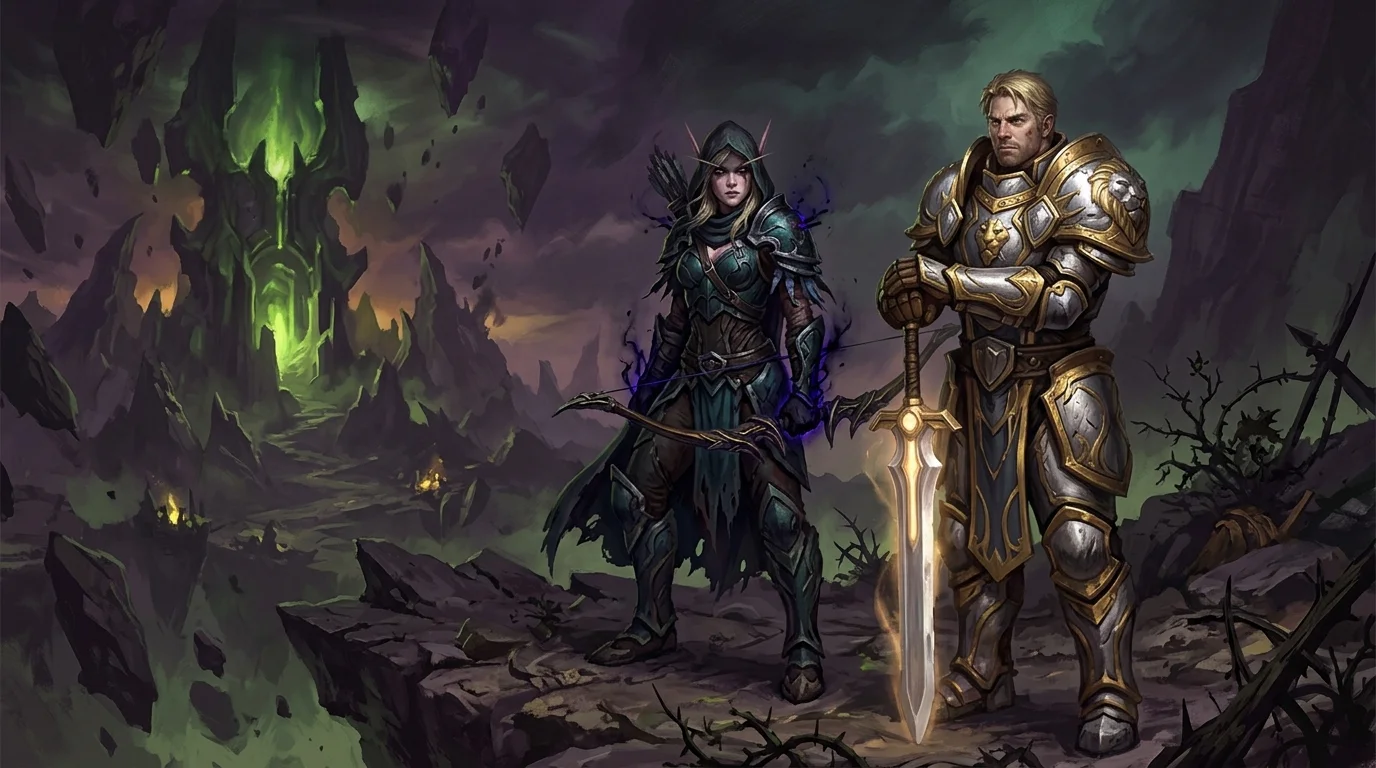
A Thousand Years of War: Alleria and Turalyon in the centuries they spent in Argus
Their disappearance was never narratively empty
For a long time, Alleria and Turalyon existed in Warcraft lore as legendary absences. Everyone knew they had disappeared after the Second War. Few people felt the real weight of this. A Thousand Years of War solves this problem brilliantly.
The audio drama doesn't just tell you where the two have been. It shows what centuries of war do to a relationship, to an identity and to the idea of resistance itself.
The audio drama format
The work was released in three parts and has its own rhythm, very different from a written short story or animated short.
Why format matters
Audio drama depends on voice, pause, narration and atmosphere. This fits perfectly with the story's proposal, because the text talks about the passage of time, accumulated tiredness and internal transformation. The listener feels the emotional duration of the war.
What happened to Alleria and Turalyon after Draenor
After disappearing at the end of the Second War, the two were not simply “saved for future use”. They continued fighting.
What the audio drama establishes
They join the Army of Light, participate in a very long war against the Burning Legion and are no longer just heroes of Azeroth. They become veterans of a practically cosmic conflict.
This point is essential because it places Turalyon and Alleria on a much larger scale than that of the old Warcraft II.
The Army of Light and the price of endless war
One of the greatest merits of the audio-drama is showing that the Army of Light is not a clean fantasy of heroism. It is an extreme survival force.
What does this do to the characters
Centuries of combat produce something ambiguous:
- strength;
- discipline;
- transcendence of purpose;
- but also wear, rigidity and distance from the world they left behind.
This helps to understand why their return in Legion is not a simple happy reunion. They come back very changed.
Alleria and the Void
This is the heart of the text for anyone thinking about Midnight.
When everything changes
Alleria doesn't just fight the Legion. At some point, she realizes that the Light alone may not be enough to face certain threats. This is where her trajectory becomes truly unique. She begins to approach the Void and, with that, enters a region of lore that no other great hero of Azeroth occupied in that way.
The effect of this
Alleria is no longer just a legendary ranger. She becomes a liminal figure between incompatible forces. This is what makes her such an important piece for Midnight.
Turalyon in the face of this transformation
The audio drama is also strong because it does not make Turalyon a mere companion to Alleria.
What he feels
For Turalyon, Alleria remains the person he loves, but she also becomes something he doesn't fully understand. The conflict between devotion to the Light and love for someone touched by the Void produces an intimate tension that is very rare in Warcraft.
This tension enriches both characters. Neither comes out any smaller. Both are more complex.
Why this is essential for Legion
Without A Thousand Years of War, their return in Legion loses a lot of weight. The player would see them almost as legends reappearing at the right time. With the audio drama, the return starts to carry:
- history;
- trauma;
- change of scale;
- ideological transformation.
They don't return intact. They return marked by too much time.
And why this is even more important for Midnight
If Legion needed the audio drama to explain the return, Midnight needs it to explain the centrality of Alleria.
The reason
Midnight revolves around the Void, Xal'atath, K'aresh and the dispute over how to face this threat. Alleria had been prepared for this for years. Anyone who listens to the audio-drama realizes that her path to Midnight is not improvised. It's a long build-up.
The greatest merit of the audio drama
It treats time as narrative matter. It doesn’t just say “a thousand years have passed”. It makes the audience feel that a thousand years have deformed relationships, beliefs, perspectives and even emotional language.
This is very rare in Warcraft, where centuries sometimes pass too quickly.
Minimum recommendation
Listen to A Thousand Years of War thinking about two things at the same time: the war against the Legion and the birth of the Alleria who would one day step into Midnight as a central figure. The audio-drama bridges the gap between these two moments. Without it, the return of Alleria and Turalyon is just lore. With it, it becomes accumulated life.
Posts Recomendados
Velen: ten thousand years running from Kil'jaeden and the prophecy that has always guided the Draenei
Velen is less a powerful wizard and more the leader who carried the Draenei through millennia of flight, faith and loss, eyeing a future few could see.
Locus-Walker: Alleria's ethereal master and what he knows about the Void
Locus-Walker masters the Void without losing himself, trained Alleria when almost no one understood that power and carries the memory of K'aresh's fall.
Magtheridon: the pit lord of Hellfire Citadel
Who is Magtheridon: the pit lord who ruled Outland, lost the Black Temple to Illidan and became the blood source for fel orcs in Hellfire Citadel.
Saurfang and Dranosh: father and son of the Horde
Varok and Dranosh Saurfang: the son hidden in Nagrand, his death at the Wrathgate, the Deathbringer in ICC and the father who takes him home. Full arc.