
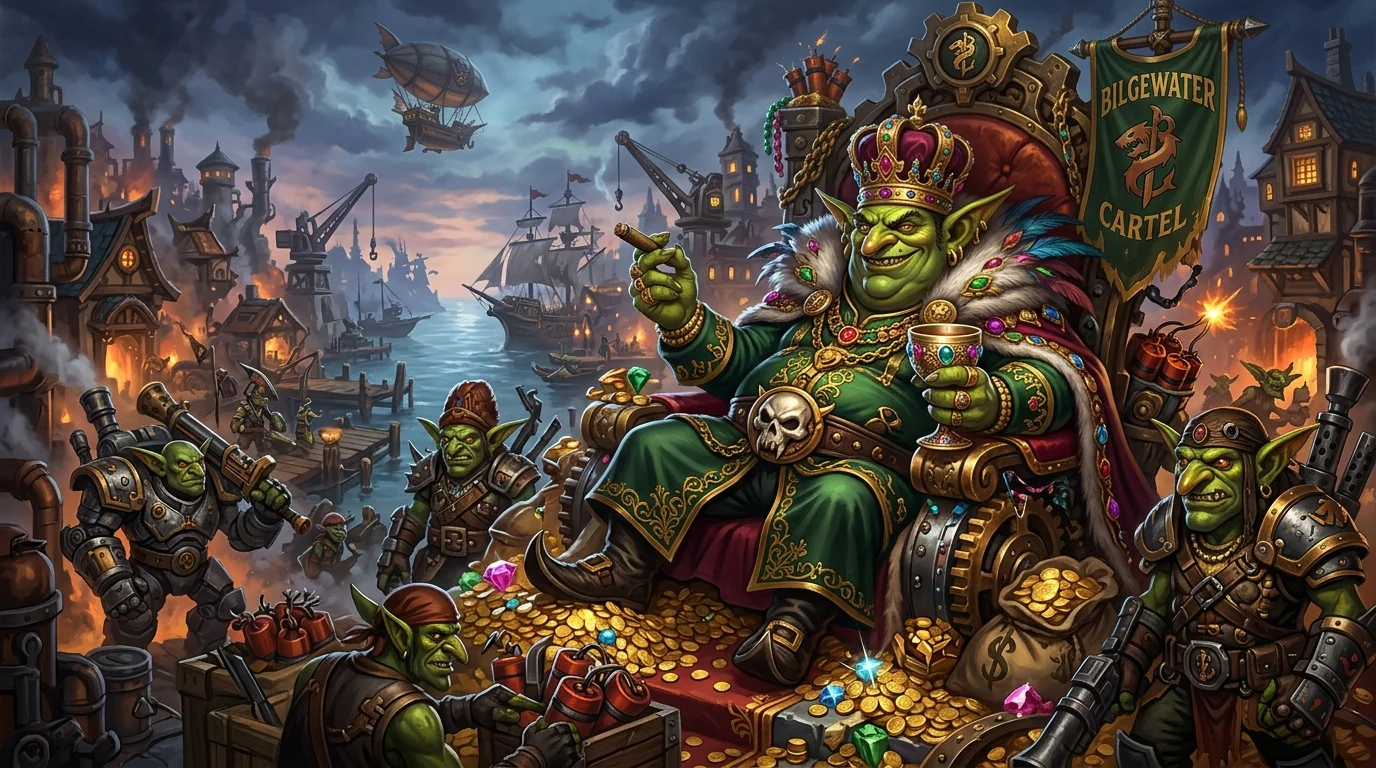
Gallywix: Trade Prince, opportunist and the goblin who shaped the Bilgewater Cartel
Gallywix works because it never tries to look better than it is
Gallywix is neither a noble-sounding villain nor a guilt-ridden contradictory leader. He is a goblin taken to its logical extreme. Instead of hiding his own nature, he transforms it into a method: profit above dignity, advantage above loyalty, survival above any honor that gets in the way of the business.
This is precisely why he is so good as a character. Gallywix doesn't pretend. He embodies the goblin caricature to the point where the caricature becomes a real threat.
The rise: betrayal, opportunism and calculation
How he gets to the top
Gallywix does not rise by moral legitimacy. It rises through predatory efficiency. He understands early on that in the goblin world, charisma, intimidation, debt, and spectacle can be as important as money—as long as they all end up working for you.
What does this reveal
His rise explains one central thing: Gallywix isn't just rich. He is someone who understands how to turn chaos into personal leverage.
This is his talent:
- explore despair
- buy temporary loyalty
- sell exit where there is only fear
- always leave with more than you entered
He is less a statesman and more a professional crisis operator for his own benefit.
Kezan exploding and the "ransom" charged
What happened
When Mount Kajaro erupts and Kezan begins to crumble, Gallywix turns catastrophe into opportunity. Instead of acting as a leader of the people, he acts as a mediator of the apocalypse. He charges tickets, packages survivors, treats evacuation like a market.
This is perhaps the character's most defining moment.
Why this phase is so important
There it becomes clear that Gallywix would never see the cartel itself as a community. For him, the cartel is an economic asset. The people exist as long as they generate margin.
This logic makes him a perfect portrait of the most rotten side of goblin fantasy:
- ingenuity without ethics
- improvisation without solidarity
- leadership without any sense of care
Forced entry into the Horde
What happened
After the disaster, Gallywix tries to continue operating with the same ego as always. The problem is that he finally finds someone with enough raw power to frame him: Thrall.
The incorporation of Bilgewater into the Horde does not happen because Gallywix had admirable political vision. It happens because he realizes that, faced with Thrall, the best deal available is to surrender and keep what he can keep.
What does this say about him
This point is great because it shows the difference between Gallywix and suicidal villains. He doesn't fight to the end out of abstract pride. He backs down when the account doesn't close.
This makes it more realistic and, in certain contexts, even more dangerous. He knows how to lose a round to stay alive in the game.
Gallywix within the Horde: always operating from his own angle
How it works in the coalition
Within the Horde, Gallywix never sounds like a true man of cause. He is there because the Horde offers structure, access, market, protection and space to continue getting rich.
He does not dissolve into the coalition. He uses it.
Why this is important
This prevents the character from becoming just "the funny goblin of the faction". Gallywix represents a permanent internal critic:
What if a leader is in the Horde not because he believes in it, but because it is convenient?
With him, the faction has an ally at home who is always calculating the next individual advantage.
Bilgewater's legacy goes beyond Gallywix himself
What he shaped
Even though he is morally toxic, Gallywix helps define the image of the Bilgewater Cartel on Azeroth. The cartel arrives associated with speed, risk, exploration, industrial improvisation and a culture in which everything can be sold.
This marks the goblins of the Horde for many years. And that is precisely why Gallywix's subsequent departure becomes so relevant.
What changes without him
When Gallywix leaves the scene as the main political face and Gazlowe takes over as Trade Prince, the contrast is brutal. Bilgewater remains goblin, remains capitalist, remains chaotic — but it no longer needs to be governed by the logic of the absolute parasite.
The difference between the two characters helps to show that "being a goblin" and "being Gallywix" are not exactly the same thing.
Disappearance does not end the character
The most common reading error
It's easy to think that Gallywix simply disappears and becomes a transitional detail for Gazlowe. Today, this no longer describes the situation well. His legacy doesn't end with his abandonment of the Horde.
What the recent phase shows
The latest developments place Gallywix back at the center as Chrome King and high-profile antagonist in Undermine. This is perfect for the character, because it shows that he was never someone who was meant to go out quietly. Even away from Bilgewater's direct control, it continues to represent the same principle: accumulating power, luxury and dominance until it becomes a systemic problem.
In other words: "without Gallywix in command" applies to Bilgewater, but not to the history of goblins as a whole. He continues to haunt this universe.
What does Gallywix represent in WoW
Gallywix represents the extreme version of a question that Warcraft likes to repeat across various factions:
what is left when competence and ambition no longer have any moral restraint?
In his case, this is what remains:
- an effective but corrosive leader
- a brilliant survivor but incapable of genuine loyalty
- a cultural symbol so strong that it continues to shape goblins even when it no longer rules directly
Why he is an important character
Gallywix is important because it stops the goblin fantasy from becoming just comic relief. With him, the game with profit and explosions gains political consequences.
He remembers all the time that:
- technology without ethics can become oppression
- economic improvisation can turn into slavery
- cynical humor can hide real brutality
This gives weight to the goblin core of the lore.
Minimum recommendation
To understand Gallywix properly, follow this order:
- the rise of Bilgewater as the result of opportunism and cruelty
- Kezan and evacuation treated like business
- pragmatic submission to Thrall and entry into the Horde
- the years in which he operates the coalition, always for his own profit
- the comparison to Gazlowe and Gallywix's recent return as proof that his legacy was never small
Gallywix is not great because he is admirable. He's great because he turns all the worst goblin impulses into a system of power—and he still manages to seem satisfied with it.
Posts Recomendados
Undermine: the goblin capital and what the city says about power, profit and chaos
Undermine is the city where Azeroth tests what happens when almost everything becomes a market: neighborhoods, security, politics and even loyalty.
Baine Bloodhoof: the tauren leader between honor, diplomacy and his father's heritage
Baine Bloodhoof, son of Cairne, inherited a grieving people and an unstable Horde. His strength was the courage to say no when honor was put up for sale.
Magtheridon: the pit lord of Hellfire Citadel
Who is Magtheridon: the pit lord who ruled Outland, lost the Black Temple to Illidan and became the blood source for fel orcs in Hellfire Citadel.
Saurfang and Dranosh: father and son of the Horde
Varok and Dranosh Saurfang: the son hidden in Nagrand, his death at the Wrathgate, the Deathbringer in ICC and the father who takes him home. Full arc.