
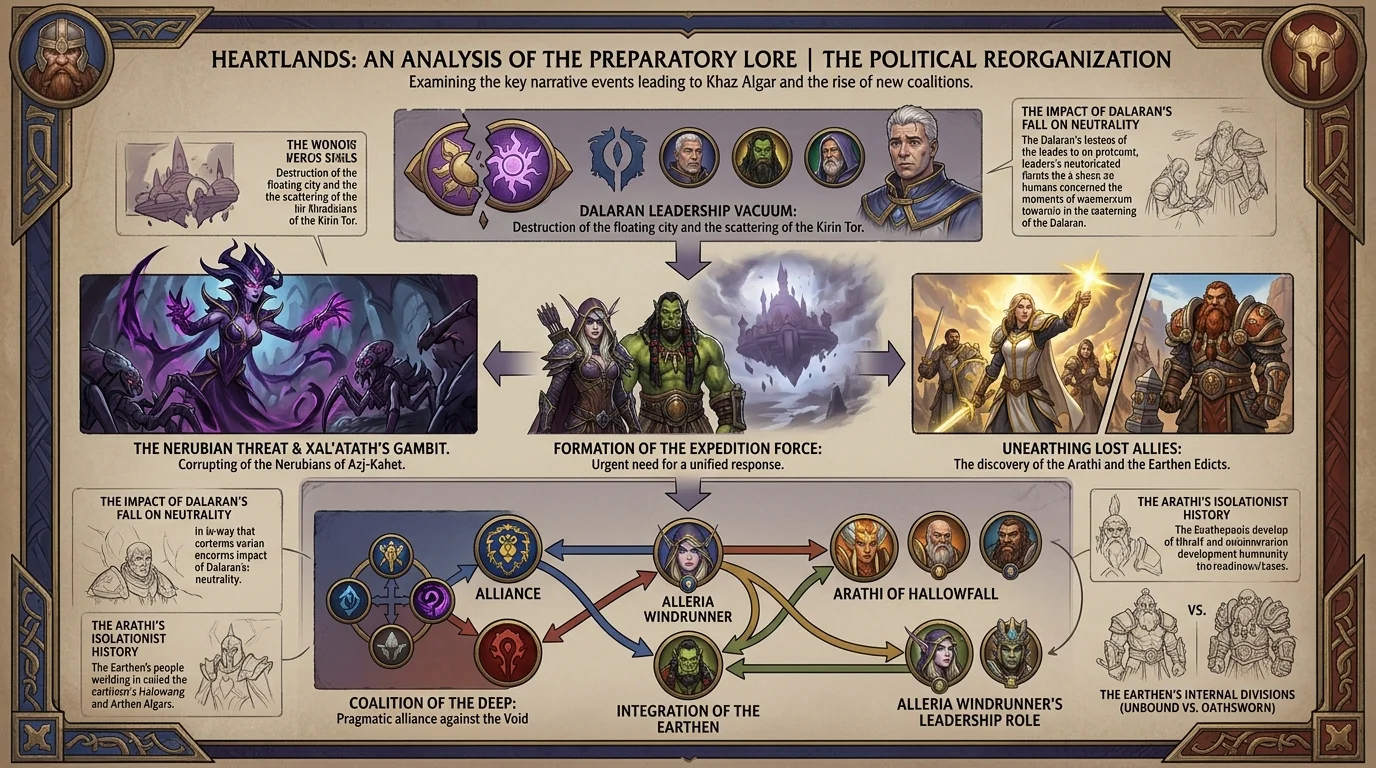
Heartlands: analysis of the official tale that prepared the political reorganization of The War Within
A short story that deals with politics without looking like meeting minutes
Heartlands works better than many people imagine because it understands one simple thing: after so many expansions of cosmic trauma, the world needs to relearn how to talk.
The story does not exist to replace the campaign. It exists to prepare the emotional and political ground in which the next decisions will make sense. That's why it weighs so much on those who follow the bigger story.
What happens in Heartlands
The starting point already shows the ambition of the text: after the fall of Dalaran, Jaina and Thrall try to bring together leaders in Boralus to organize a response to Xal'atath and the new moment of crisis.
This premise is excellent because it shifts the focus from the individual hero to the collective problem. It's not about a champion discovering something. It's about leaders trying to build coordination in a tired, hurting and distrustful world.
Why Blizzard publishes this story now
Heartlands has a clear editorial function: to create political density between major chapters of the saga. The main campaign needs to move forward, but it is not always able to stop to show meetings, resentments, hesitations and disputes of vision.
The story does this job. He weaves together mental states and power relations that, without additional text, would only remain presupposed.
And this helps a lot in the experience of those who follow the narrative more closely. Instead of receiving ready-made decisions, you see the process of preparing them.
What the tale reveals about Thrall, Jaina and the others
Thrall
Thrall appears here not just as a former Warchief or ancient moral symbol, but as someone trying to relearn mediation in a world very different from the one that formed him. This gives the character an interesting maturity.
Jaina
Jaina, in turn, emerges as one of the few figures with enough weight to talk about war and cooperation at the same time without seeming naive. She knows cost, loss and responsibility.
The rest of the table
The most important thing, however, is the set. Heartlands is not a text about a single protagonist. It is a text about a difficult balance between voices with different stories, wounds and interests.
Political reorganization at stake
The story is valuable because it shows that politics in Azeroth is no longer limited to the old “Horde versus Alliance and that’s it” model. The problem is now more complex.
There is a need for coordination against existential threat, but there is also the weight of memories too recent to be erased. Heartlands works precisely with this tension: necessary cooperation and insufficient trust.
This is the best possible basis for the current stage of the saga.
How it changes the reading of The War Within
Reading Heartlands before or alongside the campaign helps because the story adds texture to the background. Characters stop looking like pieces that “just are there” and start to be seen as political agents trying to decide how the world will respond to a different crisis.
He doesn't rewrite TWW. It improves your support.
Why Heartlands matters
Because Warcraft, when it wants to, knows that good war isn't just explosions and invasions. It is also difficult alignment, wounded pride, an attempt to rebuild legitimacy and a dispute over who still deserves to be heard.
Heartlands understands this and delivers one of the best recent uses of supplementary media in the universe.
Minimum recommendation
If you want to make the most of the current phase of the lore, read Heartlands not as an “extra story”, but as a political backdrop to the saga. It helps you understand why certain alliances feel strained, why certain leaderships weigh more heavily now, and why The War Within doesn't begin in a world at peace — it begins in a world trying to learn to cooperate again.
Posts Recomendados
The Tipping Point: the tale that showed the political break between Horde and Alliance
The Tipping Point uses Renzik, Undermine and a clash with an Alliance agent to show how crime, survival and politics intertwine. Learn what it really does.
Faith & Flame: analysis of the tale of Faerin Lothar and the weight of faith in Midnight
Faith & Flame shows Faerin Lothar before she became a symbol, with faith as a tested calling. See the bridge between Hallowfall and Midnight's Light.
Magtheridon: the pit lord of Hellfire Citadel
Who is Magtheridon: the pit lord who ruled Outland, lost the Black Temple to Illidan and became the blood source for fel orcs in Hellfire Citadel.
Saurfang and Dranosh: father and son of the Horde
Varok and Dranosh Saurfang: the son hidden in Nagrand, his death at the Wrathgate, the Deathbringer in ICC and the father who takes him home. Full arc.