
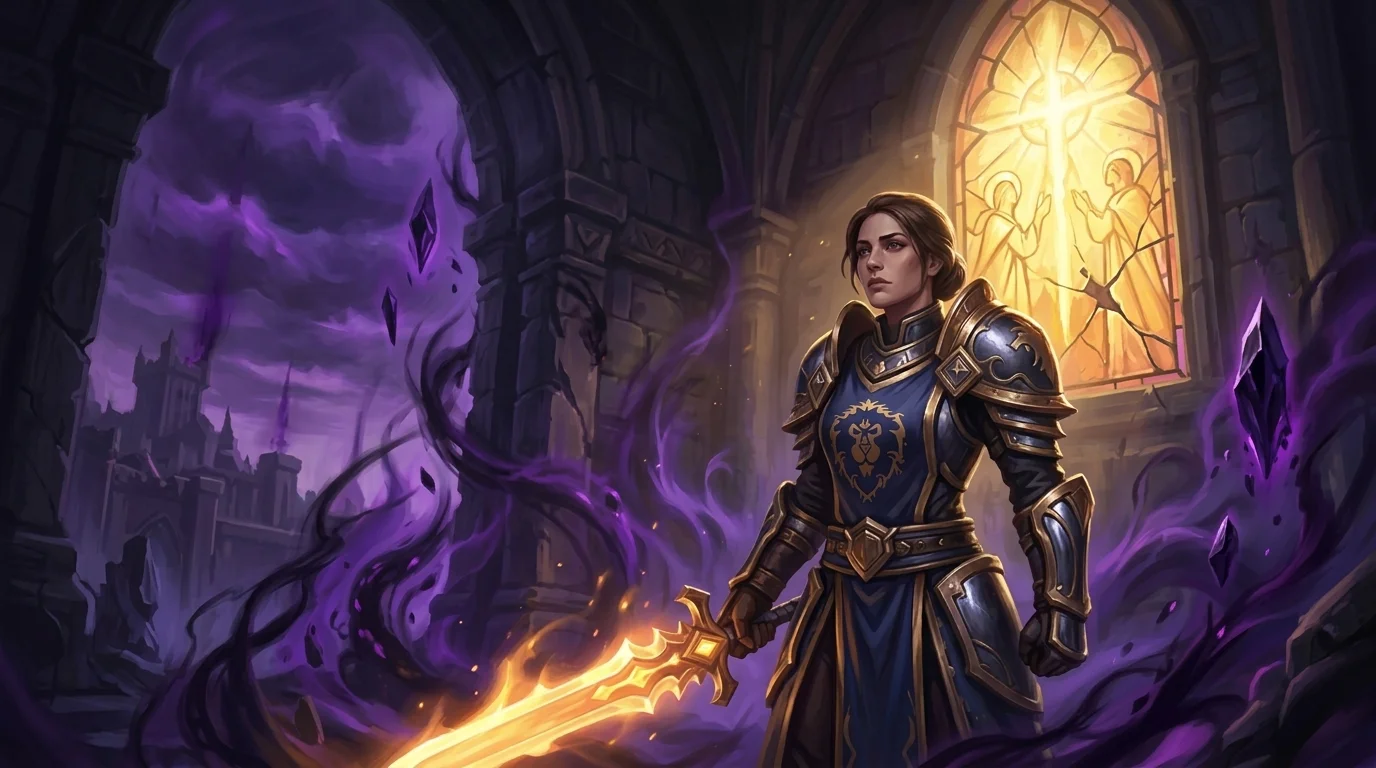
Faith & Flame: analysis of the tale of Faerin Lothar and the weight of faith in Midnight
A tale about faith before being a tale about heroism
Faith & Flame gets it right because it doesn't treat Faerin as “the important new character” and that's it. Treat her as a person formed by calling, tradition and doubt.
This is essential. When a religious character enters the center of the lore without interiority, he becomes a slogan. The story avoids this. He shows faith as weight, momentum and risk.
What happens in Faith & Flame
The tale follows Faerin once again feeling the call that pushes her out of Hallowfall alongside Anduin and the outsiders. Instead of presenting this as an easy decision, the narrative works on the tension between staying and leaving.
This is the engine of the text. Leaving is not just abandoning a place. It is putting the form of faith built within that place to the test.
Where does this tale fit in
Faith & Flame was published in the later narrative cycle of The War Within, linked to the Legacy of Arathor arc, but its thematic strength clearly points to Midnight. It helps set the emotional stage for a phase of lore in which Light, identity, and heritage will return to center.
In other words: even though it is not “the main campaign of Midnight”, it is very important to understand the atmosphere that is being created.
What Faerin reveals about the new generation
Faerin is not a repeat of the old image of the Warcraft paladin. It comes from Hallowfall, from isolation, from rituality and from a very concrete relationship with the Light.
That makes a difference. Your faith is not born in consolidated order from the surface. It was born in an underground civilization that preserved a language of duty and transcendence in extreme conditions.
That's why it sounds new even though it carries old symbols.
Faith established versus faith tested
This is the central theme of the story. Established faith is faith that already has a home, rite, routine and vocabulary. Tested faith is faith forced to move, confront the world and live with the unknown without losing form.
Faith & Flame works precisely on the transition between one and the other. And he does this without ridiculing devotion or romanticizing insecurity.
The result is good because it avoids caricature. Faerin is neither a fanatic nor a “cool believer”. It's someone trying to be faithful without stopping thinking.
Why the short story matters to understand Midnight
Because Midnight will push the themes of Light, Void, inheritance and identity to a much more intense level in Quel'Thalas and its surroundings. Having a character like Faerin already worked on internally before this is a huge advantage.
The story does this preparation. It doesn't just deliver information. Deliver disposition of soul. And that's what helps most when the character gets into bigger stories later.
The value of complementary media like this
Faith & Flame is a great example of why official tales can matter a lot. They take characters who, within the campaign, could appear already “resolved” and show the inner process that makes their choices more convincing.
Warcraft improves a lot when it does this.
Minimum recommendation
If you want to understand Faerin beyond her look, her last name, or her campaign role, read Faith & Flame as a vocation study. The tale shows that its value is not only in representing a tradition of faith, but in being able to take it outside the protection of Hallowfall without emptying it.
Posts Recomendados
Faerin Lothar: relative of Anduin Lothar and the new voice of faith in Midnight
Faerin Lothar is more than a famous surname: she links human legacy, arathi faith, courage and the Worldsoul Saga's new phase, without empty nostalgia.
Hallowfall: eternal light, faith of the Arathi and the civilization that survived underground
Hallowfall makes The War Within's underground a place of transcendence, where light is no metaphor: it is infrastructure, faith, politics and survival.
Magtheridon: the pit lord of Hellfire Citadel
Who is Magtheridon: the pit lord who ruled Outland, lost the Black Temple to Illidan and became the blood source for fel orcs in Hellfire Citadel.
Saurfang and Dranosh: father and son of the Horde
Varok and Dranosh Saurfang: the son hidden in Nagrand, his death at the Wrathgate, the Deathbringer in ICC and the father who takes him home. Full arc.