
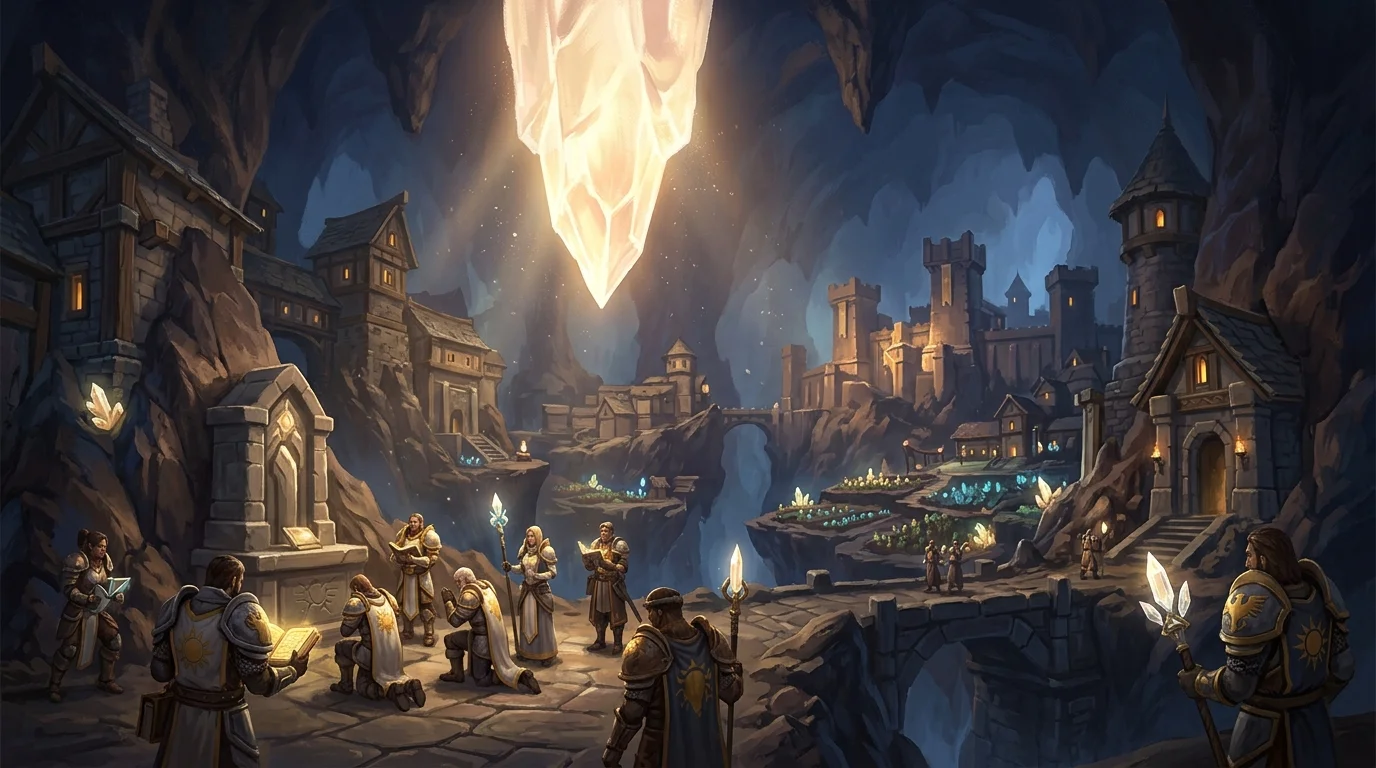
Hallowfall: eternal light, faith of the Arathi and the civilization that survived underground
The cave that looks like heaven
Hallowfall first impresses with its scale: a cave so vast that it defies the idea of a cave. But what makes the area stay in memory is not size. It is spiritual order.
Beledar, constant light, Arathi architecture and military discipline create an environment in which the underground stops feeling like exile and starts feeling like a mission. This alone makes Hallowfall different from almost everything else in WoW.
What is Hallowfall
Hallowfall is the luminous region of Khaz Algar, sustained by the presence of Beledar. The place seems impossible: an underground world in which light organizes everyday life, settlements, language and the very idea of hope.
This detail is essential. Hallowfall is not a random oasis. It is an entire civilization built around the permanence of light.
How the Arathi got there
The best way to read the origin of the arathi in Hallowfall is to accept that the people themselves narrate their presence in different ways. For some, it is about providential survival. For others, exile. For others still, the historical continuity of a mission.
And that variation is good, not bad. It helps build the feeling that Hallowfall is not just a pretty map, but a society with its own memory, and therefore with competing versions of its own past.
The society they built
Faith as social order
The arathi of Hallowfall are not just “devotees of the Light”. They structure their entire lives around it: defense, hierarchy, expectation of duty, moral reading of the crisis and way of facing the unknown.
This makes the area immediately dense. When faith is not just individual belief, every threat also becomes an institutional crisis.
Militarism as protection, not just aggression
The Arathi society there has a militaristic appearance, but it is not limited to caricatural militarism. Discipline is born of isolation and necessity. They survived because they organized themselves as a people who expected constant testing.
This kind of worldbuilding is what makes Hallowfall so interesting. It’s not just “paladins underground”. It is an entire culture shaped by more than a decade of enclosure and almost permanent light.
Beledar and the meaning of eternal light
Beledar does more than illuminate. It legitimizes. It is the point that unites cosmology, routine and political imagination. As long as its light remains, society feels that it is still within a greater meaning.
Therefore, any threat linked to this light is also a threat to collective identity. It's not just about losing physical security. It's about losing the visible proof that their faith is still responding.
Rise of the Red Dawn and the crisis within
The strength of the arc is in showing that the danger does not just come from outside. Hallowfall enters into tension because faith and pragmatic survival begin to diverge.
This type of conflict is always better than a simple external attack. It forces the people to decide what they are willing to sacrifice in order to continue existing. And that's where the area grows.
Rise of the Red Dawn doesn't just work as a regional campaign. It functions as a moral test for a society that believed itself to be spiritually cohesive.
What Hallowfall represents in The War Within
Hallowfall is an uncomfortable reminder for surface Azeroth. It shows a people who preserved a vocabulary of duty, honor, discipline and transcendence in a way that many cultures above have already diluted or lost.
But the zone doesn't fully romanticize this. It also makes clear the cost of this type of preservation: rigidity, tension between orthodoxy and adaptation, and the danger of transforming faith into an absolute filter.
This is precisely why Hallowfall works so well. It is not just nostalgia for a purer Light. It is a lively debate about what faith does to a people isolated for more than a decade.
Faerin and the new generation
Faerin is one of the most important faces in this area because she embodies the transition between preserved tradition and a reopened world. She carries the arathi heritage, but does not exist just to repeat it. She exists to test it.
This makes Hallowfall even more relevant for the future of the saga. What emerges from there is not just a striking scenario. It is a new religious and moral voice for Azeroth.
Why Hallowfall has become so strong in recent imagination
Because it delivers something rare: a visually wonderful space that is also conceptually clear. You look at the zone and understand the theme. Light beneath the earth. Faith in isolation. Civilization surrounded by night, but refusing the night.
It's a simple, elegant and powerful idea.
Minimum recommendation
If you want to understand Hallowfall, don't just treat it as “the pretty zone of TWW”. Read the map as an experiment in civilization: what happens when an entire people grows underground, but around a light that never lets them forget who they believe they are?
Posts Recomendados
Khaz Algar: the underground continent and the four biomes of The War Within
Khaz Algar turns Azeroth's interior into narrative geography in The War Within: each zone is an argument about titans, survival, faith and invasion.
Faith & Flame: analysis of the tale of Faerin Lothar and the weight of faith in Midnight
Faith & Flame shows Faerin Lothar before she became a symbol, with faith as a tested calling. See the bridge between Hallowfall and Midnight's Light.
Magtheridon: the pit lord of Hellfire Citadel
Who is Magtheridon: the pit lord who ruled Outland, lost the Black Temple to Illidan and became the blood source for fel orcs in Hellfire Citadel.
Saurfang and Dranosh: father and son of the Horde
Varok and Dranosh Saurfang: the son hidden in Nagrand, his death at the Wrathgate, the Deathbringer in ICC and the father who takes him home. Full arc.