
Khaz Algar: the underground continent and the four biomes of The War Within
"The History of the Expansions" series — Episode 11. The story of World of Warcraft told expansion by expansion, with the patches that changed it. The episodes are listed in order at the end of the post.
The underground stops being a passage and becomes a continent
For many years, the underground of Azeroth served as a corridor, ruin, mine, prison or dungeon. Khaz Algar changes this scale. The War Within makes the interior of the world stop being an appendage and become a continental mass with its own history.
This matters because it changes the imagination of the scenario. We are no longer talking about “what’s underneath”. We are talking about an entire world beneath the world, with its own rhythms, people, infrastructures and crises.
Khaz Algar as a discovery
Khaz Algar's first impact is geographic, but the second is civilizational. The heroes descend hoping to find depth. They find continuity.
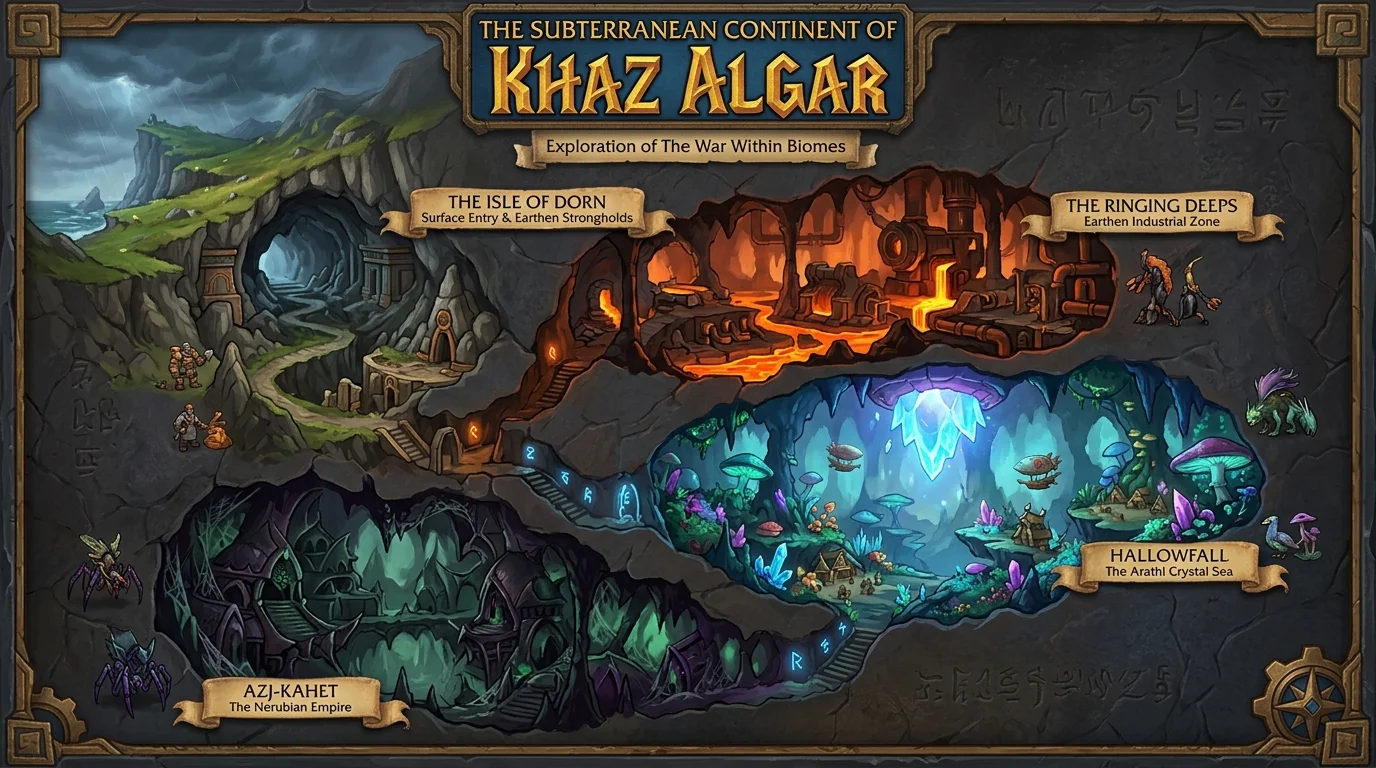
This is what sets the continent apart from so many other WoW underground zones. Khaz Algar does not exist as an anomaly. It exists as a system: high islands, industrial tunnels, cave of eternal light, nerubian hive and a titanic presence that stitches everything together.
Isle of Dorn: the entrance and the surface connected to the abyss
Isle of Dorn acts as a threshold. This is where The War Within tells the player that the underground is not the opposite of the surface, but a reorganized continuation of it.
The earthen, mineral landscape and the feeling of a “descending frontier” make the area a portal in a narrative sense. There begins the reading of Khaz Algar as something older than the current crisis.
It's also the best possible introduction to the expansion's central theme: the interior of Azeroth is not empty. It was always inhabited.
Ringing Deeps: industry, routine and titanic technology still in use
If Isle of Dorn introduces, Ringing Deeps explains how it works. The zone is important because it shows titanic technology not as a static ruin, but as a still operational structure.
This detail changes the tone. It's not just archaeology. It's world maintenance. Forges, routines, work and infrastructure create the feeling that the titanic legacy continues to produce everyday effects.
The expansion gains a lot from this because it avoids the caricature of “ancient civilization that only exists for loot and mystery”. Here, the ancient still works.
Hallowfall: eternal light in the center of the dark
Hallowfall is perhaps the biggest tonal shock on the continent. After so much stone, industry and depth, a space of persistent light emerges supported by Beledar and populated by isolated arathi.
The zone shows that Khaz Algar is not just a big underground map; it is a set of mental ecologies. Each biome carries a way of imagining the world. Hallowfall imagines the underground not as a grave, but as a sacred refuge.
That's why it weighs so much in the campaign. The Light there is not an ornament. It is social organization.
Azj-Kahet: the depth that becomes politics of the Void
Azj-Kahet is the stage in which Khaz Algar stops being discovered and becomes a structural confrontation. There, the expansion abandons any comfort of exploration and enters the terrain of domination, infiltration and ideological reorganization.
The nerubian hive is not just a military threat. It is a way of life transformed by power, caste, and pressure from the Void. This makes the zone the right closure of the continent before the final climb.
The four biomes as a thematic map
Khaz Algar works so well because each zone represents a different axis of the expansion:
- Isle of Dorn talks about entry, settlement and first contact
- Ringing Deeps talks about infrastructure, work and mechanism
- Hallowfall talks about faith, preservation and community
- Azj-Kahet talks about empire, paranoia and corruption
Together, they transform the continent into a narrative argument. They are not stacked biomes. These are stages of interpretation.
Why Khaz Algar feels so new in WoW
Because it does two things at the same time: it expands the scale of the world and compresses the feeling of enclosure.
You are on a vast continent, but there is always the awareness of ceiling, wall, depth and echo. This produces a unique identity. It's not an open ocean, it's not an infinite plain, it's not a lost island. It's an encapsulated world.
This idea fits perfectly with The War Within. The entire expansion talks about interiority: the planet, the factions, the memory, the faith and the threat.
The continent as a character
Khaz Algar is not just a setting for TWW. It puts pressure on all the characters. It forces us to rethink what is “center” and what is “margin” in Azeroth.
The surface no longer appears complete. The underground no longer seems secondary. This is a big change for the universe.
And maybe that's why Khaz Algar works so well. It doesn't just expand the map horizontally. It expands the way Azeroth can be imagined.
Minimum recommendation
If you want to truly understand Khaz Algar, don't think of the continent as four zones connected by campaign. Think of it as four different answers to the same question: What happens when an entire world exists beneath the thing you've always called the world?
"The History of the Expansions" series
← Previous: Patch 10.2: Fyrakk, Amirdrassil and the new beginning of the night elves Next → The War Within, part 1: The Radiant Song and Dalaran
- Episode 1: WoW Classic at a glance: major conflicts and faction reconstruction
- Episode 2: The Burning Crusade in order: Illidan, Kael'thas, Vashj and the fate of Outland
- Episode 3: WoW History: Wrath of the Lich King
- Episode 4: Cataclysm and the return of Deathwing
- Episode 5: WoW History: Mists of Pandaria
- Episode 6: WoW History: Warlords of Draenor
- Episode 7: WoW History: Legion, the Full Expansion
- Episode 8: The Fourth War in brief: how Azerite reignited the conflict between Horde and Alliance
- Episode 9: WoW History: Shadowlands
- Episode 10: The awakening of the Dragon Isles and the return of the Aspects
- Episode 11: Khaz Algar: the underground continent and the four biomes of The War Within (you are here)
- The War Within, part 1: The Radiant Song and Dalaran
- The War Within, part 2: The Earthen and Isle of Dorn
- The War Within, part 3: The Ringing Deeps
- The War Within, part 4: The Arathi Expedition
- The War Within, part 5: Azj-Kahet and Ansurek
- The War Within, part 6: The War for Khaz Algar
- The War Within, part 7: Undermine and Gallywix
- The War Within, part 8: Ghosts of K'aresh
- Episode 12: Midnight: why Quel'Thalas became the center of the war against the Void
- Episode 13: The Last Titan: what we know about the end of the trilogy
Posts Recomendados
Hallowfall: eternal light, faith of the Arathi and the civilization that survived underground
Hallowfall makes The War Within's underground a place of transcendence, where light is no metaphor: it is infrastructure, faith, politics and survival.
Azj-Kahet: the nerubian hive and what the colony city reveals about the Void
Azj-Kahet, the Nerubian hive of The War Within, turns Nerubian heritage into a total society: politics, caste, paranoia and the Void. Learn more.
Saurfang and Dranosh: father and son of the Horde
Varok and Dranosh Saurfang: the son hidden in Nagrand, his death at the Wrathgate, the Deathbringer in ICC and the father who takes him home. Full arc.
Dalaran in Northrend: why the city flew
Dalaran in Northrend: why the Kirin Tor took the city into the sky over Crystalsong, who rules it and what the Violet Hold keeps locked. See the summary.