
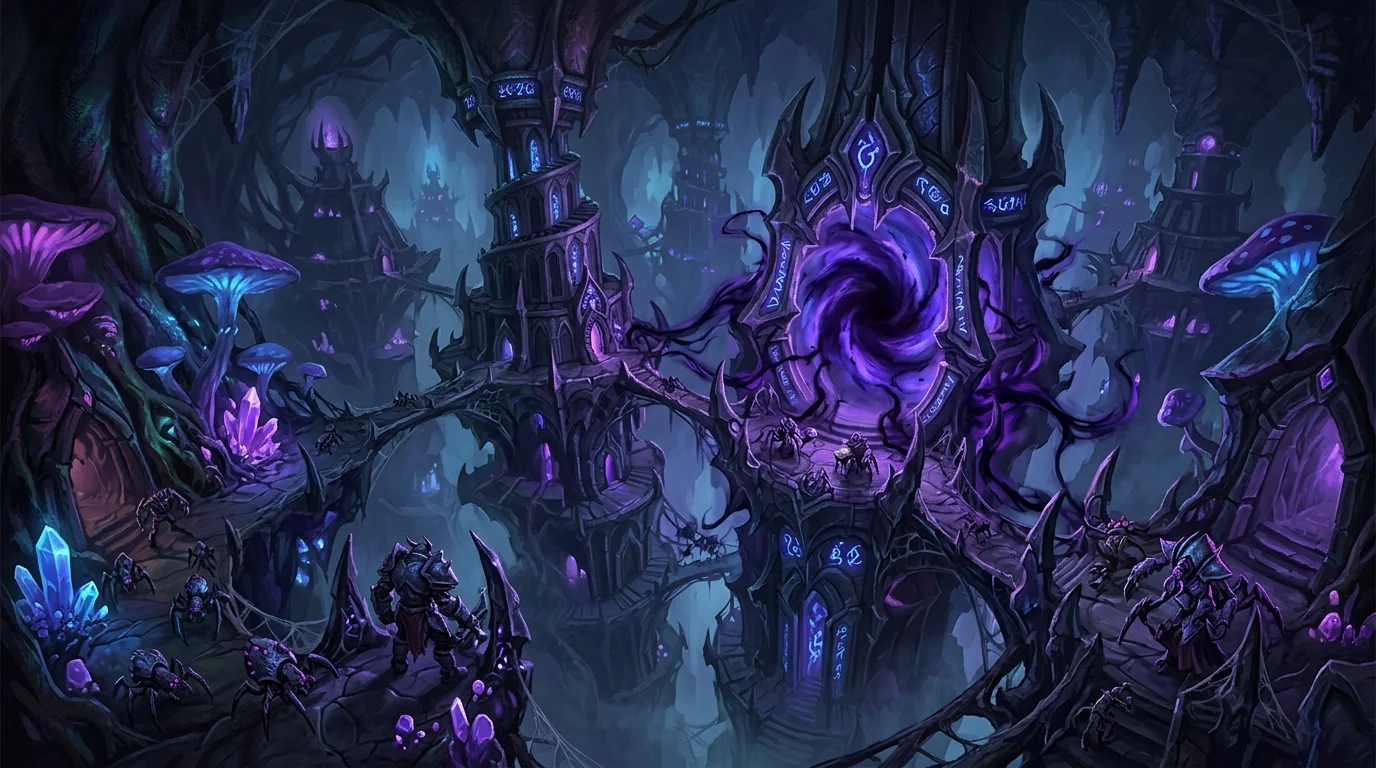
Azj-Kahet: the nerubian hive and what the colony city reveals about the Void
The city where the Void does not enter as an invader — it enters as language
Azj-Kahet impresses not only with its hive look, tunnels and oppressive architecture. What makes the zone special is the feeling of a closed system.
There, everything seems to obey a collective logic that precedes the player, even prior to the immediate crisis itself. Castes, duties, access to power, obedience to the Queen, ideological manipulation: the colony city was already highly organized before the Void intensified everything.
That's what makes it so dangerous. The Void doesn't need to build an empire from scratch. He just needs to infiltrate what already works.
Azj-Kahet as a society
Azj-Kahet is not just “the nerubian zone”. It is a political model. The hive organizes function, hierarchy and identity almost completely.
This makes the city seem inevitable to those born there. And this inevitability is the perfect ground for control. The more natural an order seems to its inhabitants, the less it needs to justify itself.
Castes, hierarchy and the logic of the hive
The best way to understand Azj-Kahet is to realize that there is not just social division there. There is distribution of meaning. Each group knows where it is, what it is for and who it responds to.
This structure generates efficiency, but it also generates moral fragility. When the central authority is captured by paranoia or the lure of greater power, the entire hive can be dragged along.
That's why the city is so good as a setting for The War Within. It translates politically something that the Void has always done metaphysically: absorbing everything into a single order.
The role of Queen Ansurek
Ansurek is not just a ruler. It sets the tone for what it means to be Nerubian at that historical moment. This type of figure is central in such verticalized societies.
When the Queen changes her orientation, the collective identity changes with her. The problem is that, in Azj-Kahet, this change does not happen in a neutral environment. Xal’atath’s influence accelerates the worst kind of transformation: one that promises greatness while dissolving autonomy.
Ansurek then becomes more than just the final boss. It becomes the symbolic center of a race in dispute.
The Void inside the hive
Infiltration before open war
The great intelligence of the area is to show the Void as an ideological infiltration, not just as a military force.
Before becoming an army, the Void becomes a language of destiny, greatness, inevitability and purification. He convinces before he crushes. This fits perfectly with the Nerubian structure, which already values order, command and centrality.
Xal’atath understands the terrain
That's why Xal'atath works so well here. It doesn't come by imposing everything from the outside. She interprets society and finds where to press: fear, ambition, obedience, dream of sovereignty.
Azj-Kahet then becomes less “a conquered place” and more “a reprogrammed place”.
What the nerubians wanted before this
This is too important a point to ignore. The Nerubians didn't exist just waiting for the Void to give them purpose. There was self-will, self-memory and self-interest before the infiltration.
The question “did they want independence or conquest?” is good precisely because the answer is not clean. There was political ambition there. The problem is that the Void transforms ambition into absolutism.
Nerub-ar Palace and the collapse of the system
The final battle doesn't just destroy one boss. It destroys the stable — albeit terrible — way in which that system had been sustaining itself.
And that gives the climax real weight. After Ansurek, there is simply “a liberated kingdom” left. What remains is a collapsing body politic. An empire that loses its center without automatically gaining a new balance.
This type of consequence is what differentiates a good political zone from a boss map.
What Azj-Kahet reveals about the Void
Azj-Kahet reinforces an important idea for the Worldsoul Saga: the Void is more dangerous when it finds a structure ready to inhabit. He doesn't need to destroy first to dominate later. Sometimes it is enough to amplify rigidity, paranoia and the desire for transcendence.
This is why the zone is so valuable to the larger narrative. It shows the Void as a corruption of the system, not just of the individual.
Minimum recommendation
If you want to truly understand Azj-Kahet, don’t just treat the zone as “the TWW raid realm.” Read the hive as a thesis about power: when total hierarchy meets Void influence, the problem isn't just who's in charge. It is the idea of identity that starts to rule everyone.
Posts Recomendados
Khaz Algar: the underground continent and the four biomes of The War Within
Khaz Algar turns Azeroth's interior into narrative geography in The War Within: each zone is an argument about titans, survival, faith and invasion.
Locus-Walker: Alleria's ethereal master and what he knows about the Void
Locus-Walker masters the Void without losing himself, trained Alleria when almost no one understood that power and carries the memory of K'aresh's fall.
Saurfang and Dranosh: father and son of the Horde
Varok and Dranosh Saurfang: the son hidden in Nagrand, his death at the Wrathgate, the Deathbringer in ICC and the father who takes him home. Full arc.
Dalaran in Northrend: why the city flew
Dalaran in Northrend: why the Kirin Tor took the city into the sky over Crystalsong, who rules it and what the Violet Hold keeps locked. See the summary.