
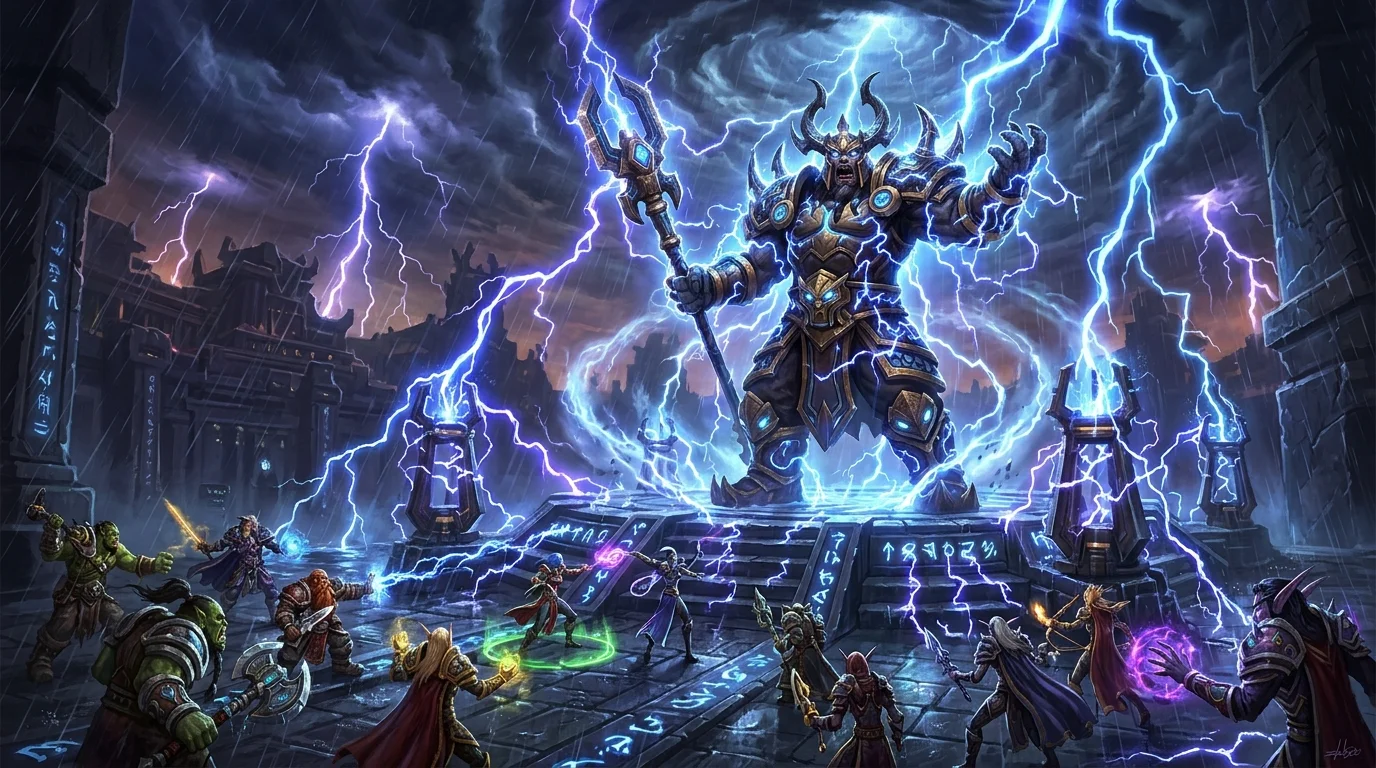
Isle of Thunder: Throne of Thunder, the return of Lei Shen and the mogu secrets
The Isle of Thunder is the moment when Pandaria dives once and for all into the mogu past
To a certain extent, Mists of Pandaria seems to revolve mainly around Sha, Horde, Alliance and Garrosh. But the Isle of Thunder changes the scale of the expansion. With the return of Lei Shen, the history of Pandaria goes back much deeper in time and forces the continent to face the legacy of the mogu once again.
The island functions almost like a political crypt: an isolated place, prepared to preserve the power, memory and technology of an empire that never stopped wanting to return.
The Isle of Thunder
The isolated stronghold of mogu secrets
The Isle of Thunder is not just any island converted into a raid. It was kept as a space for the concentration of power, knowledge and imperial apparatus linked to the Thunder King. Everything there gives a feeling of deliberate seclusion.
What does this say about Lei Shen
Lei Shen was not just a strong conqueror. He was a ruler who understood the value of keeping technology, strength, and symbols of power in places separate from the ordinary world. The island exists to say that its domain had structural depth.
Who resurrected Lei Shen
The Zandalari
The return of the Thunder King passes directly through the Zandalari. They don't enter this story as extras. They are the ones who invest in the rebirth of Lei Shen and bet that the imperial past can reorganize the balance of the world in their favor.
The political price of this decision
Their partnership with the mogu shows another important thing: Zandalari desperation in the face of the weakening troll in the modern world. Resurrecting Lei Shen is an extreme risk gamble. It’s not just reverence for the past; it is an attempt to regain continental relevance.
What exists in Throne of Thunder besides the final boss
Mogu technology
The raid and the island make a point of showing that the mogu empire combined brutality with technical sophistication. Lei Shen was not just a tyrant with an army. He controlled structures, conduits, systems, and engineering aimed at maintaining large-scale domination.
Slavery as a structure of empire
Another important part of the mogu legacy is the normalization of slavery. The Throne of Thunder doesn't just communicate military power; it also communicates an order based on constant subjugation.
Blood magic and terror centralization
The architecture, experiments and the way power circulates throughout the fortress reinforce that the mogu empire did not separate science, mysticism and violence. Everything could become an instrument of government.
Ra-den and what Lei Shen stole
The imprisoned Titan Keeper
Ra-den is one of the most important pieces on the island because it changes the scale of the problem. With him, the story stops being just “mogu tyrant resurrected” and also becomes a narrative of the usurpation of a titanic legacy.
What Lei Shen took from him
Lei Shen did not build his empire from nothing. He appropriated power, knowledge and authority that belonged to a greater order. This helps show why he is remembered as something more dangerous than a simple warlord.
The legacy of the Isle after the fall of Lei Shen
What remains when the emperor falls again
Lei Shen's second death does not erase what the island revealed. The continent continues to know that the mogu possessed imperial depth, access to stolen titanic power, and possible alliances with other ambitious forces.
Who passes by afterwards
Even after the main campaign, the island remains a space of imperial memory and dangerous archaeological residue. The problem was not just Lei Shen being alive. The problem was also what his return proved about Pandaria's past.
What the Isle of Thunder really adds to the lore
| Element | What adds | |---------|-------------------| | Lei Shen resurrected | return of mogu imperial logic | | Zandalari | political bet on the past as a weapon | | Throne of Thunder | concentration of technology, terror and power | | Ra-den | direct link with the titanic legacy | | Post-fall | permanence of the secrets and residues of the empire |
Lei Shen matters because it shows what Pandaria buried beneath the surface
The Sha show what arises from the emotional and spiritual. Lei Shen shows what comes back from the political and the imperial. It's this combination that makes Mists of Pandaria feel so dense.
The Isle of Thunder proves that the continent didn't just hide ancient fears. It also hid structures of domination ready to reappear.
Minimum recommendation
To read Isle of Thunder well, it’s worth following this logic:
- see the island as a vault of mogu past
- understand the Zandalari as active agents of Lei Shen's return
- treat the Throne of Thunder as an empire condensed into architecture
- remember that Ra-den expands the story to the titanic plane
- realize that the fall of Lei Shen resolves the boss, but does not erase the mogu legacy
Posts Recomendados
Vale of Eternal Blossoms: the heart of Pandaria and the August Celestials
The Vale of Eternal Blossoms was more than a beautiful zone: it was Pandaria's symbolic center, and its destruction by Garrosh was a great desecration.
Pandaria Beyond the Sha: The Stories That Don't Revolve Around Emotional Threat
Pandaria goes beyond the Sha: ancient peoples, local alliances, mogu secrets, Klaxxi, Jinyu and Hozen shape a continent with its own identity. Explore it.
Magtheridon: the pit lord of Hellfire Citadel
Who is Magtheridon: the pit lord who ruled Outland, lost the Black Temple to Illidan and became the blood source for fel orcs in Hellfire Citadel.
Saurfang and Dranosh: father and son of the Horde
Varok and Dranosh Saurfang: the son hidden in Nagrand, his death at the Wrathgate, the Deathbringer in ICC and the father who takes him home. Full arc.