
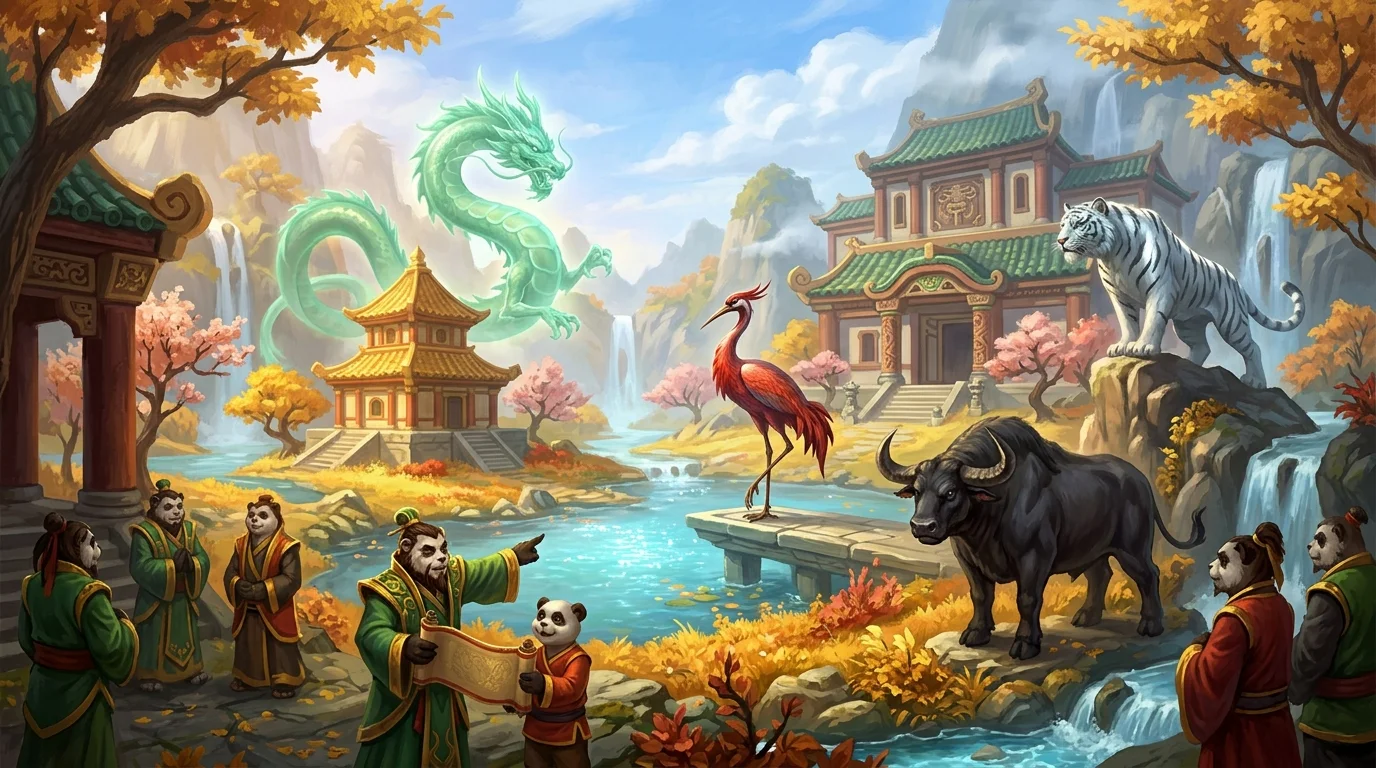
Vale of Eternal Blossoms: the heart of Pandaria and the August Celestials
The Vale of Eternal Blossoms was the heart of Pandaria before it became a wound
Few zones in WoW carry as much symbolic weight as the Vale of Eternal Blossoms. It doesn't just function as a beautiful, central or sacred place. It functions as a visual summary of what Pandaria intended to preserve: harmony, abundance, tradition and spiritual order.
This is precisely why Garrosh's destruction of the Vale weighs so heavily. To understand this scene, you first need to understand what the Vale was before it was desecrated.
What is the Vale
The original garden of Pandaria
The Vale is presented as a privileged space, cultivated, guarded and full of sacredness. It's not just a resource-rich area. It is a center of meaning.
Protected by magic and guardians
The Vale existed under special protection because it symbolized the purest version of Pandaria: a place where the continent still seemed close to its ideal form. This helps explain why it has been so carefully preserved for so long.
The August Celestials
The August Celestials are not just setting deities. They help structure the continent's spirituality.
Xuen
Xuen, the White Tiger, is linked to strength, courage and martial discipline. His presence helps show that power, in Pandaria, does not have to mean uncontrolled brutality.
Niuzao
Niuzao, the Black Ox, represents resistance, duty and firmness. He symbolizes the ability to support weight without losing integrity.
Chi-Ji
Chi-Ji, the Red Crane, brings hope, inspiration and grace. Her presence reminds us that Pandaria also values spiritual lightness, not just harsh self-control.
Yu'lon
Yu'lon, the Jade Serpent, represents wisdom, contemplation and fluidity. She is perhaps the figure that best reflects the most meditative dimension of the continent.
What the four represent together
Together, the August Celestials do not function as a distant pantheon. They function as the moral language of Pandaria. They help organize the way the continent thinks about virtue, defense, balance and transcendence.
The destruction by Garrosh
The heart of the Vale, pierced
When Garrosh uses Y'Shaarj's heart to desecrate the Vale, the act is not just strategic. It's sacrilegious. He takes the sacred center of the continent and turns it into a container of corruption.
Why this weighs so much
The horror of the scene doesn't just come from the environmental damage. It comes from symbolic inversion. The place that represented abundance and order became proof that war can contaminate even what seemed preserved from the rest of the world.
What escaped and what remained
What survived
Even desecrated, the Vale does not completely lose its memory. This is an important part of the zone: the destruction is enormous, but the idea of the Vale as the heart of Pandaria lives on.
The gradual recovery
After the fall of Garrosh, the continent does not “press a reset button”. Recovery is slow, partial and fraught with scarring. This makes sense. A symbolic place does not become the same again just because the attacker fell.
Why the Vale matters beyond the scenery
| Element | What the Vale represents | |---------|--------------------------| | Preserved garden | ideal of Pandaria before total war | | August Celestials | spiritual and moral structure of the continent | | Garrosh's desecration | rupture of the sacred due to political ambition | | Corruption of the Vale | symbolic wound across the expansion | | Partial recovery | memory, resilience and scar |
The Vale shows what Pandaria wanted to be
This is perhaps the central point. The Vale of Eternal Blossoms matters because it shows what Pandaria meant before it was drawn into the center of Azeroth's war. It's not just a beautiful place destroyed by a dramatic script. It is the symbol of the continent at its best.
When Garrosh destroys it, he doesn't just destroy one territory. He tries to prove that there is no place sacred enough to escape the logic of raw power.
Minimum recommendation
To understand the importance of the Vale, it is worth remembering these points:
- treat the Vale as the symbolic heart of Pandaria
- see the August Celestials as the continent's moral language
- understand the destruction by Garrosh as desecration, not just war damage
- consider the Vale's recovery to be slow and marked by scars
- remember that the strength of the place lies in what it represented before it fell
Posts Recomendados
Pandaria Beyond the Sha: The Stories That Don't Revolve Around Emotional Threat
Pandaria goes beyond the Sha: ancient peoples, local alliances, mogu secrets, Klaxxi, Jinyu and Hozen shape a continent with its own identity. Explore it.
Isle of Thunder: Throne of Thunder, the return of Lei Shen and the mogu secrets
The Isle of Thunder isn't just Lei Shen's zone: it's where Mists of Pandaria digs up the mogu past, revisits the Zandalari and shows a resurrected tyrant.
Magtheridon: the pit lord of Hellfire Citadel
Who is Magtheridon: the pit lord who ruled Outland, lost the Black Temple to Illidan and became the blood source for fel orcs in Hellfire Citadel.
Saurfang and Dranosh: father and son of the Horde
Varok and Dranosh Saurfang: the son hidden in Nagrand, his death at the Wrathgate, the Deathbringer in ICC and the father who takes him home. Full arc.