
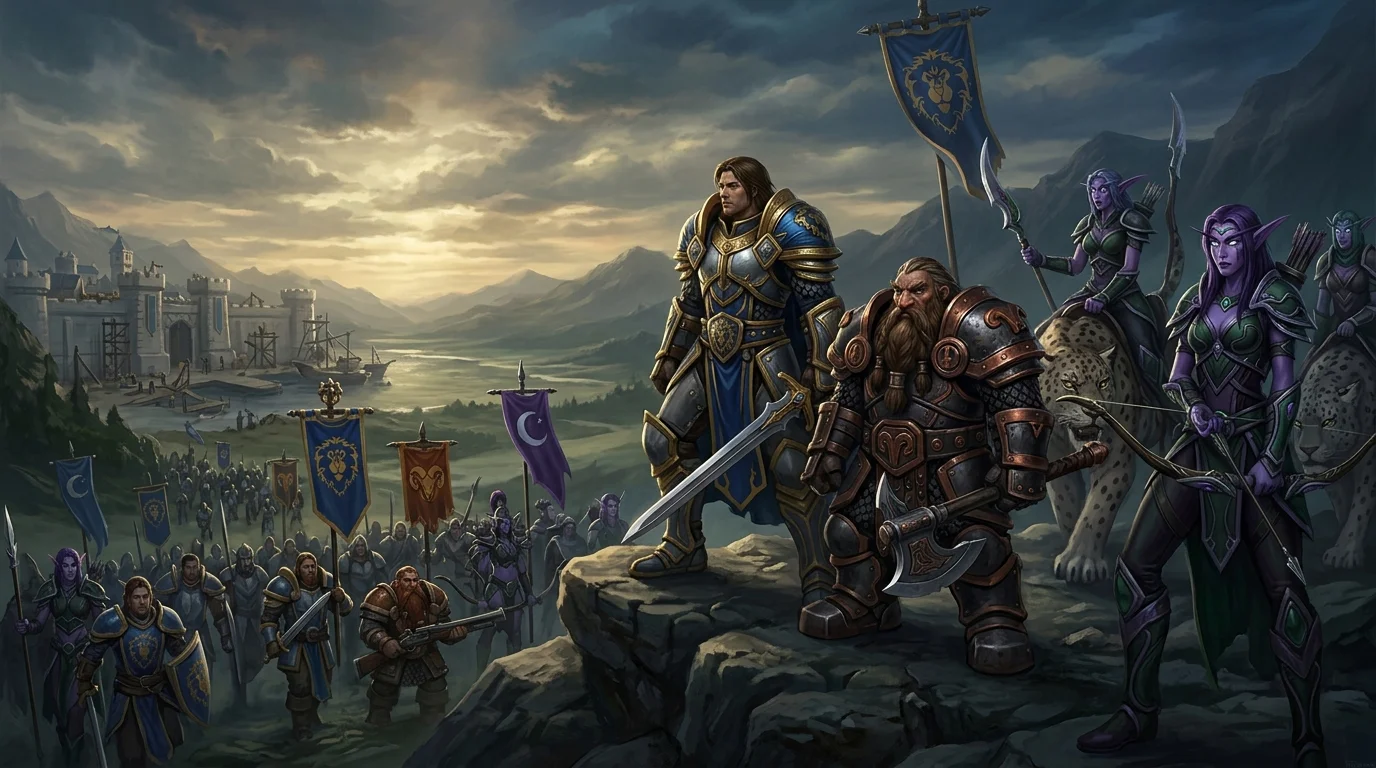
The Alliance only appears monolithic from afar
The Alliance was born out of military necessity, grew out of the urgency to survive and continues to exist despite deep disagreements between its members. The central point of the faction was never unanimity. It was enough cohesion to not collapse before the enemy fell.
The First Alliance
How she is born
The Alliance of human kingdoms, with the support of dwarves and high elves, was born in response to the orc threat. The initial driver is not perfect cultural affinity. It is shared fear and strategic need.
What does this already reveal
From the beginning, the Alliance is more coalition than single identity. It works because there is a war that forces different people to cooperate.
The Second World War and the expansion of the bloc
The larger the alliance, the greater the internal friction. Kingdoms and peoples enter with their own interests, their own memories and their own limits. Military strength increases, but uniformity never arrives.
What separates the kingdoms from within
Stormwind, Gilneas, Kul Tiras, Ironforge and then the night elves do not see the world in the same way. Some are more expansionist, others more isolationist, others more pragmatic, others more idealistic.
Important internal conflicts
Jaina embodies restraint at times when other leaders want a tough response. Varian often embodies distrust and firmness. Gilneas is the classic example of a kingdom that walks away when the cost of union seems too high. Theramore shows how the attempt at coexistence can blow up in the face of the Alliance itself.
The Alliance in WotLK
In Wrath, the threat of the Lich King forces political discipline. There is no real room for each kingdom to fight its own separate war. Cohesion increases, but differences do not disappear.
Minimum recommendation
- treat the faction as a coalition, not as a homogeneous identity
- see each kingdom as a political actor with its own agenda
- use Jaina, Varian and Gilneas as examples of internal fracture
- reread Wrath as a moment of cohesion out of necessity
- remember that the strength of the Alliance is almost always born from crisis, not from spontaneous harmony
Posts Recomendados
The Horde: from invading army to coalition
The Horde is no straight line: born as a demonic tool, reborn under Thrall as a project of honor, and forever torn between redemption and pragmatism.
Kirin Tor and Dalaran
Kirin Tor and Dalaran in WotLK: the Kirin Tor was never just a council of neutral mages, but a political, military and arcane force choosing when to act.
Magtheridon: the pit lord of Hellfire Citadel
Who is Magtheridon: the pit lord who ruled Outland, lost the Black Temple to Illidan and became the blood source for fel orcs in Hellfire Citadel.
Saurfang and Dranosh: father and son of the Horde
Varok and Dranosh Saurfang: the son hidden in Nagrand, his death at the Wrathgate, the Deathbringer in ICC and the father who takes him home. Full arc.