
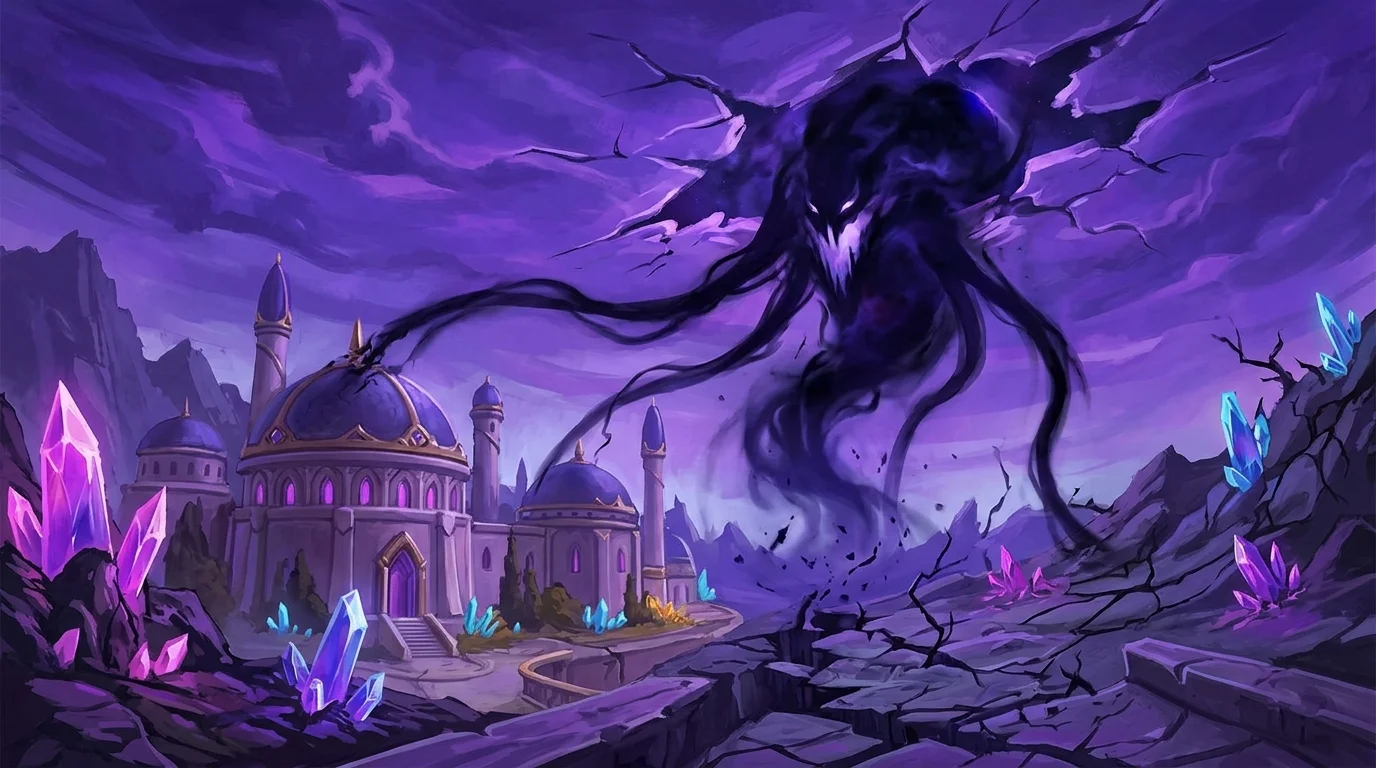
The Doom of K'aresh: the story of the world destroyed by the Void Lords
The tale that gives flesh to the origin of the ethereals
For years, the origin of the hollows existed as a good idea summed up in a few lines: a people of K'aresh, destroyed by the Void, forced to survive as energy wrapped in bands.
The Doom of K'aresh does what was missing. He gives landscape, everyday life, loss and testimony. And when he does that, the story stops being an encyclopedia curiosity and becomes one of the heaviest tragedies in recent lore.
What the story tells
The structure of the tale is powerful because it starts with Locus-Walker telling Alleria of the fall of her homeworld and the role Xal'atath played in that disaster. This already places the narrative under two layers: memory and warning.
It is not a neutral text. It is a memory spoken by those who survived and know that what happened once can happen again on an even larger scale.
What we see of K'aresh before the ruin
This is the first big success of the story. He doesn't start out in misfortune. It begins in existence.
By showing K'aresh alive, beautiful and civilized, the text makes the destruction much more serious. We are not seeing “just any strange planet”. We are seeing a home, a cultural system, and a world worth lasting.
This emotional investment is what makes the collapse so powerful.
The arrival of Dimensius
Dimensius enters history as a devouring force on an almost impossible scale. And it is important that this is the case. The tale does not want to reduce the Void to local intrigue. He wants to show that the threat has cosmic drainage capacity.
When Dimensius appears, the sensation is not just of war. It is a complete inadequacy of normal defenses in the face of what is approaching. K'aresh doesn't just face one invader. It faces the end of its own world condition.
The moment of transformation
Perhaps the most brutal part of the story is precisely the passage in which the k'areshi lose their old form and need to continue existing in another way. There is no glory in this. There is need.
This detail matters a lot. Ethereals do not transform because they chose energetic ascension. They transform because the old body no longer fits into the type of survival that remains.
The story understands this and, therefore, the trauma works.
What the text adds to the threat of the Void
The Doom of K'aresh extends the Void in two directions:
- Scale: shows that destruction can reach entire worlds.
- Intimacy: shows that this destruction does not just erase geography; erases the feeling of home, body and continuity.
This combination is what makes the tale so valuable to the current saga. It helps you realize that the threat of the Void is not just “another powerful enemy”. It's a form of reality collapse.
Locus-Walker and Alleria within this story
The choice to use Locus-Walker and Alleria as the axis is also great. He speaks as a disciplined survivor of the Void. She listens like someone who has already learned to touch power without giving herself over completely to it.
This makes the tale more than a flashback. Make him talk about responsibility. Who knows what the Void can do will not leave the story the same as it entered.
Why the story matters so much now
Because the Worldsoul Saga needed a story that expanded the threat of the Void without losing humanity. The Doom of K'aresh does just that.
He doesn't explain everything. No need. Just show enough for K'aresh to stop being an exotic term and become a civilizational warning.
Minimum recommendation
If you want to understand the weight of The Doom of K'aresh, read the tale not as a technical prologue for the hollows, but as an elegy for a lost world. That's what it is at its core: a memory told against oblivion, so that Azeroth doesn't treat the Void as an abstract danger until it's too late.
Posts Recomendados
K'aresh: the world destroyed by the Void Lords and what was left to tell the story
K'aresh shows the Void doesn't just corrupt minds or kingdoms: it can consume an entire world and force its survivors to exist without bodies. Learn more.
Locus-Walker: Alleria's ethereal master and what he knows about the Void
Locus-Walker masters the Void without losing himself, trained Alleria when almost no one understood that power and carries the memory of K'aresh's fall.
Magtheridon: the pit lord of Hellfire Citadel
Who is Magtheridon: the pit lord who ruled Outland, lost the Black Temple to Illidan and became the blood source for fel orcs in Hellfire Citadel.
Saurfang and Dranosh: father and son of the Horde
Varok and Dranosh Saurfang: the son hidden in Nagrand, his death at the Wrathgate, the Deathbringer in ICC and the father who takes him home. Full arc.