
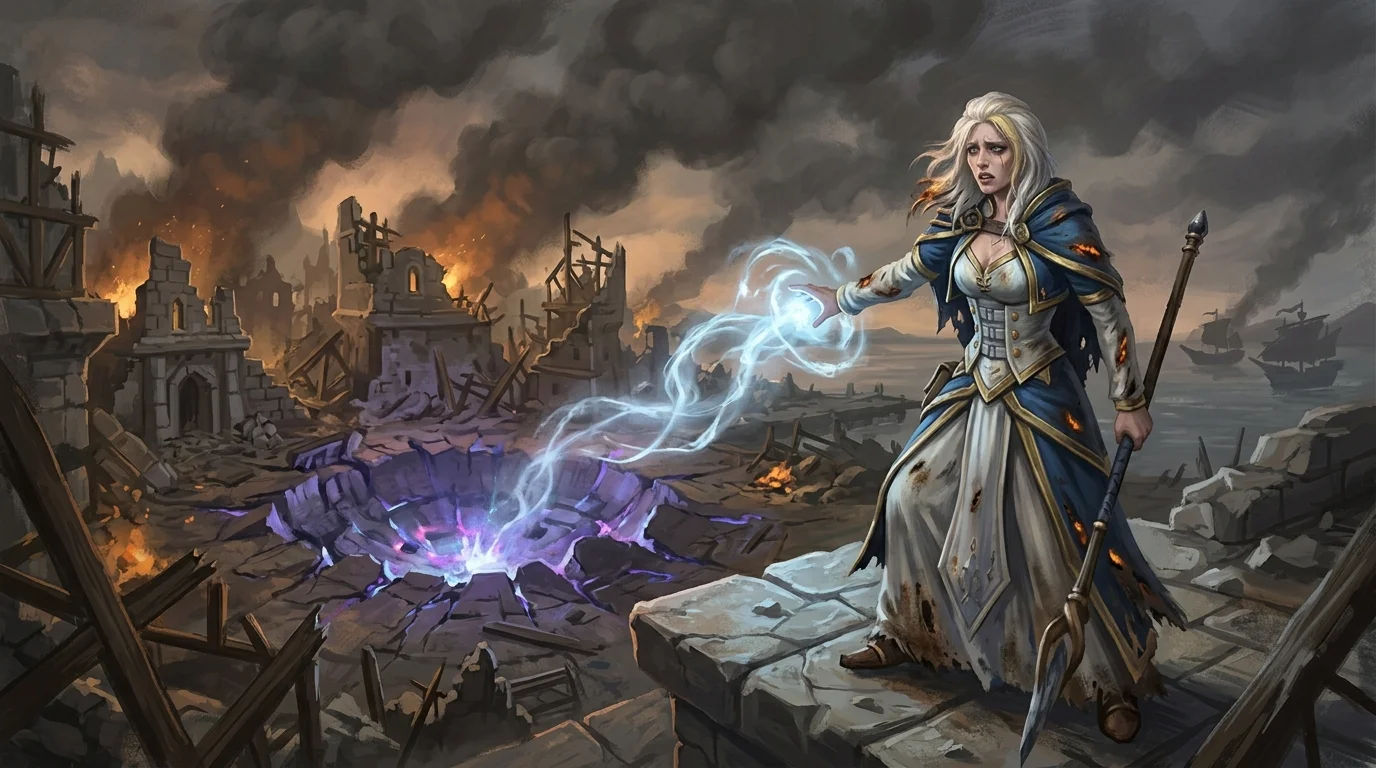
The book that kills Jaina's innocence
Tides of War is essential because it records the moment when Jaina stops believing that goodwill and diplomacy would be enough to contain the brutality of the world. Theramore wasn't just a city. It was a political project. It was living proof that coexistence between Alliance and Horde could, at least in theory, exist.
When Theramore falls, it's not just a fortress that falls. An idea comes up.
What the novel tells
The book follows the escalation that leads Garrosh to attack Theramore with a devastating mana bomb. The tension is not just military. It is also ideological: Jaina tries to preserve a space of balance while Garrosh's Horde already operates in a logic in which this balance is a weakness to be exploited.
This makes the destruction even worse. Garrosh doesn't just kill people. He chooses to destroy a symbol.
Jaina in Theramore
Theramore's Jaina is important precisely because she still carries real political hope. She built the city as a possible point of coexistence, even after so many wars and losses. That's why the novel works as a breaking point. We are not just seeing another military defeat. We are seeing the murder of a world project.
Without understanding this, Jaina's later hardness just seems like dramatic hardening. With this, it looks like grief transformed into an emotional structure.
Bombardment and mana bomb
The attack on Theramore is written as violence on an almost obscene scale. Garrosh uses the mana bomb not only to win, but to traumatize. The gesture carries a symbolic calculation: destroying an arcane, political and affective center with a weapon of crushing and cruel power.
This is the moment when Tides of War makes it clear that Garrosh is no longer just at war. It's shaping a new language of horror.
Jaina's transformation
After Theramore, Jaina does not “become another person” in the simple sense. She remains Jaina — and that's exactly what hurts. The novel shows that wounded idealism does not go away clean. It turns into anger, desire for response, loss of confidence and moral hardening.
This is why gray hair, the change in tone and the subsequent coldness matter so much: they are not cosmetic. They are external signs of a conviction that has been violently torn away.
Why the book explains Jaina in BfA better than the game alone
Battle for Azeroth shows a Jaina filled with guilt, isolation and harshness. Tides of War shows the concentrated origins of this. Without this book, some of her reactions just seem like “bitter character comeback.” With it, everything gains emotional continuity.
You understand that the woman in BfA was not born there. It was being formed since Theramore.
Minimum recommendation
If you want to understand Jaina as a character, Tides of War is essential reading. It is the book that shows the exact moment when coexistence stopped seeming like a horizon for her and started to sound like a moral lust too dangerous for the world in which she lived.
Posts Recomendados
Warbringers: Jaina, Sylvanas and Azshara — three shorts that changed the tone of Battle for Azeroth
Warbringers turned prelude into art: in a few minutes, the shorts gave Jaina, Sylvanas and Azshara an emotional depth many long campaigns never reach.
Before the Storm: the book that shows what happened between Legion and Battle for Azeroth
Before the Storm turns the impossible peace between Anduin and Sylvanas into BfA's emotional prologue and shows why Teldrassil didn't come out of nowhere.
Magtheridon: the pit lord of Hellfire Citadel
Who is Magtheridon: the pit lord who ruled Outland, lost the Black Temple to Illidan and became the blood source for fel orcs in Hellfire Citadel.
Saurfang and Dranosh: father and son of the Horde
Varok and Dranosh Saurfang: the son hidden in Nagrand, his death at the Wrathgate, the Deathbringer in ICC and the father who takes him home. Full arc.