
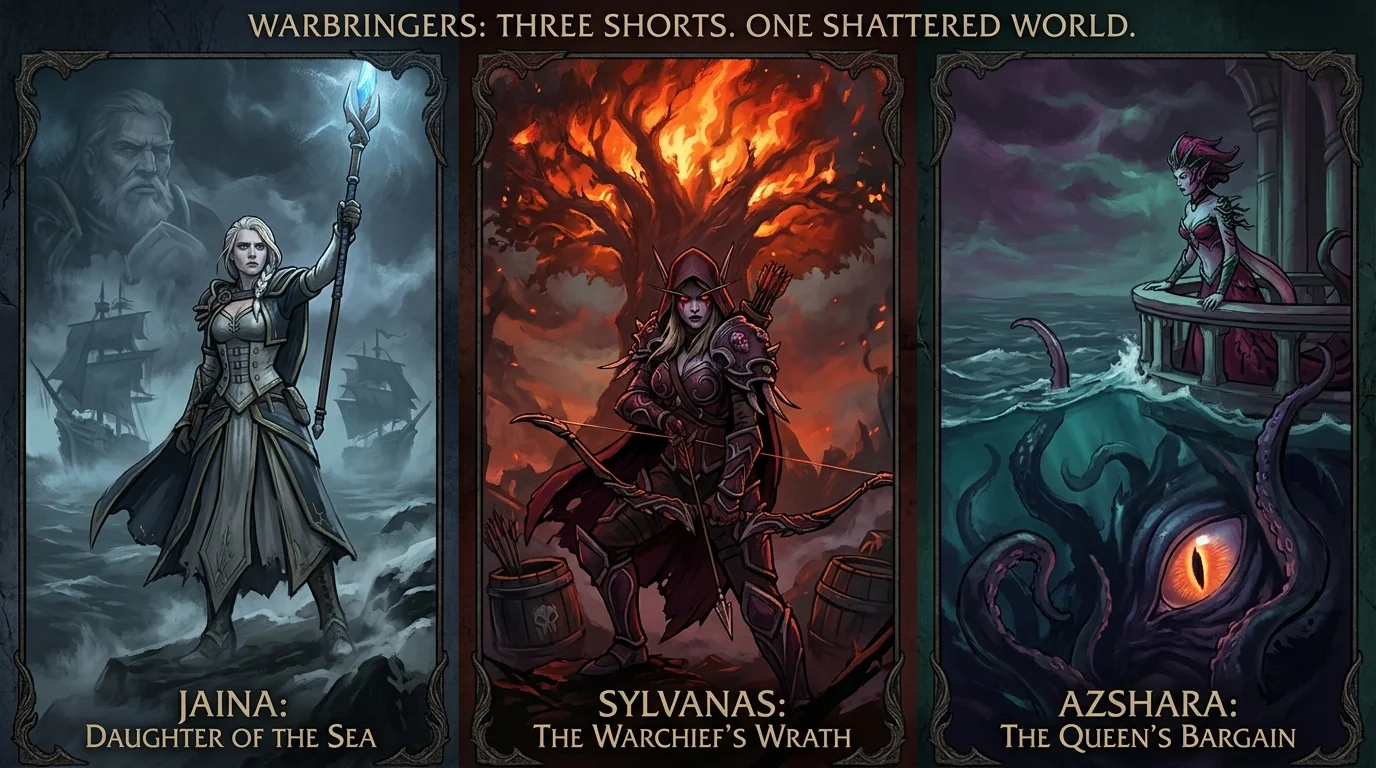
Warbringers: Jaina, Sylvanas and Azshara — three shorts that changed the tone of Battle for Azeroth
Three songs, three portraits, an entire repositioned expansion
Before Battle for Azeroth opened for good, the Warbringers series had already made it clear that the expansion would not be sold just by naval battle and faction warfare. The three shorts chose something better: transforming their central figures into emotional presences.
Jaina, Sylvanas and Azshara don't just appear as leaders. They appear as voice, memory and manifesto. This is why Warbringers works so well. It does not attempt to summarize the expansion. She sets her tone.
The Warbringers format
Warbringers mixes animation, narration, and music in a way that almost feels like a hybrid of lament, prophecy, and political statement.
Why this format is so strong
Because it compresses a lot of things at the same time:
- traumatic past;
- present desire;
- projected fear;
- identity in its pure state.
All this in just a few minutes. There is no waste. Each frame seems chosen to carry symbol.
Jaina: Boralus' lament
Jaina's short is perhaps the most emotionally devastating in the series. He takes an already well-known character and reintroduces her not through biography, but through guilt.
What Theramore still does with her
Jaina has always been seen as a bridge, diplomat, moderator. After Theramore, that image cracked. The short understands this precisely: the center of the character is no longer naive hope. It's emotional survival on top of ruins.
What the music says the game doesn't always say
The music and visual composition communicate an enormous loneliness. Jaina does not only appear as a leader rejected by Kul Tiras. She appears as someone haunted by what she was unable to stop, by what she lost and by what she became because of it.
Sylvanas: the decision before the fire
Sylvanas's short is the most directly connected to a moment that would change the history of Azeroth.
What he does well
He does not treat the fire of Teldrassil as a simple explosion of gratuitous evil. Instead, the short frames Sylvanas as someone who lives at a point where war, calculation, grudge and nihilism start to speak the same language.
The effect of this
The short does not absolve Sylvanas. But it shows why its logic has become so dangerous: it no longer operates within the normal rules of war. She wants to break meaning, not just win territory.
That's why video is so important. He prepares the audience to see that Sylvanas no longer fits into the normal political framework of the Horde.
Azshara: power that never needed to apologize
If Jaina is pain and Sylvanas is rupture, Azshara is arrogant permanence. Her short is less sad and more imperial.
What makes this video work
Azshara is not constructed as a victim, nor as a leader in crisis. She is constructed as someone who has gone through ten thousand years without giving up her own certainty of superiority. And music acts as an extension of this colossal ego.
Why this matters to BfA
Because BfA needed a figure who would remind the public that Warcraft still knows how to work monstrous majesty. Azshara does not come to overly humanize the conflict. She comes to expand it.
Why Warbringers changed the tone of Battle for Azeroth
Expansion already promised war. What Warbringers did was make this war more intimate, more musical, and more fatalistic.
The result
After the shorts, BfA didn't just feel like an expansion on “Alliance vs. Horde”. It looked like an expansion marked by:
- grief;
- radicalization;
- irreparable memory;
- pride transformed into a weapon.
This tone is decisive. Without Warbringers, the beginning of BfA could feel shallower. With Warbringers, the expansion gains emotional density before the player even begins.
Jaina, Sylvanas and Azshara as triad
The three shorts also work because each character embodies a different emotional axis:
- Jaina is the pain that still tries to organize itself;
- Sylvanas is the war that decides to destroy meaning;
- Azshara is the power that never agreed to fall.
This triad helps explain why videos are so memorable. They don't repeat formulas. Everyone finds the right language for their character.
Is it really Blizzard's best lore format?
The statement may sound exaggerated, but there is a strong argument there. Warbringers manages to communicate, in a few minutes, more character than many long campaigns. Not because it simplifies, but because it concentrates.
What Blizzard gets right here
She trusts in image, music and synthesis. Instead of explaining too much, it makes the viewer feel. And lore that only explains it gets old quickly. Lore that makes you feel stays.
What Warbringers left as a legacy
Even years later, the three videos continue to be a reference on how to present a character in Warcraft without relying on heavy exposition. They also proved that short media can carry as much weight as large cinematics.
Minimum recommendation
Watch Warbringers as an emotional portrait, not a plot summary. The value of the shorts is how they capture three characters in their purest form. If you want to understand why Battle for Azeroth started with such a different weight than usual, the answer is in these three videos.
Posts Recomendados
Tides of War: Jaina and the destruction of Theramore
Tides of War explains why Jaina in Battle for Azeroth isn't bitter out of nowhere: it comes from the violent collapse of everything Theramore stood for.
Nazjatar and the Naga Empire: The Sunken City and Ten Thousand Years of Hidden Civilization
Nazjatar is the extreme result of Zin-Azshari's fall: a naga empire shaped by Azshara and N'Zoth, hidden for millennia and full of secrets after BfA.
Magtheridon: the pit lord of Hellfire Citadel
Who is Magtheridon: the pit lord who ruled Outland, lost the Black Temple to Illidan and became the blood source for fel orcs in Hellfire Citadel.
Saurfang and Dranosh: father and son of the Horde
Varok and Dranosh Saurfang: the son hidden in Nagrand, his death at the Wrathgate, the Deathbringer in ICC and the father who takes him home. Full arc.