
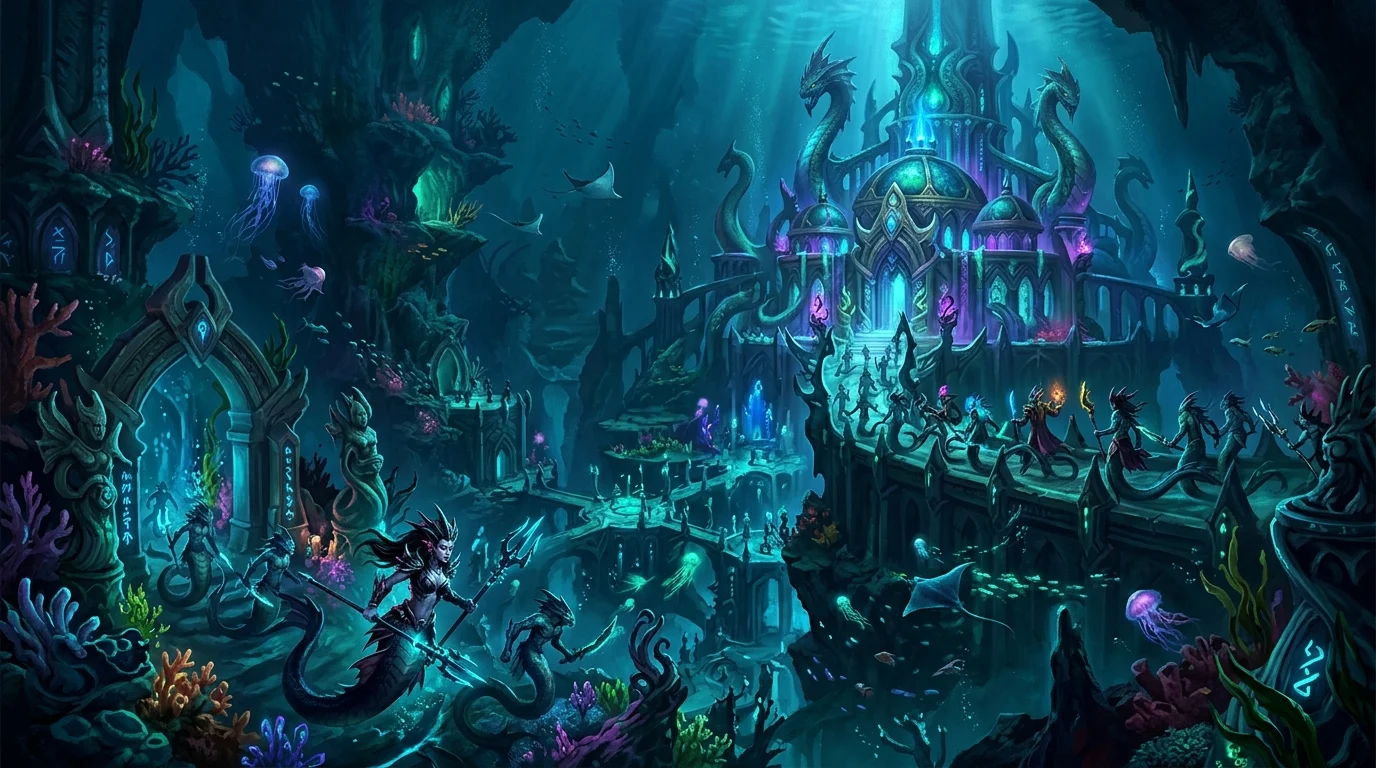
Nazjatar and the Naga Empire: The Sunken City and Ten Thousand Years of Hidden Civilization
Nazjatar is Azeroth's sunken past that has returned with teeth
When Nazjatar finally appears in Battle for Azeroth, it feels like a belated reveal. The naga were always around, always plotting, always serving Azshara. But the center of gravity of this civilization remained to be seen.
Nazjatar delivers exactly that: not a makeshift lair, but an empire that has had ten thousand years to exist far from the surface.
How Nazjatar came to be
The fall of Azshara and Zin-Azshari
At the end of the War of the Ancients, the collapse of the world sinks Zin-Azshari. It is there that Azshara and her highborne are transformed by N'Zoth into naga.
Birth by pact, not by natural evolution
This matters because Nazjatar is born of bargaining and deformation. It is not an independent underwater civilization. It is the corrupted extension of the elite that already existed before Sundering.
What did the Naga do in ten thousand years
Hidden empire, not absence
The Naga did not “disappear”. They retreated to build, plot, conquer and prepare the moment of return. Nazjatar is proof that their concealment has always been strategic.
An expansionist logic
Everything about Azshara points to future expansion. The empire is not contemplative. It is military, magical and guided by imperial patience.
The architecture of Nazjatar
Sunken Mirror of Zin-Azshari
Nazjatar is impressive because it seems like a distorted continuation of the ancient kaldorei grandeur. There is beauty, verticality, ostentation and cruelty in the same landscape.
Aesthetics as ideology
The city tells you visually what Azshara thinks of herself: she was not degraded by the fall. She reinvented herself as a sovereign on a different scale.
Allies, servants and coercion
Not everyone there serves out of devotion
Part of the empire operates out of loyalty to Azshara. Another part works out of fear, dependence and political capture. This makes Nazjatar more credible as an empire: it is not sustained only by worship, but by structure.
The power of Azshara
Azshara rules because she remains brilliant, terrifying, and centering. The naga empire exists because she never stopped acting as empress.
What happened after Battle for Azeroth
A city without a queen, but not without a legacy
With Azshara's fall in the BfA arc, Nazjatar does not automatically become an empty ruin. The place continues to carry scattered armies, deep secrets and legacies that do not disappear with defeat.
This is an important point: the city loses its visible center, but it does not lose its historical value or narrative potential.
What Nazjatar represents
| Element | What does it symbolize | |----------|-----------------| | Fall of Zin-Azshari | warped continuation of the highborne empire | | Naga | survival through corruption | | Azshara | imperial pride without regret | | Architecture | beautiful and monstrous memory at the same time | | Post-BfA | dispersed power, not closed |
Minimum recommendation
Nazjatar works best when you read the city as a submerged continuation of an ancient imperial project.
Naga are not just sea monsters.
They are the aristocracy of the old world who survived the apocalypse and decided to return.
Posts Recomendados
Argus and the Collapse of the Eredar: The Draenei Homeworld in Ruins
Argus was the eredar's intellectual and magical center. Under Sargeras, it became the Legion's war factory and the site of the draenei's painful return.
Warbringers: Jaina, Sylvanas and Azshara — three shorts that changed the tone of Battle for Azeroth
Warbringers turned prelude into art: in a few minutes, the shorts gave Jaina, Sylvanas and Azshara an emotional depth many long campaigns never reach.
Magtheridon: the pit lord of Hellfire Citadel
Who is Magtheridon: the pit lord who ruled Outland, lost the Black Temple to Illidan and became the blood source for fel orcs in Hellfire Citadel.
Saurfang and Dranosh: father and son of the Horde
Varok and Dranosh Saurfang: the son hidden in Nagrand, his death at the Wrathgate, the Deathbringer in ICC and the father who takes him home. Full arc.