
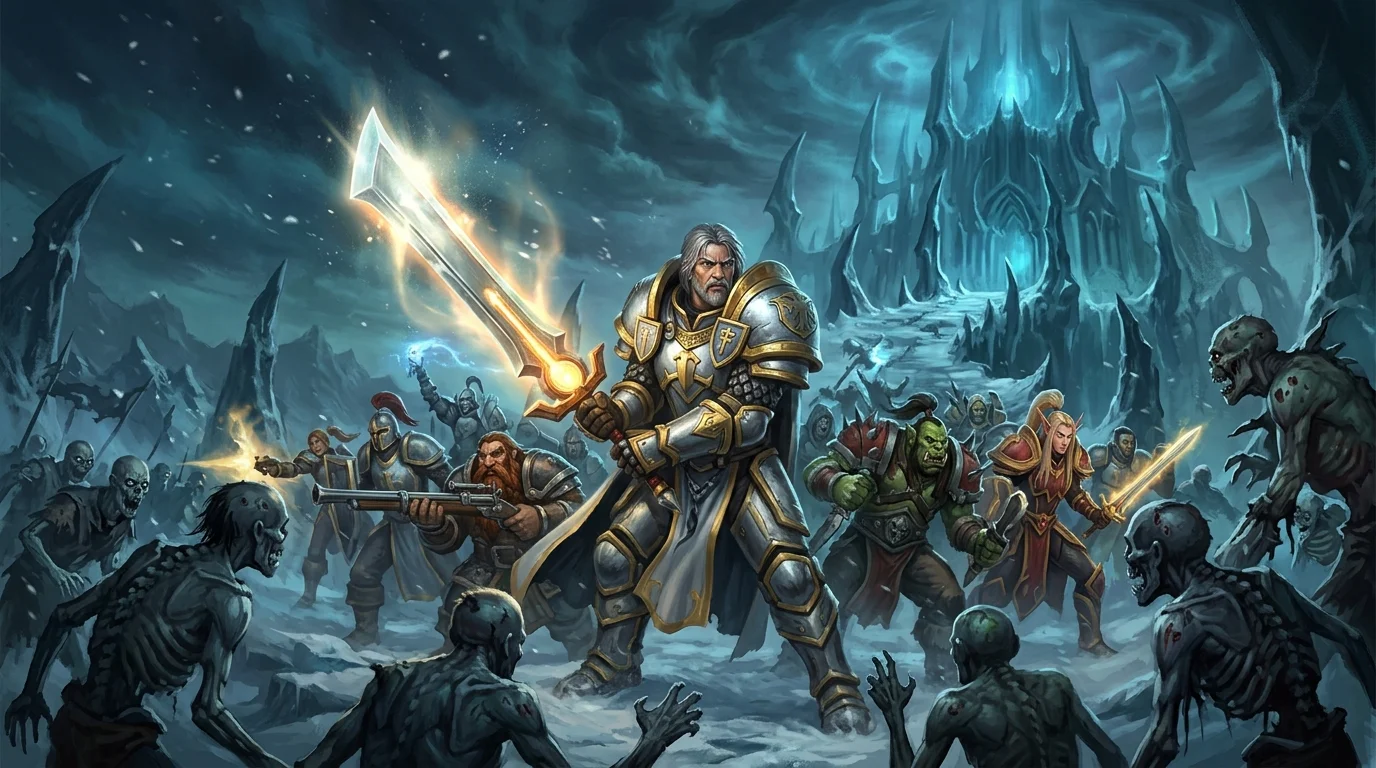
Tirion Fordring, the Ashbringer and the resistance against the Scourge
Introduction
Few characters represent resistance against the Scourge as well as Tirion Fordring. In a universe marked by tragic falls, corruption and fanaticism, Tirion functions as the opposite of cynicism: a paladin who loses position, title and prestige, but does not abandon the very notion of honor.
Next to him is the Ashbringer, a legendary sword whose story involves glory, betrayal, corruption, redemption and holy war against the undead. Talking about Tirion is also talking about Alexandros Mograine, Renault Mograine, Darion Mograine, the formation of the Ebon Blade and the creation of the Argent Crusade.
More than a strong warrior, Tirion becomes the moral center of the campaign against the Lich King. He is the character who insists that victory against the Scourge needs to preserve what is still worth saving.
Who is Tirion Fordring and why was he exiled
Tirion Fordring was one of the first five paladins of the Order of the Silver Hand. A veteran of the Second War, he became a respected figure within the Alliance and held a leadership position in Hearthglen.
His public downfall comes when he decides to defend Eitrigg, a veteran orc, instead of accepting a blind logic of racial hatred and revenge. By facing soldiers of the Alliance itself and keeping his word, Tirion is judged and exiled. In practice, he loses status, formal ties and part of his previous life.
This exile matters a lot for character development. Tirion does not become a hero because he was always applauded; he becomes a hero because he chooses honor even when it costs everything. This decision shapes the role he will later have in front of the Scourge, the Scarlet Crusade and the Lich King.
The origin of Ashbringer
Ashbringer is born amidst the war against the undead. Forged by Magni Bronzebeard from a dark crystal purified by the Light and transformed into a sacred weapon, the sword becomes legendary in the hands of Alexandros Mograine, one of the Silver Hand's greatest champions.
The name of the blade itself comes from its devastating capacity against the undead: wherever it went, it left ash. Alongside Alexandros, Ashbringer becomes a symbol of hope for the living and terror for the Scourge.
But the sword also carries tragic weight. In Warcraft, almost every legendary weapon has a price — and the Ashbringer was no different.
The murder of Alexandros and the corruption of the sword
Ashbringer's downfall comes from betrayal. Renault Mograine, son of Alexandros, murders him with his own sword. This act breaks the purity of the weapon and marks its corruption. Kel'Thuzad then resurrects Alexandros to serve the Scourge, further tying the sword's story to the horror of Naxxramas.
This is one of the strongest moments in the lore because it transforms a symbol of light into a reminder of guilt, manipulation and death. The Ashbringer stops being just a weapon against the undead and starts carrying the pain of a destroyed family.
Darion Mograine and redemption through the Ebon Blade
If Renault represents ruin, Darion Mograine represents an attempt at redemption. Son of Alexandros, he enters decisively into the history of the sword when he confronts his father's legacy and the rule of the Lich King.
During the events linked to Light's Hope Chapel, Darion realizes that he and the death knights were being used as expendable parts. In the final battle of the quest The Light of Dawn, he rebels against Arthas and throws the Corrupted Ashbringer to Tirion.
This moment is crucial because it marks the moral turning point of the former force created by the Lich King. From there, Darion and his death knights break away from Arthas and become the base of the Knights of the Ebon Blade, a faction of free undead who choose to fight against their creator himself.
The purification of Ashbringer and the path to Icecrown
An important adjustment for historical accuracy is worth making here: the purification of Ashbringer takes place in Light's Hope Chapel, not inside Icecrown Citadel. When Darion throws the sword to Tirion, the blade is taken by the Light and purified in his hands.
After that, Tirion takes on Ashbringer as a central weapon in the campaign against the Lich King. He reorganizes forces, leads the Argent Crusade and leads the war in Northrend with the sword already redeemed. In other words: Light's Hope is the moment of purification; Icecrown is the moment of the final consecration of the sword and Tirion in the war against Arthas.
Why Tirion and the Argent Crusade are the moral heart of the campaign
After the events of Light's Hope, Tirion founds the Argent Crusade, uniting the old Argent Dawn with the reconstituted Silver Hand. The order's purpose was not just to fight the Scourge, but to do so without repeating the blind fanaticism of the Scarlet Crusade.
This point defines Tirion's moral role in the expansion. While Arthas represents absolute domination and the Scarlet Crusade represents warped religious radicalism, Tirion represents discipline, faith and honor without total dehumanization of the enemy and without abandoning what the living should defend.
Later, the campaign in Northrend reinforces this. Tirion organizes the Argent Tournament, presses the offensive against the Lich King and remains central leader until the final attack on Icecrown. At the climax of the war, it is with Ashbringer that he breaks Frostmourne, paving the way for Arthas' definitive defeat.
Quick timeline
| Step | What happens | |---|---| | Tirion in the Silver Hand | Appears as one of the first great paladins of Lordaeron | | Exile | Loses position when defending Eitrigg and maintaining his code of honor | | Alexandros and Ashbringer | The sword becomes a legend in the war against the undead | | Renault's betrayal | Alexandros is murdered and the sword is corrupted | | Darion enters the scene | The Mograine legacy begins to seek redemption | | Light's Hope Chapel | Darion rebels, Tirion receives and purifies the Ashbringer | | Formation of the Argent Crusade | Tirion joins forces against the Scourge | | War in Northrend | Tirion leads the campaign to Icecrown | | Fall of the Lich King | Ashbringer breaks Frostmourne in final showdown |
What does this story represent within Wrath of the Lich King
The campaign against Arthas doesn't work just because there are strong armies. It works narratively because there are characters who represent different responses to horror:
- Arthas is the absolute fall in the name of control;
- Darion is guilt transformed into rebellion;
- Tirion is the permanence of honor when everything around seems doomed;
- Ashbringer is the symbol that something corrupt can still be redeemed.
That's why Tirion is so important. He's not just the strong paladin who shows up at the end to help. He is the ethical linchpin of the war against the Scourge.
Closing
The story of Tirion Fordring and Ashbringer works so well because it brings together two classic Warcraft threads: that of faith tested by tragedy and that of the legendary weapon marked by blood, fall and redemption.
Tirion was exiled for acting with honor, Ashbringer was corrupted by family betrayal, Darion needed to break his bond with Arthas to save the meaning of his father's legacy, and the Argent Crusade was born precisely from the idea that fighting darkness cannot transform you into the same thing you are trying to destroy.
In the end, this is the strength of the arc: the war against the Scourge is not won by raw power alone, but by characters who still believe that justice, sacrifice and redemption matter.
Posts Recomendados
Magtheridon: the pit lord of Hellfire Citadel
Who is Magtheridon: the pit lord who ruled Outland, lost the Black Temple to Illidan and became the blood source for fel orcs in Hellfire Citadel.
Saurfang and Dranosh: father and son of the Horde
Varok and Dranosh Saurfang: the son hidden in Nagrand, his death at the Wrathgate, the Deathbringer in ICC and the father who takes him home. Full arc.
Dalaran in Northrend: why the city flew
Dalaran in Northrend: why the Kirin Tor took the city into the sky over Crystalsong, who rules it and what the Violet Hold keeps locked. See the summary.
Bolvar Fordragon: from regent to Lich King
Bolvar Fordragon was regent of Stormwind, a hero of the Wrathgate and ended up on the Frozen Throne. Read his full story and where to find him in WotLK.