
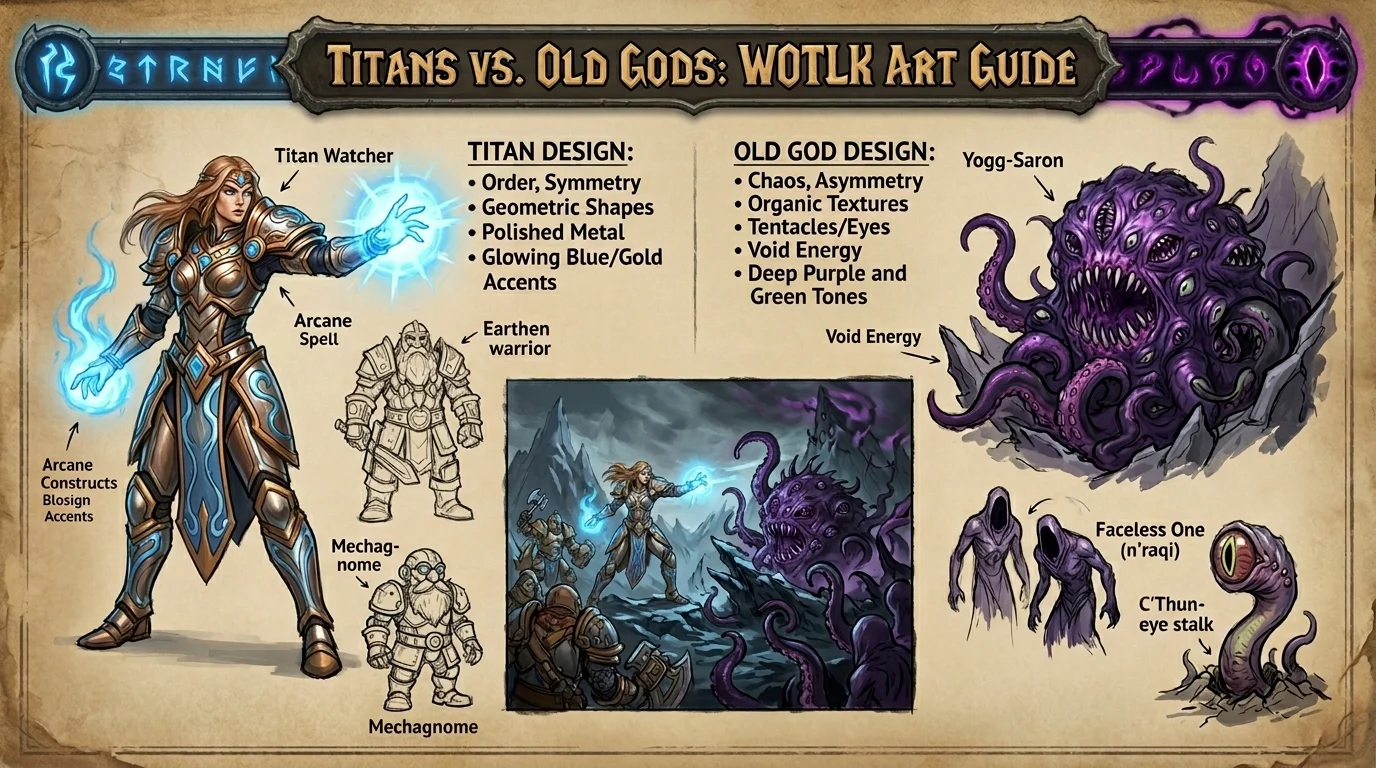
Without Titans and Old Gods, Azeroth makes no sense
Much of World of Warcraft's lore feels like a collection of wars, races, and villains spread across time. But, when you move the camera up a little, you realize that there is a central axis holding a good part of the cosmology: the dispute between the order of the Titans and the corruption of the Old Gods.
This conflict is not just background. It explains why Azeroth was shaped, why certain ruins exist, why so many titanic prisons appear in different expansions, and why Northrend, Ulduar, Yogg-Saron, and even the idea of the soulworld matter so much within the WoW universe.
Who are the Titans and what did they come to do in Azeroth
The Titans are cosmic entities associated with the Order. They didn't arrive on Azeroth as curious explorers. They came because they realized that the planet was home to something extremely rare: a world-soul, a titanic soul in gestation.
This completely changes the scale of the conflict. Azeroth is not valuable just because it is an inhabited world. It is valuable because it can spawn a Titan of immense power. In other words: whoever controls or corrupts Azeroth doesn't just win a planet, they win the future of an entire cosmic force.
In practice, the Titans and their servants organized the world, erected complexes, forges, prisons and observation systems. Much of what looks like “ancient ruin” in WoW is actually a vestige of this attempt to order Azeroth before the corruption became irreversible.
What were the Ancient Gods
The Old Gods are Void entities planted on worlds to corrupt world-souls. On Azeroth, they created the Black Empire, deformed the planet's surface and rooted themselves so deeply in the world that they were no longer just invaders: they became part of the anatomy of Azeroth's own corruption.
This is the crucial difference. The Old Gods did not stay “on top” of the planet. They buried themselves in it. When the Titans arrived, it was too late for a simple cleanup.
How the Old Gods were defeated — but not destroyed
The Titans managed to break the Black Empire's dominance. The most famous case is Y’Shaarj, ripped directly from Azeroth. The problem is that this act showed the real price of victory: removing an Old God by force caused catastrophic damage to the planet itself.
That's when the strategy changed. Rather than exterminate the remaining Old Gods in the same way, the Titans chose to imprison them in vast titanic complexes. It was a less clean solution, but safer for the integrity of world-soul.
This is one of the most important ideas in the entire Warcraft cosmology: in Azeroth, containment was sometimes more viable than destruction.
Why “killing” an Old God is a problem
There is a very common simplification in the fandom: “if the heroes already killed C’Thun, Yogg-Saron and N’Zoth, then the Old Gods were just big bosses”. The lore has always tried to show that the situation is more delicate than that.
In narrative terms, the Old Gods in Azeroth are so tied to the fabric of the world that their total removal has always been presented as dangerous. That's why WoW's language oscillates so much between defeat, containment, weakening and ritualized destruction. It's not just indecision in the script: it's the cosmology itself saying that Azeroth doesn't deal well with crude surgery.
Azeroth as world-soul
The idea of world-soul is the real heart of this conflict. Azeroth is not just a stage where Titans and Old Gods face off. She is the prize.
What does this mean
- explains why so many cosmic forces converge on the planet
- justifies the presence of large-scale titanic installations
- gives different weight to the corruption of the Old Gods
- turns local wars into symptoms of a much larger conflict
If you look at Ulduar, at the titanic forges, at the prisons of the Old Gods and at the constant fear of deep corruption, all of this becomes more coherent when you remember that Azeroth is not “another world”.
What does this change in WotLK
Wrath of the Lich King is often remembered as the expansion of Arthas. But Northrend is also an expansion where the cosmology of the Titans and the Old Gods becomes much more visible.
Ulduar
Ulduar isn't just a memorable boss raid. It reveals the scale of the titanic machinery, the role of the Keepers, the corruption of Yogg-Saron, and how much the conflict between Order and Void was still alive beneath the surface.
Yogg-Saron
Yogg-Saron does not appear as a villain disconnected from the rest. He is proof that Northrend was not just the Lich King's continent. It was also the land of titanic prisons, ancient contamination, and cosmological threats long before Arthas.
The feeling that Azeroth is bigger than the main campaign
This is perhaps WotLK's greatest legacy for cosmology: the expansion shows that even a strong and personal story like Arthas's takes place within a much older, deeper and more disturbing world.
How this conflict reverberates to this day
| Element | What it reveals | |----------|------------------| | Ulduar | the Order's direct presence in Azeroth | | Yogg-Saron | the persistence of the Old Gods even in containment | | Uldum, Ulduar and other facilities | the size of the titanic project on the planet | | recurring corruption | the fact that arresting was never the same as solving | | world-soul of Azeroth | the reason why so many forces compete in this world |
What this conflict really teaches you about WoW
Titans vs. Ancient Gods is not a war of “good versus evil” in the simplest version. It is a dispute between cosmic order, survival of the world and structural corruption. The Titans saved Azeroth, but they also shaped it. The Old Gods corrupted her, but became so deep within her that the price of removal became almost unthinkable.
This conflict is the kind of foundation that makes the rest of the lore better. Arthas, Neltharion, Azshara, Xal'atath, Ulduar, the Void, the Keepers, the vrykul, the humans — all speak to this base on some level.
Minimum recommendation
If you want to understand WoW's cosmology without getting lost:
- treat Azeroth as a world-soul, not just a planet
- see the Old Gods as deep-rooted corruption, not just raid monsters
- read Ulduar and Yogg-Saron as part of the world's main conflict
- remember that the Titans won by containment, not by total cleanliness
- use this axis as a key to rereading Northrend, Dragonflight and the Worldsoul Saga
Posts Recomendados
The nature of magic in Azeroth
The nature of magic in Azeroth goes beyond schools: Arcane, Fel, Shadow, Holy, Nature and Death come from cosmic forces that shape lore and classes.
The fall of the Vrykul and the birth of humanity
The fall of the Vrykul explains human origins: humans descend from vrykul touched by the curse of flesh, which changes how you read Northrend in WotLK.
Magtheridon: the pit lord of Hellfire Citadel
Who is Magtheridon: the pit lord who ruled Outland, lost the Black Temple to Illidan and became the blood source for fel orcs in Hellfire Citadel.
Saurfang and Dranosh: father and son of the Horde
Varok and Dranosh Saurfang: the son hidden in Nagrand, his death at the Wrathgate, the Deathbringer in ICC and the father who takes him home. Full arc.