
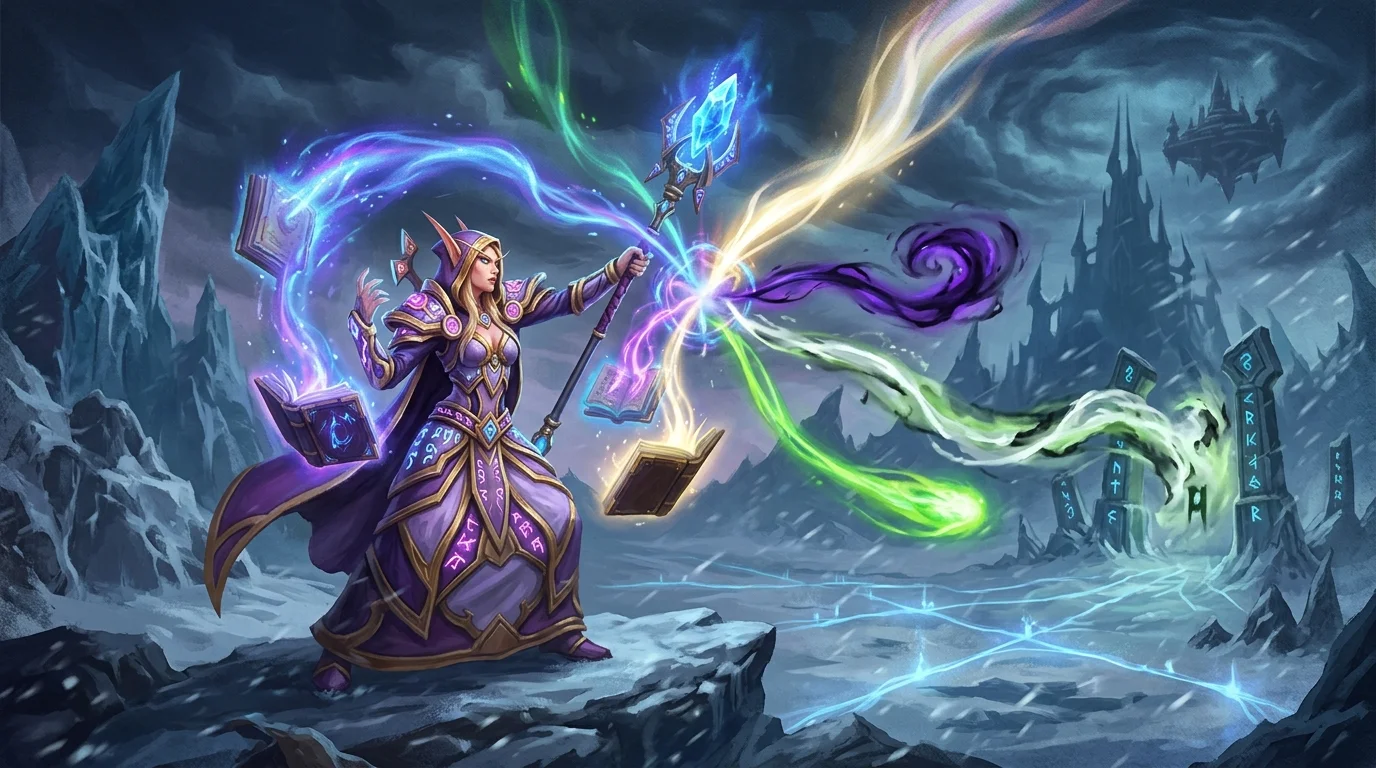
Magic in WoW is not all the same with different colors
One of the biggest confusions for those who delve deeper into the lore of Warcraft is treating all magic as if it were the same energy applied in different ways. It is not. In Azeroth, magic is linked to different cosmic forces, cultural traditions, and moral values.
This matters because it changes how you read classes, factions, and characters. A wizard does not use power of the same origin as a warlock. A Light priest does not manipulate the same logic as a Void user. And a druid doesn't touch nature like someone accessing a neutral resource — he relates to a living force.
The six main forces
Modern Warcraft cosmology usually organizes the universe into six great forces: Order, Disorder, Light, Void, Life and Death. In the game, this tends to appear more practically in the forms of magic that players recognize.
| Strength/magic | General origin | Usage example | |---------------|--------------|----------------| | Arcane | Order | wizards, portals, time and energy manipulation | | Fel | Disorder | warlocks, Legion, corruption, felfire | | Holy | Light | paladins, priests of Light, naaru | | Shadow | Empty | dark priests, void elves, Old Gods | | Nature | Life | druids, partly shamans, wild gods | | Death | Death | necromancy, Scourge, death knights |
Arcane: the most refined and most addictive power
Arcane is the most classic form of “civilized” magic in Warcraft. It is linked to Order, to structure, to the precise manipulation of reality.
Why it looks clean
Arcane often seems like the most controllable of the spells because:
- is studied
- can be systematized
- generates institutions such as Dalaran and Kirin Tor
- rewards discipline, repetition and technique
Why it remains dangerous
The problem is that Arcane attracts attention and generates dependence. In various phases of the lore, excessive use of it calls upon external forces or creates cultural addiction. The Highborne are the best example of this. The nightborne of Suramar also show how an entire civilization can become tied to an arcane source until it almost loses its autonomy.
In WotLK, this helps to understand why classes and NPCs linked to Arcane often seem powerful, but also arrogant, isolated, or tempted to go too far.
Fel: fast, destructive and corrupting power
If Arcane is refined order, Fel is violent disruption. It is born from Disorder and almost always appears associated with sacrifice, consumption and corruption.
What does Fel do
- offers fast power
- deforms body and mind
- consumes life as fuel
- leaves lasting physical and spiritual marks
That's why Warlocks and Demon Hunters occupy such different places in the lore. They both use what should destroy them. The difference is philosophical: the Warlock dominates the Fel with pragmatism and ambition; the Demon Hunter is constructed as a sacrificial weapon.
Holy and Shadow: opposites that explain themselves together
Light and Void function as mirrored forces. It’s not just “good vs. evil”. They are opposing views of truth and reality.
Holy
Holy works with conviction, certainty, healing, protection and imposition of moral order. This explains why paladins and priests of the Light can seem as inspiring as they are inflexible.
Shadow
Shadow, linked to the Void, works with possibility, multiplicity, paranoia, revelation through excess and erosion of mental stability. That's why she is so associated with madness, whispers and forbidden power.
The most interesting point is that Warcraft insists on showing that the Void is not automatically “stupid and evil”. It is dangerous because it requires absurd discipline. That's where Alleria, the Ren'dorei and Locus-Walker come in.
Nature: balance, cycle and response
Nature is the magic of Life in its most organic sense. It is not generic “green power”. It is linked to growth, balance, cycle, healing, wildness and response from the living world.
Who uses Nature
- druids
- part shamans
- guardians of the wild
- wild gods
- cultures strongly linked to the land
It tends to be less about imposing will and more about tuning in, asking, channeling or restoring.
Death: necromancy, domain and function
Death magic in Warcraft rarely appears as something neutral on the moral plane of the game, but cosmologically it is a real, organized and functional force.
On a practical level, when the player thinks of Death in WotLK, they think of:
- Scourge
- necromancy
- runeblades
- death knights
- forced servitude
- artificial permanence
This helps you understand why WotLK weighs so much. It’s not just a “dark” expansion. It is the expansion in which Death functions almost as a political and military system.
How does this affect classes in WotLK
Mage
It is the class most obviously linked to Arcane, even when playing Fire or Frost. The basic logic continues to be order, study and controlled manipulation.
Warlock
It is the class that most embraces Fel as a deliberate tool. The moral price is part of the fantasy.
Priest
Perhaps it is the most cosmologically interesting class, because it can play Holy and Shadow. Priest lives exactly in the tension between certainty and abyss.
Paladin
Channels Holy as duty, faith, and militarized discipline. It is the Light as an oath.
Druid
It represents Nature as balance and transformation.
Shaman
He is less a “wizard of nature” and more a mediator of elemental and spiritual forces, but speaks directly to the logic of Nature and the living world.
Death Knight
It is the class that makes Death mechanical, operational and permanent.
The big difference between using magic and being shaped by it
This is the point that separates Warcraft from a simpler fantasy: no one uses these forces with impunity. All magic, at some level, shapes worldview, culture, discipline, and personal cost.
| Magic | What it offers | The most common price | |-------|-------------------|--------------------| | Arcane | control and refinement | arrogance, addiction, exposure | | Fel | immediate power | corruption | | Holy | certainty and protection | stiffness | | Shadow | perception and rupture | instability | | Nature | balance and healing | demand for harmony | | Death | permanence and dominance | dehumanization |
Minimum recommendation
If you want to better understand magic in Azeroth:
- Don't treat magic schools as just visual effects
- always think about origin, cost and philosophy
- remember that Arcane, Fel, Holy and Shadow are not interchangeable
- use cosmology to reread the classes you play
- in WotLK, notice how Arcane, Shadow and Death dominate the tone of the expansion
Posts Recomendados
Titans vs. Old Gods
Titans vs. Old Gods is the core conflict of WoW's cosmology. Without them and Azeroth's world-soul, almost everything that came after seems random.
Void Elves
Void Elves: the Ren'dorei are not just corrupted blood elves, but a radical experiment in disciplined coexistence with the Void. Learn their place.
Magtheridon: the pit lord of Hellfire Citadel
Who is Magtheridon: the pit lord who ruled Outland, lost the Black Temple to Illidan and became the blood source for fel orcs in Hellfire Citadel.
Saurfang and Dranosh: father and son of the Horde
Varok and Dranosh Saurfang: the son hidden in Nagrand, his death at the Wrathgate, the Deathbringer in ICC and the father who takes him home. Full arc.