
Introduction
When talking about Cataclysm, a lot of people summarize the expansion as Deathwing breaking the world. But the destruction did not come alone. Behind it was a religious, political and military machine that helped push Azeroth towards collapse: Twilight's Hammer.
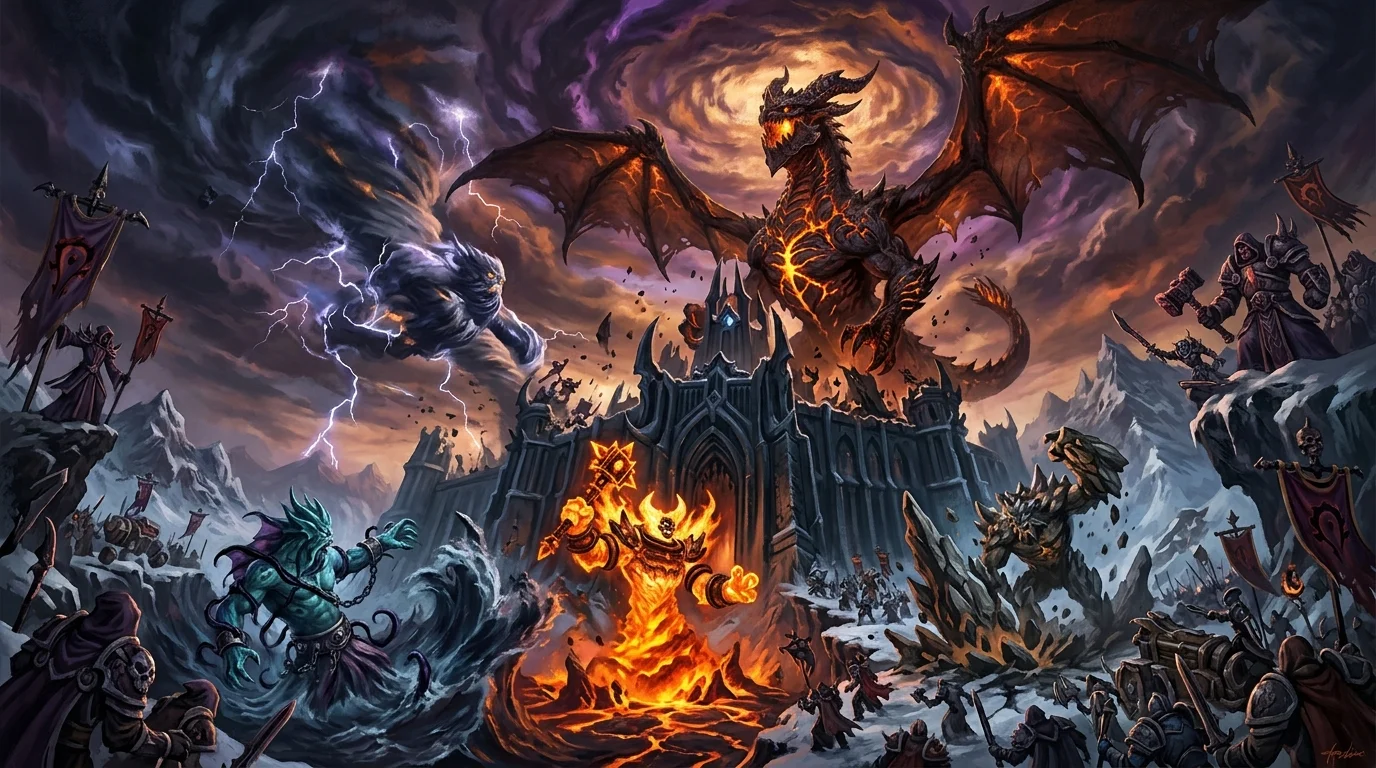
This cult was not just another group of fanatics. He functioned as the deadly arm of the will of the Old Gods and as a supporting force for Deathwing's apocalyptic vision. At the same time, Cataclysm reignited the role of the Elemental Lords, with some of them directly serving Chaos and others resisting the end-of-the-world plan.
Understanding this arc is understanding that Cataclysm wasn't just “the return of a mad dragon”. It was a coordinated attempt to break the order of Azeroth from within: cultists, elementals, naga, void creatures and Deathwing's servants acting at the same time to bring about the so-called Hour of Twilight.
What was the Twilight's Hammer cult
Twilight's Hammer began as a group linked to Cho'gall, but in Cataclysm it now appears as a global cult, obsessed with the Old Gods, the ruin of the world and the idea that all current reality needed to be destroyed to give way to a new age of darkness.
This point is important: they did not fight for common political power, for territory or for wealth. The cult believed that the end of the world was desirable. In their view, Azeroth's “salvation” would come through the destruction of sanity, order, and life as they were known.
That's why Twilight's Hammer appears in so many corners of the expansion: fortresses, laboratories, rituals, experiments with elementals and dragonkin, corruption of leaders and large-scale sabotage. They weren't extras in Deathwing's plan; they were a structural part of it.
Cho'gall's role in the end of the world plan
If Deathwing was the great force of destruction, Cho'gall was one of the chief deadly architects of chaos. Under his command, the ancient Twilight's Hammer clan was transformed into a murderous cult shaped by worship of the Old Gods and their herald, Deathwing.
Cho'gall works really well as a villain because he's not just an obedient servant. He is someone who helps translate cosmic horror into concrete actions: sacrificing cultists, erecting fortresses, manipulating leaders, creating ascendants, and using end-times religion as a political weapon.
In Bastion of Twilight, this function is clear. The place is practically the symbolic center of the sect, a point where the cult organizes its apocalyptic vision and tries to push Azeroth towards total madness.
The four Elemental Lords and who sided with Deathwing
The Elemental Lords are the great sovereigns of the elemental planes:
| Elemental Lord | Element | Domain | |---|---|---| | Ragnaros | Fire | Firelands | | Al'Akir | Air | Skywall | | Neptulon | Water | Abyssal Maw | | Therazane | Earth | Deepholm |
An important detail that many people confuse: not everyone sided with Deathwing.
Ragnaros and Al'Akir accepted the chance to wreak havoc on Azeroth. Ragnaros reappears as a major threat linked to elemental fire and the attack against Hyjal, while Al'Akir operates from Skywall and in plots linked to Uldum and Deathwing's interests.
Neptulon and Therazane do not embark on this project of global devastation. They remain dangerous and ancient, but they do not enter as full allies of Deathwing's apocalypse. This helps give Cataclysm more nuance: the elementals are not a single block with a single agenda.
Al'Akir and Ragnaros recalled
In practice, Cataclysm allows the elemental planes to break barriers and affect Azeroth again in a much more direct way. That's where Al'Akir and Ragnaros come in as big pieces on the board.
Al'Akir, lord of the air, becomes an open threat around Skywall and the deserts of Uldum, as Deathwing's agents attempt to exploit titanic artifacts and spread devastation.
Ragnaros, in turn, returns with full force in Firelands, where the war stops being just defensive and becomes a direct attack on the heart of the elemental plane of fire. This is important to the structure of the expansion: before facing Deathwing in the final climax, Azeroth needs to dismantle an essential part of the elemental chaos that sustains it.
Cho'gall, Ozumat and the secondary villains of Cataclysm
Cataclysm also works because it doesn't rely on a single villain. He spreads the feeling of collapse across several fronts.
Cho'gall represents apocalyptic fanaticism.
Ozumat represents the advance of abyssal forces linked to the Old Gods at sea, putting pressure on Neptulon and reinforcing that the conflict is not just terrestrial.
Archbishop Benedictus, revealed in the Hour of Twilight arc, shows that the corruption of Twilight's Hammer has also reached the religious and political heart of the Alliance itself.
This set of secondary villains makes the expansion feel bigger than “kill the final boss.” The problem wasn't just Deathwing falling from the sky. The problem was that the entire Azeroth was already contaminated by agents, cults, elemental pacts and void forces working at the same time.
What would Hour of Twilight be?
The Hour of Twilight was the vision of the complete triumph of Deathwing and the Old Gods: a future in which Azeroth would be reduced to a ruined landscape, with no real hope of recovery, with past and future practically blocked by a broken reality.
The End Time dungeon shows exactly this idea visually: a desolate future for Azeroth if Deathwing was not stopped. The Hour of Twilight dungeon shows the final stage of this plan in the present, when Twilight's Hammer tries to prevent Thrall and the Dragon Soul from reaching Wyrmrest Temple.
In other words, the Hour of Twilight wasn't just a fancy name for “the final boss has arrived.” It was the notion of historical end of Azeroth: civilization destroyed, defending forces defeated and reality handed over to the project of the Old Gods.
Quick timeline
| Step | What happens | |---|---| | Rise of the cult | Twilight's Hammer Spreads as Apocalyptic Sect of the Old Gods | | Deathwing returns | The Cataclysm disrupts the balance of the world and the elemental planes | | Elementals enter the war | Ragnaros and Al'Akir begin to act directly in the chaos of Azeroth | | Cho'gall leads the cult | The Bastion of Twilight becomes the center of end-of-the-world fanaticism | | Pressure on several fronts | Ozumat, naga, faceless ones and other servants amplify the threat | | Vision of failure | End Time shows the desolate future if Deathwing wins | | Final stage | Hour of Twilight follows the siege of Wyrmrest Temple | | Apocalypse averted | Deathwing's defeat prevents the full realization of the Hour of Twilight |
Why this arc is so important in Cataclysm
This theme ties together almost everything that makes Cataclysm work as a lore:
- explains why expansion looks like a collapse on several continents at once;
- shows that Deathwing did not act alone;
- places the Old Gods as the ideological force behind the cult's madness;
- gives context to elemental warfare beyond simple “raid bosses”;
- turns the final fight against Deathwing into a race against the total end of Azeroth.
Without Twilight's Hammer, Cataclysm would just be physical destruction. With it, the expansion also gains a layer of end of the world religion, mental manipulation and cosmic horror.
Closing
The great merit of this arc is to show that Cataclysm was a project of total destruction, not an isolated disaster. Twilight's Hammer took care of the fanatical and ritualistic part, Cho'gall translated this into organized action, Ragnaros and Al'Akir amplified the elemental chaos, and the Hour of Twilight represented the point at which Azeroth would no longer have a return.
That's why this theme is so strong within the expansion: it shows that Deathwing didn't just want to win a war. He wanted to end an entire era and consign the world to ruin.
If you like following the Cataclysm chronology, this post fits very well with the themes of Firelands, Dragon Soul, the fall of Deathwing, and then the transition to the discovery of Pandaria.
Posts Recomendados
Magtheridon: the pit lord of Hellfire Citadel
Who is Magtheridon: the pit lord who ruled Outland, lost the Black Temple to Illidan and became the blood source for fel orcs in Hellfire Citadel.
Saurfang and Dranosh: father and son of the Horde
Varok and Dranosh Saurfang: the son hidden in Nagrand, his death at the Wrathgate, the Deathbringer in ICC and the father who takes him home. Full arc.
Dalaran in Northrend: why the city flew
Dalaran in Northrend: why the Kirin Tor took the city into the sky over Crystalsong, who rules it and what the Violet Hold keeps locked. See the summary.
Bolvar Fordragon: from regent to Lich King
Bolvar Fordragon was regent of Stormwind, a hero of the Wrathgate and ended up on the Frozen Throne. Read his full story and where to find him in WotLK.