
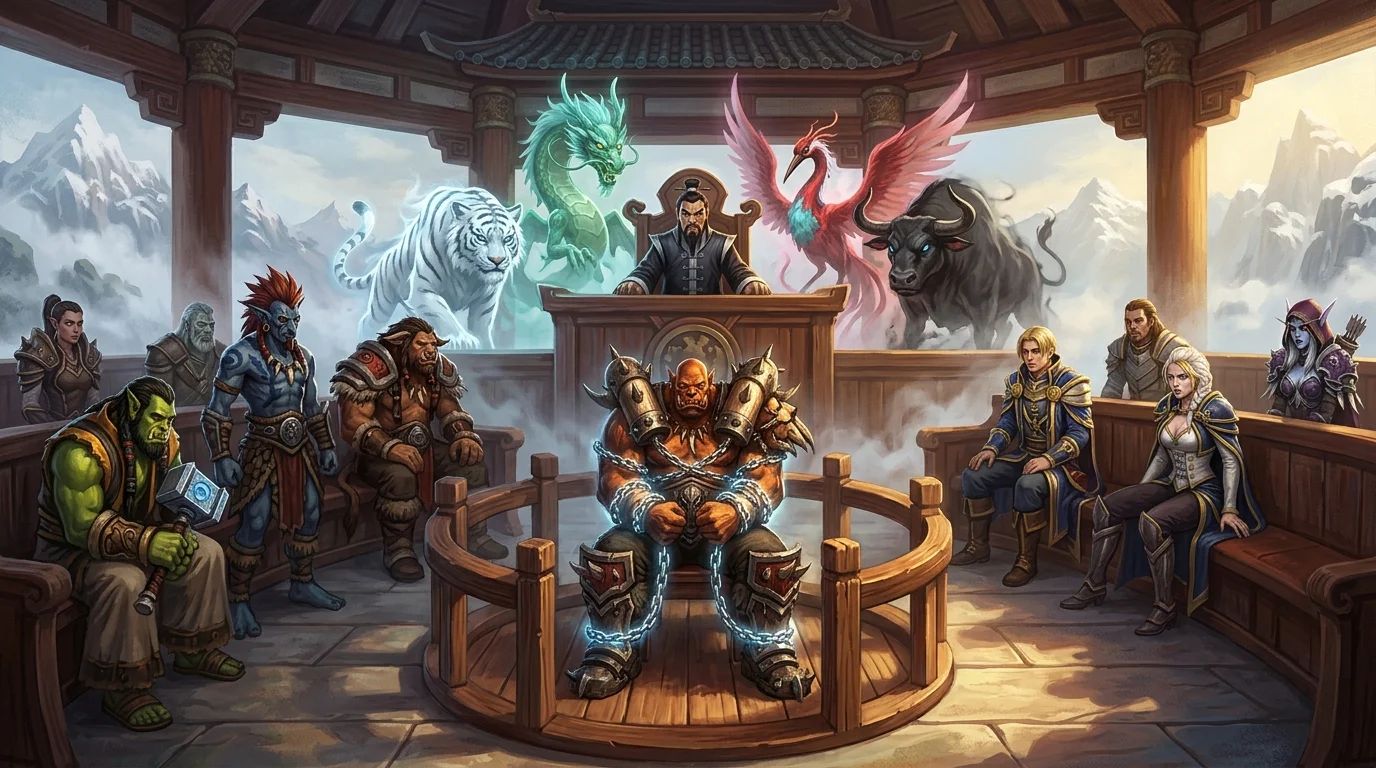
War Crimes: Garrosh's trial and what it revealed about each character present
The trial that became a mirror of Azeroth
War Crimes looks, in summary, like a book about Garrosh in the dock. In practice, it is a book about all others. The court set up in Pandaria forces leaders, heroes and witnesses to revisit old choices and face how much violence each faction normalized to get there.
Garrosh is the accused, but no one comes out of the book completely clean.
What the novel tells
After the Siege of Orgrimmar, Garrosh is captured and put on trial in Pandaria. The structure of the court is expanded upon by the use of visions presented by the Bronze Dragonflight, which display past events as evidence. This turns the process into a legal and historical spectacle at the same time.
It's an excellent choice, because it allows Warcraft to treat its own memory as evidence.
The court and what each position reveals
Who judges, who accuses, who defends and who witnesses matters as much as the verdict. The novel uses these positions to show still open political wounds. Jaina, Thrall, Baine, Anduin, Tyrande and many others do not arrive there as neutral figures. They arrive as people affected directly or indirectly by the defendant and everything that produced him.
That's why the court is so interesting. There is no truly external observer.
Garrosh in the dock
Garrosh is written awkwardly because he never accepts the language of regret. He doesn't apologize, he doesn't beg, and he doesn't try to appear better than he is. His defense is brutal ideological coherence: he believed he was saving the Horde through force, supremacy, and total war.
That doesn't absolve him. But it prevents him from being reduced to a caricature. Garrosh is terrible because he thinks of horror as a historical necessity.
Visions of the past
The use of the Bronze Dragonflight is the strongest device in the book. Instead of witnesses simply narrating memories, we see events from the past being displayed as pieces of accusation and moral confrontation. This expands the scope of the trial: it not only discusses what Garrosh did, but also the world that allowed him to get so far.
War Crimes thus becomes a novel about memory as a battlefield.
Why the trial fails
The big point of the book is that formal justice is not enough when parallel forces are already operating. Garrosh's escape, with Kairozdormu and temporal manipulation, is not just a twist to prepare Warlords of Draenor. It's a bitter comment: Azeroth manages to set up a court, but it cannot sustain its own order until the end.
The system fails because it is still too vulnerable to ambition, vanity and cosmic calculation.
Minimum recommendation
Read War Crimes not as an epilogue to Mists, but as a moral examination of the post-Garrosh world. It's one of the rare Warcraft novels where the goal isn't just to move the plot forward, but to force almost everyone important to testify, even when they're not sitting in the defendant's chair.
Posts Recomendados
Before the Storm: the book that shows what happened between Legion and Battle for Azeroth
Before the Storm turns the impossible peace between Anduin and Sylvanas into BfA's emotional prologue and shows why Teldrassil didn't come out of nowhere.
Tides of War: Jaina and the destruction of Theramore
Tides of War explains why Jaina in Battle for Azeroth isn't bitter out of nowhere: it comes from the violent collapse of everything Theramore stood for.
Magtheridon: the pit lord of Hellfire Citadel
Who is Magtheridon: the pit lord who ruled Outland, lost the Black Temple to Illidan and became the blood source for fel orcs in Hellfire Citadel.
Saurfang and Dranosh: father and son of the Horde
Varok and Dranosh Saurfang: the son hidden in Nagrand, his death at the Wrathgate, the Deathbringer in ICC and the father who takes him home. Full arc.