
Broken Isles in historical perspective: why the islands have accumulated so much history
The Broken Isles seem “too full” of history — and that’s precisely the point
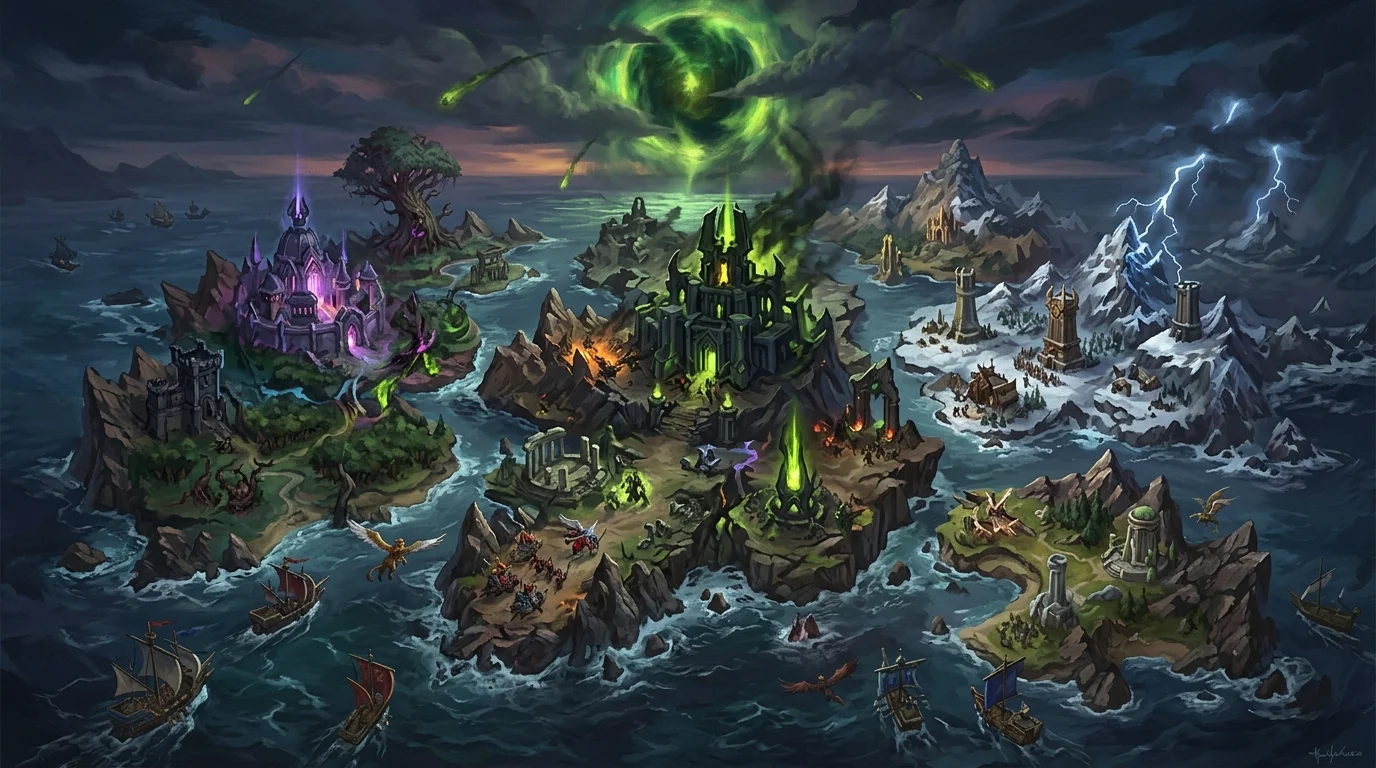
In Legion, the Broken Isles give the feeling that everything important passes through them: the Tomb of Sargeras, Suramar, Highmountain, Stormheim, the druids, the vrykul, the Nightmare, the Broken Shore. Rather than exaggeration, this is a consequence of geography, antiquity and legacy.
The islands are a point where several layers of Azeroth's history have become compressed into the same space. When the ancient continent was shattered, what was left there was not a void. It was an archipelago of ruins, routes, sanctuaries and strategic memories.
What are the Broken Isles
Fragments of the old world
The islands are remnants of ancient lands linked to the pre-Sundering world. Therefore, they carry elven ruins, titanic structures, vrykul settlements and magical centers that long predate most human kingdoms.
They were not born as an “expansion zone”. They were already important before much of Azeroth's modern history began.
The position value
The Broken Isles also occupy a symbolic place between sea, magic and ruin. Anyone who wants to hide something old will find ideal ground there. Who wants to seek lost power too.
Why the Tomb of Sargeras is here
Aegwynn's Choice
After defeating the Avatar of Sargeras, Aegwynn was unable to destroy him once and for all. Then he buried him under an ancient temple of Elune, reinforcing the place with wards and transforming the space into a prison.
This gives the islands a unique weight: they don't just hold traces of the past. They guard a dormant historical bomb, buried by one of the most powerful figures Azeroth has ever had.
The place attracts history because it attracts power
The Tomb isn't important just because Gul'dan opens it in Legion. It is important because, for centuries, the islands have carried a secret that influences decisions, expeditions and surveillance.
Many civilizations, the same archipelago
Highborne, night elves, nightborne
Azsuna, Suramar and the region's own arcane heritage show the weight of ancient elven civilization. In Suramar, this survived as a closed society. In other areas, it remains as a ruin or historical haunting.
Vrykul and titanism
Stormheim connects the islands to another layer: the vrykul culture and its relationship with the titans, proof that the archipelago was never just elven.
Druids, tauren and natural order
Val'sharah and Highmountain add a different dimension: the islands also become centers of natural, spiritual and druidic resistance. This helps explain why, in Legion, it's not just armies that converge there, but entire traditions.
Why Legion converges on the islands
All roads lead to the Broken Isles
The Legion's invasion could not end anywhere. She needed to go through a point where there were:
- ancient power
- strategic routes
- elven legacy
- titanic presence
- access to Tomb of Sargeras
The Broken Isles brings it all together.
Resisting there makes narrative sense
That's why Legion works so well as geographic expansion. It doesn't feel like a random set of maps. It seems like an inevitable theater of war. When the player arrives, he is not “discovering” any area. You are entering the meeting point of stories that have been accumulating for millennia.
What was left after Legion
Vitória does not erase old layers
After the defeat of the Legion, the islands are still important. They continue to be full of ruins, tombs, relics, surviving people and areas where the past is still active.
Suramar needs to redefine itself. The Tomb remains marked. Stormheim remains full of vrykul legacy. Azsuna remains an open historical wound.
The islands stop being the main front of war, but they continue to be one of the densest places in memory in all of WoW.
How to look at the Broken Isles
| Layer | Example | |--------|---------| | Elvish | Suramar, Azsuna, Tomb of Sargeras | | Titanic | ancient installations and cosmic surveillance echoes | | Vrykul | Stormheim and warrior legacy | | Natural | Val'sharah and Highmountain | | Legion | Broken Shore and the final campaign |
Minimum recommendation
The Broken Isles make more sense when you read them as an archipelago of historical layers.
It’s not “a lot of ideas together”.
There are many centuries of power, ruin and surveillance compressed into a single piece of the map.
Posts Recomendados
Suramar as a city-state: ten thousand years of isolation and what it did to a civilization
Suramar survived the War of the Ancients at a steep price: Nightwell dependence, political rigidity and a society that mistook preservation for paralysis.
The Tomb of Sargeras: the audio drama that connects the end of TBC to the beginning of Legion
The Tomb of Sargeras shows Khadgar, Maiev and Illidan's body at the point where TBC stops being the past and becomes the plan for Argus. Learn more.
Saurfang and Dranosh: father and son of the Horde
Varok and Dranosh Saurfang: the son hidden in Nagrand, his death at the Wrathgate, the Deathbringer in ICC and the father who takes him home. Full arc.
Dalaran in Northrend: why the city flew
Dalaran in Northrend: why the Kirin Tor took the city into the sky over Crystalsong, who rules it and what the Violet Hold keeps locked. See the summary.