
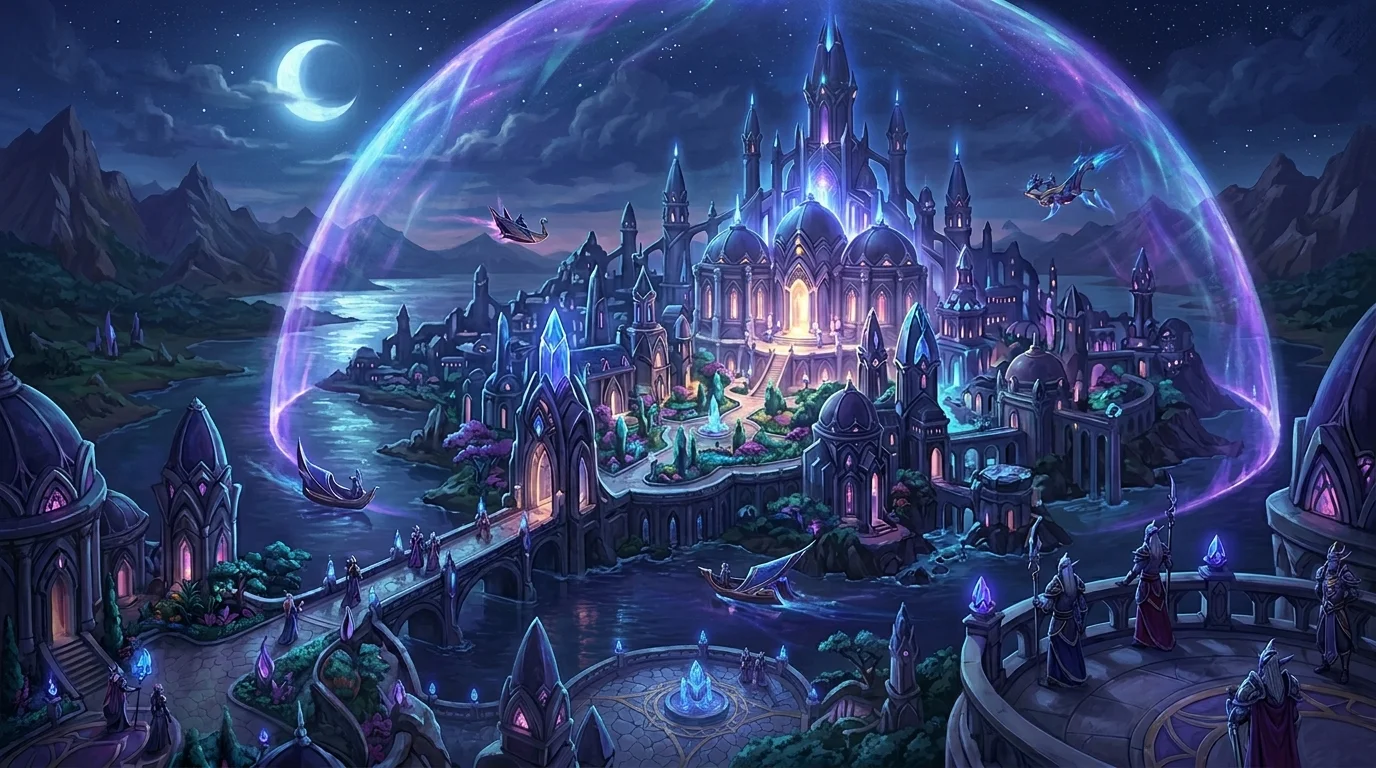
Suramar as a city-state: ten thousand years of isolation and what it did to a civilization
Suramar wasn't just hidden — it was frozen in time
When Suramar raised its seal in the chaos of the War of the Ancients, the city made an understandable choice: survive. The problem is that surviving for ten thousand years in the same way can turn into something else. It can turn into fear, rigidity and institutionalized addiction.
This is what makes Suramar one of the most interesting civilizations in WoW. She did not fall like Zin-Azshari, she was not rebuilt like Silvermoon, nor did she reinvent herself like Dalaran. Suramar remained standing. And precisely for this reason it reveals the cost of a society that avoided external collapse, but almost lost its soul within.
The seal of Suramar and the logic of isolation
Elisande's choice
At the height of the War of the Ancients, Suramar was in danger of being destroyed along with the rest of the kaldorei empire. The answer was to erect a magical barrier and turn the city into a closed fortress. It was an emergency decision, but it ended up becoming a way of life.
What began as defense became a political identity. Suramar came to understand herself as a historical exception: too refined for the outside world, too sophisticated to risk contact, and too dependent on the system itself to imagine an alternative.
Surviving is not the same as evolving
The city has preserved architecture, culture, magic and ruling elite. But it also preserved rigid hierarchies, fear of the unknown, and an increasingly unhealthy relationship with its own source of power.
This is the first big point about Suramar: isolation saved the city, but it took away the practice of adaptation.
The Nightwell as a replacement for the Well of Eternity
The source that sustained everything
Without the ancient Well of Eternity, Suramar came to exist around the Nightwell. He wasn't just a source of energy. It was food, social structure, political apparatus and biological foundation of the nightborne population.
The entire city was reorganized around the idea of access to magic. Those who had access remained functional, productive and integrated. Those who lost access began to waste away.
When survival becomes dependence
The Nightwell kept Suramar alive, but it exacted a silent price: the nightborne stopped being just users of magic and started to be sustained by it on a daily basis. The source that preserved civilization also made it vulnerable.
This explains why Suramar does not react like other societies. She doesn't think about breaking quickly with the system itself because the system literally keeps its people on their feet.
Ten thousand years of advancement and paralysis
Lots of refinement, little renovation
Suramar advanced in terms of arcane refinement, urbanism, automation, and cultural sophistication. The city looks futuristic even by elven standards. The problem is that almost all of this progress happened within a closed circuit.
When a civilization stops competing with the world for ideas, it can become brilliant on the outside and immobile on the inside. Suramar dominated space itself, but lost political and moral elasticity.
Elisande's role
Elisande works as a synthesis of this problem. She is not a simple villain. She sees the risk, understands Suramar's fragility and chooses submission to the Legion as a preservation calculation.
This is what makes her arc so strong: Suramar was already trained millennia ago to trade freedom for continuity. The alliance with Gul'dan does not come out of nowhere. It is the last step in a culture accustomed to prioritizing permanence above all else.
The cost of Withered
What happens without access to Nightwell
The Withered represent the truth that Suramar tries to hide. They are nightborne deprived of regular magical supply and degraded by arcane hunger. They are not just “local monsters”. They are the physical expression of the city’s social pact.
They show that Suramar was not supported by merit, but by controlled distribution of power.
The political side of hunger
Arcane hunger was not just a biological tragedy. It was an exclusion tool. The Withered reminds everyone that in Suramar, falling out of order meant not only losing status, but also losing one's body.
That's why the drama of the nightfallen and the withered is so important. The crisis is not just military or magical. It's civilizational.
Suramar beyond the zone
What this city really symbolizes
Suramar is a city-state that traded risk for stability and almost traded identity for dependence. It shows that a civilization can remain elegant, powerful and functional while rotting from within.
It's also one of WoW's best stories about the elite, isolation, and decay without immediate ruin. Not every fall is explosive. Some last ten thousand years and happen in slow motion.
What Suramar leaves for WoW
| Element | What it reveals | |----------|--------------| | Magic barrier | survival through isolation | | Nightwell | power that saves and imprisons | | Withered | physical and social cost of addiction | | Elisande | the political calculation of giving in to continue | | Free Nightborne | the late chance to choose again |
Minimum recommendation
Suramar works best when you read the city as a political tragedy, not just as a pretty Legion map.
The center of the story is not “elves addicted to magic”.
The center is a society that chose to survive anyway — and almost forgot why it wanted to survive in the first place.
Posts Recomendados
Broken Isles in historical perspective: why the islands have accumulated so much history
The Broken Isles hold elven temples, sacred tombs, vrykul, nightborne, the Tomb of Sargeras and the final convergence against the Legion. Learn why.
Twilight of Suramar: the Nightborne before the alliance — a civilization at the last crossroads
Twilight of Suramar shows a Suramar still alive on the outside, but politically exhausted and squeezed between Elisande and surrender. Meet the Nightborne.
Magtheridon: the pit lord of Hellfire Citadel
Who is Magtheridon: the pit lord who ruled Outland, lost the Black Temple to Illidan and became the blood source for fel orcs in Hellfire Citadel.
Saurfang and Dranosh: father and son of the Horde
Varok and Dranosh Saurfang: the son hidden in Nagrand, his death at the Wrathgate, the Deathbringer in ICC and the father who takes him home. Full arc.