
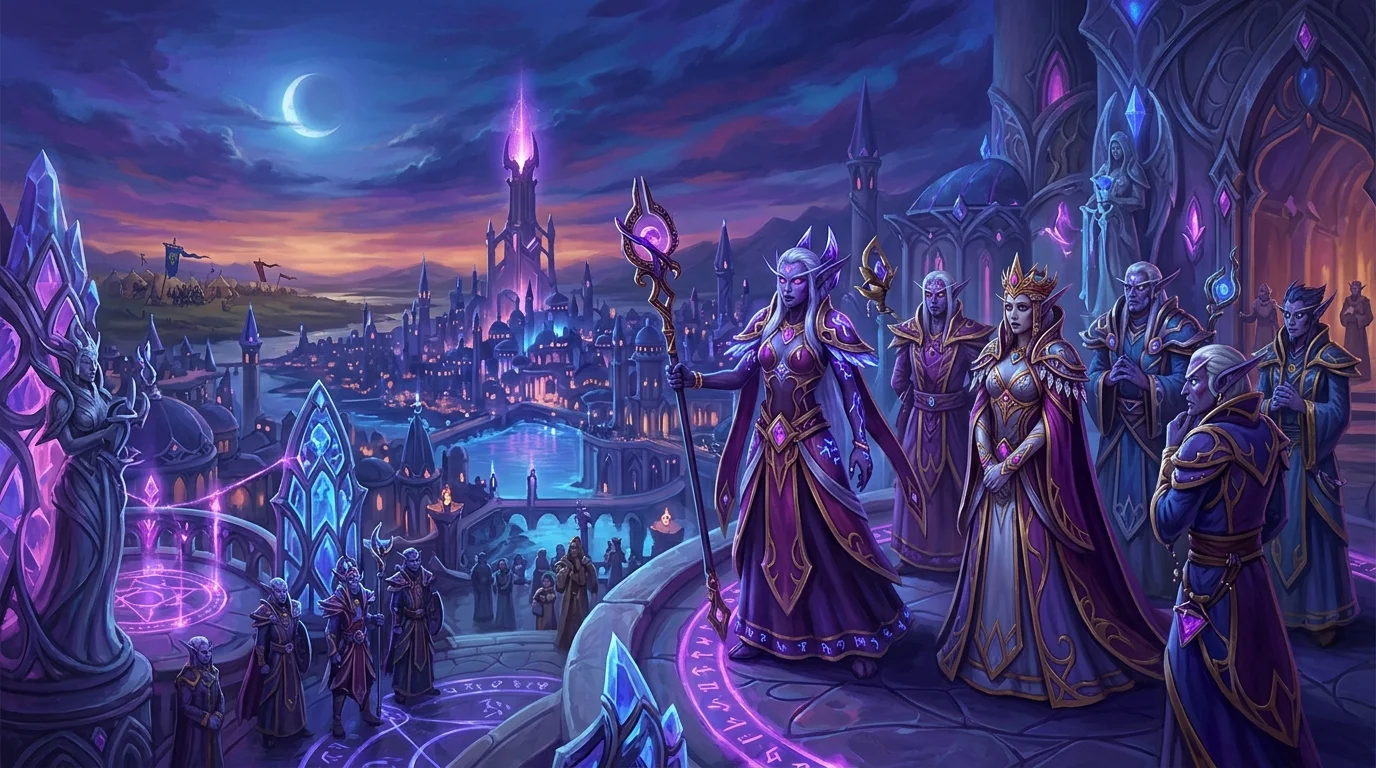
Twilight of Suramar: the Nightborne before the alliance — a civilization at the last crossroads
The comic that gives political air to the best zone in Legion
Twilight of Suramar is valuable because it takes one of Legion's strongest zones and adds what the game always sacrifices first: time to show political climate, everyday fear, and moral hesitation. The area already makes Suramar look exceptional. The comic explains why she got to that point.
More than a prologue, it is a human context for a city that learned to survive through obedience.
The internal conflict before consolidated resistance
The comic shows a Suramar in which resistance still does not seem like an inevitable destiny. That matters. Once the player enters the zone, it is easy to see Thalyssra and her allies as the obvious path. Twilight of Suramar remembers that it wasn't obvious to anyone who lived there.
Many people accepted Elisande not out of grandiose conviction, but out of fear, habit and dependence on Nightwell. This nuance is what gives weight to the text.
What the area didn't have space to show
Quests manage to show ruin, repression and arcane hunger. The comic shows something even more important: the normalization of it all. He makes Suramar seem like a city where order has remained functional for too long, even at the cost of its own dignity.
This is the strongest part. The reader realizes that the decadence of the nightborne does not come only from the Nightwell. It comes from millennia of learning to confuse survival with submission.
Elisande, acceptance and resistance
The conflict between supporting Elisande or resisting is not portrayed as a simple dispute between cowardice and courage. For many people, supporting the current order meant protecting family, access to energy and a minimal semblance of civilizational continuity. Resisting meant losing everything.
This is what makes the choice of Thalyssra and other dissenters so strong. They don't choose resistance because it's easy. They choose because they realize that living longer without a soul is not victory.
The moment when a civilization decides who it wants to be
Twilight of Suramar captures the moment when Suramar stops discussing just security and starts discussing identity. Is it worth continuing to exist if existence depends on selling the city itself to the Legion? The question is not military. It's civilizational.
That's why the comic is essential. It turns the future liberation of Suramar into something deeper than rebellion against a boss. It's a fight to decide whether the nightborne can still be a people, and not just an administrative apparatus supported by magic.
Why it is mandatory reading to understand Suramar
Without this comic, Suramar is already excellent. With it, the area gains historical density. Thalyssra stops being just a rebel leader and starts to seem like the product of a city saturated with silence. Elisande stops being just an obstacle and becomes the rational face of a civilization that chose to stay alive at any cost.
Twilight of Suramar doesn't improve Legion because it adds “extra lore”. It improves because it gives moral texture to what the player will experience afterwards.
Minimum recommendation
Read Twilight of Suramar before revisiting the nightborne campaign. It does not replace the zone, but it changes its reading. After the comic, Suramar stops being just beautiful and starts to look sick — and precisely for that reason, unforgettable.
Posts Recomendados
Suramar as a city-state: ten thousand years of isolation and what it did to a civilization
Suramar survived the War of the Ancients at a steep price: Nightwell dependence, political rigidity and a society that mistook preservation for paralysis.
Broken Isles in historical perspective: why the islands have accumulated so much history
The Broken Isles hold elven temples, sacred tombs, vrykul, nightborne, the Tomb of Sargeras and the final convergence against the Legion. Learn why.
Magtheridon: the pit lord of Hellfire Citadel
Who is Magtheridon: the pit lord who ruled Outland, lost the Black Temple to Illidan and became the blood source for fel orcs in Hellfire Citadel.
Saurfang and Dranosh: father and son of the Horde
Varok and Dranosh Saurfang: the son hidden in Nagrand, his death at the Wrathgate, the Deathbringer in ICC and the father who takes him home. Full arc.